How to Become an FAA Aviation Maintenance Technician (A&P): The Complete Path
What Is an FAA Aviation Maintenance Technician (A&P)?
If you have a passion for how aircraft work and want a hands-on career keeping them airworthy, becoming an FAA Aviation Maintenance Technician — commonly called an A&P mechanic — could be the perfect path. The "A&P" designation stands for Airframe and Powerplant, the two certification ratings issued under a single mechanic certificate by the FAA. Holders of this certificate are legally authorized to inspect, repair, and maintain aircraft structures (airframe) and engines (powerplant) in accordance with federal aviation regulations. This guide walks you through every major step of the journey, from eligibility requirements to passing the knowledge test and launching your career.
FAA Aviation Maintenance Technician Eligibility Requirements
Before you can sit for any part of the A&P certification process, the FAA requires you to meet a core set of eligibility criteria. These are well-established requirements you can verify in detail at faa.gov/mechanics:
- Age: You must be at least 18 years old to be issued a mechanic certificate.
- Language: You must be able to read, write, speak, and understand English.
- Experience or Training: You must demonstrate the required practical experience — either through an FAA-approved Aviation Maintenance Technician School (AMTS) or through documented hands-on work experience.
There are two primary paths to meeting the experience requirement, and understanding the difference is one of the first decisions you will make on this journey.
Path 1: FAA-Approved Aviation Maintenance Technician School (Part 147)
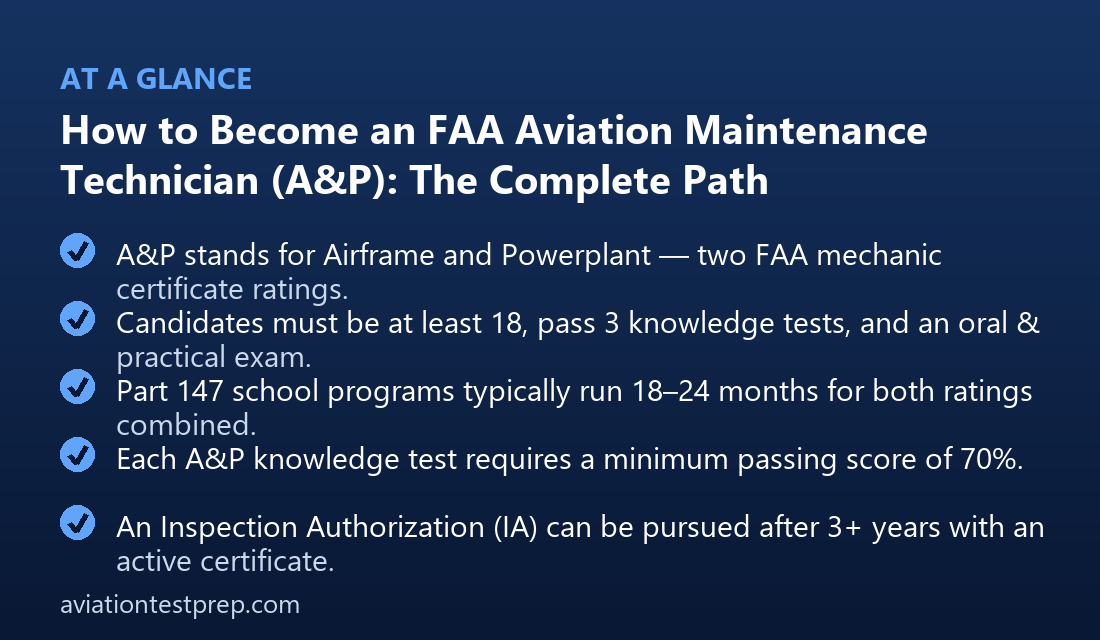
Most candidates attend a school operating under 14 CFR Part 147. These programs typically run between 18 and 24 months for both ratings combined and are structured to deliver the exact curriculum the FAA requires. Upon graduation, you receive documentation certifying you have met the training-hour requirements, which qualifies you to take the exams. Community colleges, technical schools, and dedicated aviation academies all offer Part 147 programs across the United States.
Path 2: Documented Work Experience
If you have been working in aircraft maintenance, you may qualify through experience alone. The FAA requires a minimum of 18 months of practical experience for either the airframe or powerplant rating, or 30 months of experience working on both concurrently. Your supervising A&P mechanic must verify this experience in writing before you can test.
The Three-Part FAA Mechanic Examination
Regardless of which path you took to qualify, every A&P candidate must pass the same three-part examination process administered by the FAA:
- General Knowledge Test — Covers mathematics, physics, regulations, ground operation, weight and balance, and basic electricity.
- Airframe Knowledge Test — Covers aircraft structures, hydraulics, landing gear, instruments, communications, and related systems.
- Powerplant Knowledge Test — Covers reciprocating and turbine engines, fuel systems, lubrication, ignition, and propellers.
Each knowledge test is a multiple-choice exam administered at an FAA-approved testing center. A passing score is 70% or higher on each test. If you are pursuing both ratings (which most technicians do), you will take all three tests. After passing the knowledge tests, you must also complete an oral examination and a practical skills test administered by an FAA Designated Mechanic Examiner (DME).
How to Prepare for the A&P Knowledge Tests
Solid test preparation makes a measurable difference in your outcome. The FAA publishes Airmen Certification Standards (ACS) that outline exactly which knowledge areas and skills are evaluated. Studying with ACS-aligned practice questions means every question you practice maps directly to a tested objective — no wasted study time.
At Aviation Test Prep, our platform offers a full library of FAA-aligned practice exams for the General, Airframe, and Powerplant knowledge tests. Each question is tagged with its ACS code so you know precisely which competency you are working on. You can explore the full ACS breakdown on our ACS codes page to see what areas require the most attention before test day.
Our platform also features Ace, our AI-powered tutor, which explains why an answer is correct or incorrect in plain language — not just a letter and a paragraph of jargon. When you hit a tricky question about turbine engine compressor stalls or sheet metal repair tolerances, Ace helps you actually understand the concept so it sticks.
The Aviation Test Prep 5-Step Study Method
We recommend the following structured approach to your A&P test prep:
- Diagnose: Take a free baseline practice test to identify your strongest and weakest ACS areas.
- Focus: Use your diagnostic results to prioritize study sessions on the topics where you lost the most points.
- Practice: Work through topic-specific question sets, reviewing the explanation for every question — right or wrong.
- Review: Retake mixed-topic practice tests to confirm mastery across the full exam blueprint.
- Simulate: Complete full-length timed practice exams under realistic conditions to build test-day confidence.
You can start Step 1 right now with our free practice test — no credit card required.
What Happens After You Pass the Knowledge Tests?
Passing all three knowledge tests is a major milestone, but it is not the final step. After your knowledge tests, you will schedule your oral and practical exam with a Designated Mechanic Examiner. During the oral portion, the DME will ask you questions to confirm your understanding of regulations, procedures, and technical concepts. The practical portion requires you to demonstrate hands-on tasks — such as performing a fabric repair, rigging a control surface, inspecting a reciprocating engine, or reading technical data.
Many candidates find the oral exam surprisingly demanding, especially around regulatory knowledge (what you can legally sign off, what requires an Inspection Authorization, and how to apply maintenance data). Thorough knowledge test preparation actually pays dividends here too, because the same content areas that appear on the written test often resurface in the oral.
A&P Certificate, IA Authorization, and Career Outlook
Once you pass all three examination components, the FAA issues your Mechanic Certificate with Airframe and/or Powerplant ratings. This certificate does not expire, but you must stay current and work within your areas of competency.
Inspection Authorization (IA)
After holding an active A&P certificate for at least three years and meeting additional requirements (including active experience working on aircraft), you can apply for an Inspection Authorization (IA). An IA allows you to perform annual inspections and approve major repairs and alterations for return to service — significantly expanding your professional scope and earning potential.
Career Opportunities
A&P mechanics work across a broad range of aviation environments, including:
- Commercial airlines and regional carriers
- Corporate and business aviation flight departments
- General aviation repair stations (Part 145)
- Military contract maintenance organizations
- Aircraft manufacturers and MRO (Maintenance, Repair & Overhaul) facilities
- Helicopter operators and rotorcraft specialists
Compensation varies considerably based on employer, location, experience level, and whether you hold an IA. For current salary data, consult the Bureau of Labor Statistics Occupational Outlook Handbook, which provides regularly updated wage ranges for aircraft and avionics equipment mechanics and technicians.
Tips for Success on the A&P Path
- Start with the General test — its foundational content (electricity, math, regulations) underpins both the Airframe and Powerplant tests.
- Use your school's resources — Part 147 instructors have prepared hundreds of students and know exactly where candidates lose points.
- Read the Practical Test Standards and ACS carefully — know what tasks you will be asked to demonstrate before you walk in.
- Build your logbook meticulously — if qualifying through experience, clear documentation is everything.
- Study regulations in depth — FAR Part 43 (maintenance) and Part 65 (certification) are heavily tested and critical for the oral exam.
Start Your A&P Journey Today
Becoming an FAA Aviation Maintenance Technician is a rigorous but highly rewarding process. The combination of structured training or documented experience, three comprehensive knowledge tests, and a hands-on oral and practical exam ensures that every certificate holder has genuinely earned the right to keep aircraft flying safely. The career opportunities are broad, the work is meaningful, and the demand for qualified technicians remains strong across the aviation industry.
Whether you are just beginning to explore the path or are actively preparing for your knowledge tests, Aviation Test Prep is here to support your study. Browse our full exam library, explore ACS-aligned practice questions, and get real-time explanations from Ace on our aviation blog and study platform. Create your free account today and take the first step toward your A&P certificate with a study plan built around your goals.
Ready to pass your FAA written exam?