Understanding Your FAA Airman Knowledge Test Report and ACS Codes
What Is an FAA Airman Knowledge Test Report?
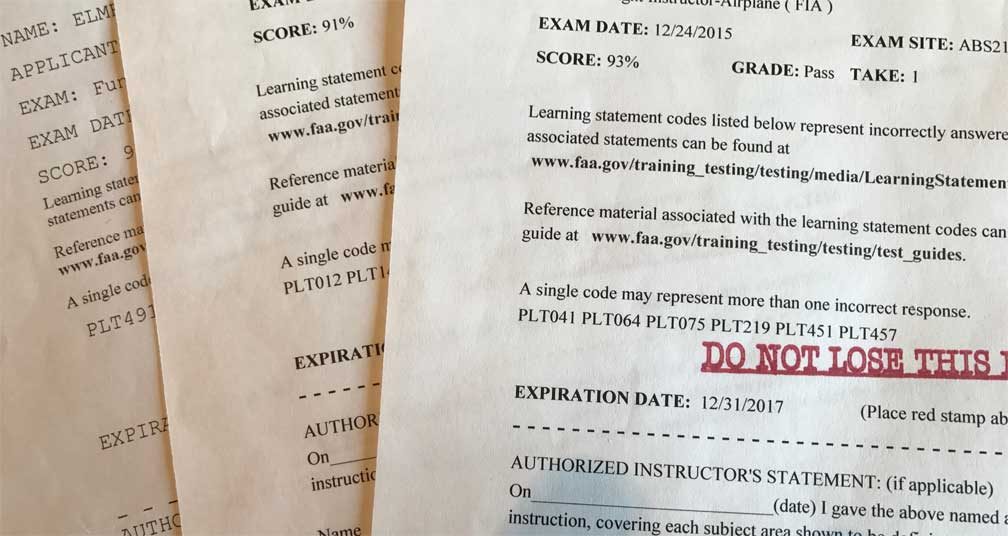
After you pass your FAA Airman Knowledge Test, the testing center hands you a document that feels deceptively simple — a score, a date, and a string of cryptic letter-number codes. That document is your FAA Airman Knowledge Test Report (AKTR), and understanding it can make the difference between a smooth checkride and a surprise grilling from your Designated Pilot Examiner (DPE). In this guide, we'll break down every section of the AKTR, explain what ACS codes mean, and show you how to turn your results into a focused, confident checkride study plan.
Reading Your AKTR: The Basics
The AKTR includes several key pieces of information you'll want to understand before your checkride appointment:
- Your score: A percentage representing the number of questions you answered correctly. Most certificates and ratings require a minimum score of 70%, though some tests have different thresholds — always verify the current requirement at faa.gov/training_testing/testing.
- Test date and expiration: Your AKTR is generally valid for 24 months. You must complete your practical test (checkride) before it expires, or you'll need to retake the knowledge test.
- Applicant and test identification numbers: These link your results to the FAA's records and to your designated examiner on checkride day.
- ACS or PTS codes: The most important — and most misunderstood — part of the report.
What Are ACS Codes?
ACS stands for Airman Certification Standards, the FAA's official framework that defines exactly what a pilot applicant must know, consider, and do at each certificate or rating level. When you miss a question on your knowledge test, the testing system tags that question with the specific ACS code it maps to. Those codes then appear on your AKTR as areas of deficiency.
An ACS code typically looks something like PA.I.B.K2. Here's how to decode it:
- PA — Certificate type (Private Pilot Airplane in this example)
- I — Area of Operation (e.g., Preflight Preparation)
- B — Task (e.g., Weather Information)
- K2 — Knowledge element number two within that task
Each element can be tagged as K (Knowledge), R (Risk Management), or S (Skill). On a written test, you'll almost exclusively see K and R codes, since Skill elements are evaluated during the practical test itself.
You can explore how ACS codes are organized and cross-referenced on our ACS Codes reference page, which maps each code to the relevant study topics and regulations.
Why Your DPE Cares About Your ACS Codes
This is the part many students don't realize until it's too late: your DPE is required to review your AKTR before your checkride. The FAA's guidance directs examiners to pay special attention to the deficiency codes on your report and probe those exact knowledge areas during the oral portion of the practical test.
In other words, your AKTR is essentially a printed list of topics your examiner is expected to quiz you on. Walking into your checkride without having addressed every single ACS code on your report is like showing up to a test knowing exactly which chapters will be on it — and skipping those chapters anyway.
Your AKTR doesn't just record your past performance; it shapes your upcoming checkride conversation. Treat every ACS code as a study assignment, not a footnote.
How to Study Your Deficiency Codes Effectively
Once you have your AKTR in hand, follow this straightforward approach to make the most of your remaining prep time:
- List every ACS code on your report. Don't skip any, even if you think the miss was a lucky guess gone wrong.
- Look up each code in the official ACS document. The FAA publishes ACS documents for every certificate and rating at faa.gov. Find the exact knowledge element described by each code.
- Trace the code to its regulatory source. Each ACS element references specific regulations, advisory circulars, or FAA handbooks. Read those primary sources.
- Practice targeted questions in the same topic area. Use ACS-aligned practice questions to reinforce the concept until you can explain it confidently out loud — not just recognize the right multiple-choice answer.
- Rehearse your oral answers. Your DPE will ask open-ended questions, not multiple choice. Practice explaining each deficiency area as if you're teaching it to someone else.
Aviation Test Prep is built by FAA-certified instructors and uses this exact 5-step study method as its backbone. Our platform lets you filter practice sessions by ACS code, so you can zero in on your personal weak spots instead of re-reviewing material you already know. Every question set is reviewed for alignment with the current ACS, and our AI Tutor provides AI-enhanced, plain-language explanations for each question — helping you understand the why behind every answer, not just memorize the result.
A Note on Old PTS Codes
If you're studying for a certificate or rating that still references the older Practical Test Standards (PTS) rather than the newer ACS, your AKTR will show PTS codes instead. The decoding logic is similar, but the document structure differs. Check the FAA website to confirm whether your specific test is governed by a PTS or an ACS — the FAA has been progressively transitioning all certificates to the ACS format.
Don't Wait Until After the Test to Think About ACS Codes
The smartest approach is to study with ACS codes in mind before you ever sit down at the testing terminal. When you understand which ACS element each practice question addresses, you build the kind of organized, concept-level knowledge that holds up under a DPE's oral questioning — not just a score that clears the 70% bar.
Browse the full range of available FAA knowledge tests and start building your ACS-code-aware study plan at aviationtestprep.com/browse-exams. Aviation Test Prep is a study aid designed to complement — not replace — the guidance of your certificated flight instructor and official FAA materials.
Conclusion
Your FAA Airman Knowledge Test Report is far more than a pass/fail document. The ACS codes printed on it are a direct map to your checkride oral exam, and understanding how to read and respond to them is one of the highest-leverage things you can do in the final stretch of your pilot training. Take every code seriously, trace it to its source, and practice until you can explain those concepts confidently and clearly.
Ready to build your knowledge from the ground up — ACS code by ACS code? Start your free account at Aviation Test Prep today and put the right study tools in your flight bag.
Ready to pass your FAA written exam?