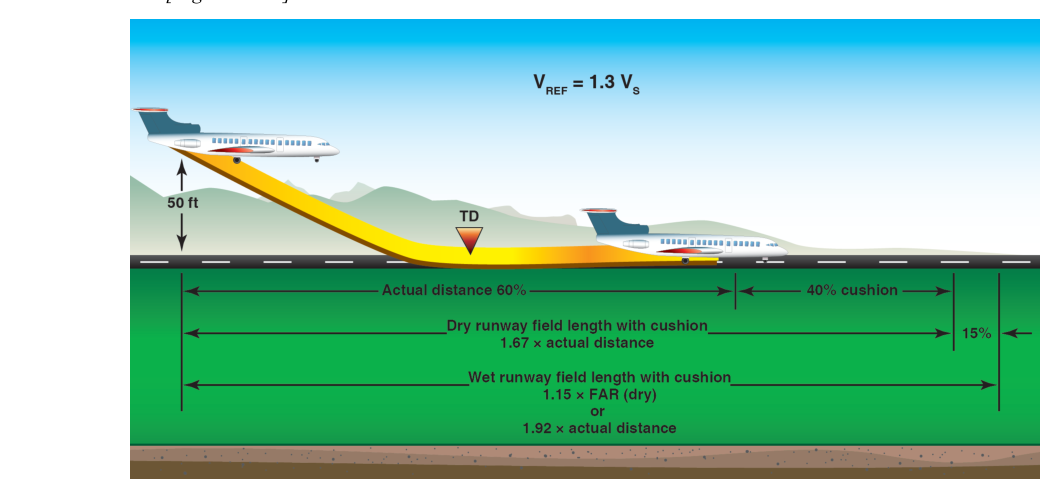
For airline transport pilots and dispatchers operating under 14 CFR Part 121, determining whether an airplane can legally land at the destination is far more complex than simply asking whether the runway is long enough to stop the aircraft. The regulations impose a structured, conservative performance margin that accounts for real-world variability in approach technique, atmospheric conditions, and runway condition. At the heart of these rules is 14 CFR 121.195, which establishes landing distance requirements for turbine-powered transport-category airplanes. Understanding these rules thoroughly is essential not only for the ATP written and oral examinations, but for the daily practice of safe airline operations.
The fundamental principle is straightforward: the landing distance required, as demonstrated in certification testing under ideal conditions, must fit within a specified fraction of the available runway length. This built-in margin is what pilots and dispatchers commonly call the 60/40 dispatch rule, though the regulation uses percentage language rather than that informal label. Mastering the math, the conditions that modify it, and the logic behind it will serve any ATP candidate well.
How the Landing Field Length Requirement Works
Under 14 CFR 121.195, before a flight departs, the dispatcher and pilot-in-command must determine that the airplane's actual landing weight at the destination — accounting for fuel burn — will not exceed the maximum weight that allows the airplane to land within 60 percent of the effective length of each runway at the destination airport. In other words, the demonstrated landing distance must be no more than 60% of the available runway length. Equivalently, the required field length is the demonstrated distance divided by 0.60, which means the airplane needs roughly 1.67 times its demonstrated stopping distance available on the runway.
The flight must also be planned so that the airplane complies with the same standard at any designated alternate airport. If weather or other conditions force a diversion, the airplane must be able to meet the field length limit there as well, providing a consistent safety margin throughout the entire planned operation.
The 60/40 Language Explained
The informal name 60/40 rule captures the idea that no more than 60% of the runway may be used, leaving 40% as a safety margin. To apply it operationally: if the destination runway is 8,000 feet long, multiply 8,000 by 0.60 to get 4,800 feet — the maximum demonstrated landing distance the airplane may require. Conversely, if the airplane's performance charts show it needs 5,000 feet to land at the planned weight, divide 5,000 by 0.60 = 8,333 feet of runway required. If the available runway is shorter than 8,333 feet, the dispatch weight must be reduced until the math works.
It is important to understand that the demonstrated landing distance used in these calculations comes from the Airplane Flight Manual (AFM), which itself is derived from FAA certification flight tests conducted on a dry, hard-surface runway. The AFM data represents a highly controlled condition. The regulatory margin of 40% accounts for normal pilot technique variation, slight differences in threshold crossing speed, and minor surface contamination — it is not intended to cover significantly degraded conditions.
Wet Runway and Contaminated Runway Modifications
14 CFR 121.195 specifically addresses wet runways. If the destination airport's most current weather report indicates that the runway will be wet at the estimated time of arrival, the required field length must be increased so that the airplane's demonstrated landing distance does not exceed 60% of the wet runway length — which is equivalent to requiring the available runway to be at least 115 percent of the dry-runway required field length. In practical terms, the available wet runway must be at least as long as: demonstrated dry landing distance ÷ 0.60 × 1.15. This increases the required field length by about 15% over the dry standard, reflecting the additional stopping distance needed on a wet surface.
For contaminated runways — those covered with standing water, slush, snow, or ice — operators must consult approved performance data that accounts for the specific contaminant type and depth. The AFM or approved performance program typically provides factored stopping distances for various contamination levels. The regulatory framework, while rooted in 121.195, relies on the operator's approved operations specifications and performance programs to address these scenarios in detail.
Why the 60/40 Rule Matters Operationally
The 40% margin built into 121.195 is not arbitrary. Consider the environment of scheduled airline operations: flights arrive at varying times of day and night, across a range of atmospheric conditions, flown by pilots with differing levels of recency. A stabilized approach may still result in a slightly fast threshold crossing, adding hundreds of feet to the ground roll. A slight tailwind component that develops after dispatch, a pilot who floats slightly in the flare, or a runway that is wetter than expected can each consume part of that margin. The 40% buffer is the system's tolerance for the accumulation of these real-world imperfections.
From a systems and safety standpoint, the rule enforces a discipline of conservative dispatch planning. Dispatchers must account for forecast winds at the destination, probable landing runway, and the airplane's expected landing weight. If the math is marginal, the flight must either depart lighter, plan a fuel stop, or be dispatched to an alternate with an adequate runway. The rule thus functions as a pre-departure gate that prevents foreseeable situations where a crew might feel pressured to land on a runway that is technically too short.
For the pilot-in-command, 121.195 carries an important operational implication: even if the dispatcher has certified compliance, the PIC must independently assess conditions. If actual conditions at arrival differ significantly from those used in dispatch — for example, a runway change to a shorter surface, unexpected tailwind, or runway contamination — the PIC must reassess before committing to the landing.
Key Numbers and Rules
- Dry runway standard: Demonstrated landing distance must not exceed 60% of the available runway length (i.e., available runway ≥ demonstrated distance ÷ 0.60).
- Wet runway adjustment: Required field length is multiplied by 1.15 when the destination runway is reported or forecast to be wet.
- Safety margin expressed differently: The airplane must have approximately 1.67× its demonstrated stopping distance available (1 ÷ 0.60 = 1.667).
- Applies at destination AND alternate: Both the destination and any required alternate airport must independently satisfy the field length requirement.
- Weight dependency: Landing distance increases with weight, so the dispatch rule may effectively limit the maximum allowable landing weight at airports with shorter runways.
- Turbine-powered aircraft only: 14 CFR 121.195 applies to turbine-powered transport-category airplanes; reciprocating-engine aircraft are governed by the parallel provisions of 14 CFR 121.197.
- AFM data basis: All demonstrated distances used in compliance calculations must come from the FAA-approved Airplane Flight Manual performance data for the specific airplane and configuration.
Worked Example
Consider a Boeing 737 planned to land at an airport with an available landing distance of 7,500 feet on a dry runway. The maximum allowable demonstrated landing distance is: 7,500 × 0.60 = 4,500 feet. If the AFM shows that at the planned landing weight the airplane requires 4,200 feet, the flight is legal — the required distance (4,200 ft) is within the 4,500-foot limit.
Now suppose the ATIS on departure indicates the runway will likely be wet. The required field length for that same 4,200-foot dry-demonstrated distance must now be adjusted: 4,200 ÷ 0.60 × 1.15 ≈ 8,050 feet of runway required for the flight to be dispatched at that landing weight. Since only 7,500 feet is available, this weight would not be legal on a wet runway. If the AFM's wet landing distance at that weight is instead 4,100 feet, the required runway becomes 4,100 ÷ 0.60 ≈ 6,833 feet — which the 7,500-foot runway does satisfy. This illustrates why wet landing distance data (rather than simply factoring the dry distance) is used whenever it is available, and why dispatch weight must be reduced whenever the wet-required field length exceeds the available runway.
Common Test Traps
- Confusing the factor direction: Candidates sometimes multiply the demonstrated distance by 0.60 (wrong) instead of comparing it to 60% of the available runway. Remember: available runway × 0.60 ≥ demonstrated distance.
- Forgetting the alternate requirement: The rule applies to both the destination and the alternate independently. Selecting a close-in alternate with a short runway does not satisfy the regulation just because the destination is legal.
- Misapplying the wet runway factor: The 1.15 wet factor increases the required field length (or equivalently reduces the allowable landing weight for a given runway) — it is never used to divide the available runway down, which would incorrectly shrink the required margin.
- Assuming the rule covers contaminated runways: The 60% dry / 115% wet provisions do not fully address ice, snow, or slush. Those scenarios require separate approved performance data and operator-specific guidance.
- Ignoring weight at landing, not takeoff: The calculation must be based on actual landing weight at the destination after fuel burn, not the takeoff weight. A flight that is legal at departure weight may still require a dispatch adjustment if the landing weight calculation is omitted.