Maneuvering During Slow Flight
Slow flight is sustained flight at a low airspeed just above the stall warning, where the airplane is on the back side of the power curve and controls feel mushy. You learn to control altitude, heading, and airspeed precisely with coordinated use of pitch, power, and trim. Per the current ACS, slow flight is flown at a speed above the one that would activate the stall warning.
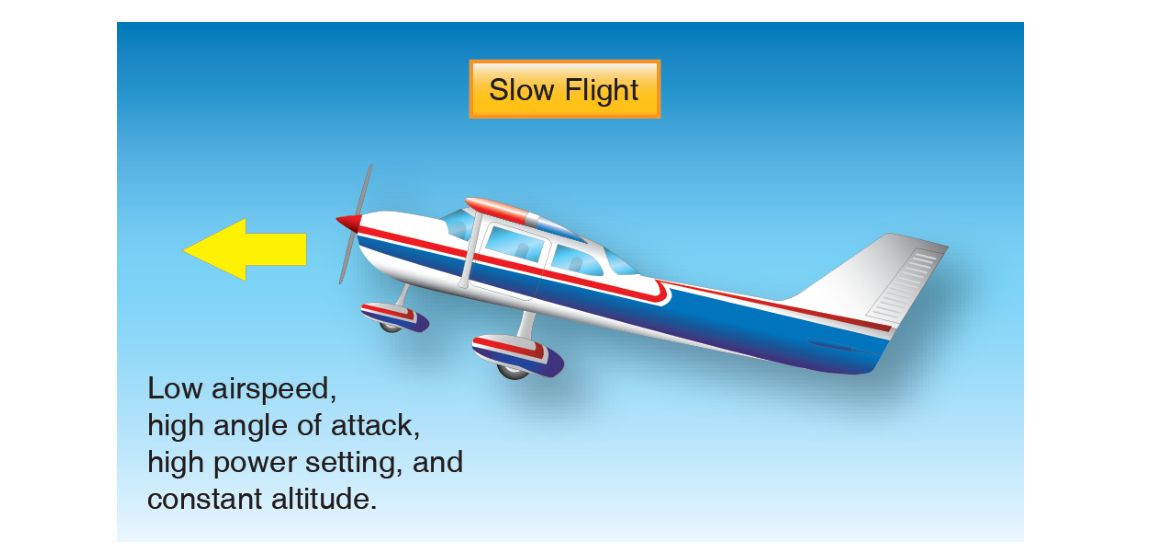
Step by step
- 1Clear the area and reduce power; as the airplane slows, add flaps/configuration per the task and raise the nose to hold altitude.
- 2Set power to maintain an airspeed just above the stall-warning activation speed in level flight.
- 3Trim off control pressures and stabilize: control altitude with pitch/power together and heading with coordinated aileron and rudder.
- 4Demonstrate level turns, climbs, and descents at this airspeed without triggering the stall warning.
- 5Anticipate the large power and rudder inputs needed — at low speed the airplane is on the back side of the power curve.
- 6To recover, smoothly add power, reduce the angle of attack as needed, and retract flaps in stages while accelerating to normal speed.
Tips & common errors
- Power largely controls altitude and pitch controls airspeed in this slow, back-side-of-the-curve regime.
- Expect to need significant right rudder at high power and low speed to stay coordinated.
- Common error: letting the airspeed decay into the stall warning, or chasing altitude with pitch alone.
- Keep the stall warning quiet — the current standard is to fly just above it, not in it.
ACS completion standards
The commonly-tested tolerances for this maneuver. Always confirm the current ACS for your certificate.
- Establish and maintain an airspeed at which any further increase in angle of attack, load factor, or power reduction would result in a stall warning.
- Maintain altitude ±100 feet, heading ±10° (or specified bank ±10° in turns), and the specified airspeed +10/-0 knots.
- Maintain coordinated flight; recover promptly and smoothly to normal flight.
FAA source
FAA-S-ACS-6 (Private) / FAA-S-ACS-7 (Commercial), Task: Maneuvering During Slow Flight; Airplane Flying Handbook FAA-H-8083-3, Chapter 4 (Slow Flight, Stalls, and Spins).
This is an original, plain-English study summary grounded in the public-domain FAA Airman Certification Standards and FAA handbooks cited above. It is a study aid, not flight instruction, and not a substitute for the official ACS, the handbooks, your aircraft’s POH/AFM, or a certificated flight instructor.
Related maneuvers
- Power-Off Stall (Approach-to-Landing Stall)A power-off stall simulates the stall that can occur in the approach/landing configuration — power reduced, flaps and gear down, descending. You recognize the aerodynamic stall (buffet, mushy controls, stall warning) and recover promptly with minimum altitude loss.
- Power-On Stall (Departure Stall)A power-on stall simulates the stall that can happen on takeoff or initial climb — takeoff power, takeoff/departure configuration, nose high. Torque and P-factor make the airplane want to roll/yaw left, so coordinated rudder is essential to a clean recovery.
- Accelerated (Maneuvering) StallAn accelerated stall demonstrates that an airplane can stall at a higher-than-normal airspeed whenever the load factor is increased — for example in a steep, level turn. The increased G raises the stall speed, so the wing reaches its critical angle of attack while the airspeed is still well above the 1G stall speed.
- Cross-Control Stall (Demonstration)A CFI demonstration stall that shows the danger of a skidding (cross-controlled) turn from base to final. With crossed controls — aileron one way, opposite rudder — the airplane can snap into an incipient spin at the stall, with little warning, at a low altitude where there is no room to recover. The point is to recognize and avoid it.
Keep studying
Turn maneuver knowledge into a passing checkride
Drill ACS-aligned questions and ask the AI tutor, Ace, anything — free to start, no account needed.
Take a free practice test →