Making Money with Your Part 107: Drone Business Ideas and Markets

Turning Your Part 107 Certification into a Profitable Drone Business
Earning your Part 107 certification is a genuine milestone — but the real excitement begins when you start making money with your drone. The commercial drone industry has expanded dramatically in recent years, opening up a wide range of drone business ideas for entrepreneurial pilots who are ready to put their FAA knowledge to work. Whether you're looking for a full-time career or a lucrative side hustle, this guide breaks down the most promising markets, practical tips for getting started, and how continued education can sharpen your competitive edge.
Why a Part 107 License Opens So Many Doors
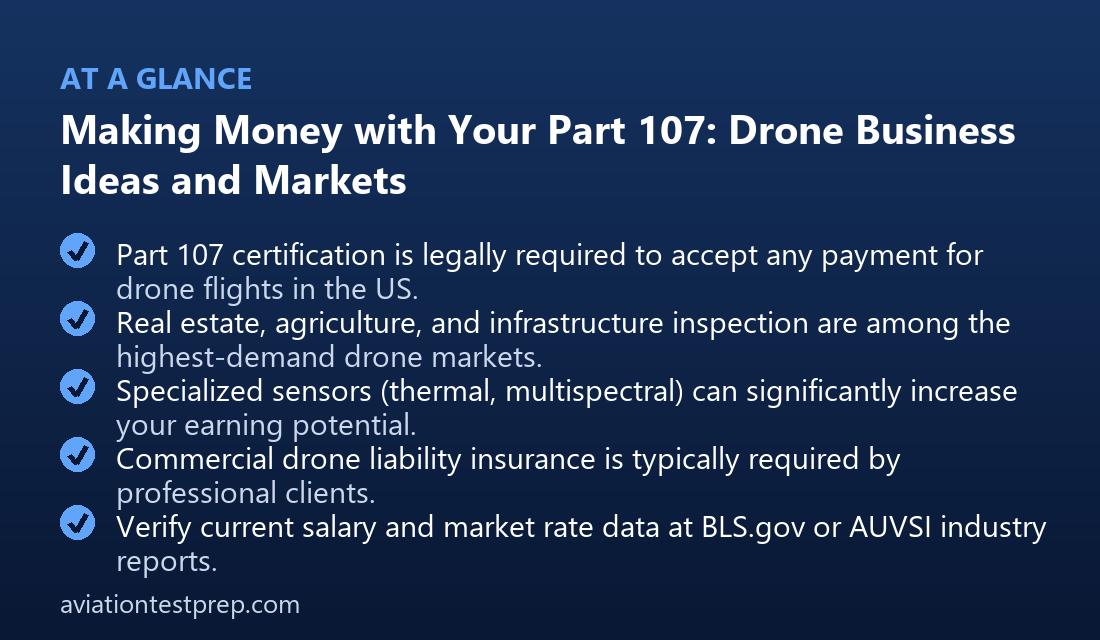
The FAA's Part 107 Remote Pilot Certificate is the legal gateway to flying drones commercially in the United States. Without it, accepting any form of compensation for drone flights — even a gift card — is a violation of federal regulations. Once certified, however, you can legally offer your services across dozens of industries, set your own rates, and build a brand around your aerial skillset.
The certificate demonstrates to clients that you understand airspace rules, weather interpretation, crew resource management, and emergency procedures. That credibility alone can justify premium pricing compared to hobbyists operating without certification. If you haven't taken the plunge yet, explore all available FAA practice exams to see exactly what knowledge areas the test covers before you commit to a study schedule.
Top Drone Business Ideas Worth Exploring
1. Real Estate and Architecture Photography
Aerial photography for real estate listings is one of the most accessible entry points for new Part 107 pilots. Studies consistently show that listings with aerial imagery attract more online views than those without. Residential realtors, commercial property firms, and architecture studios routinely hire drone operators to capture compelling exterior shots, neighborhood overviews, and construction progress documentation.
- Start-up cost: Relatively low — a mid-range camera drone and editing software.
- Earning potential: Typically charged per shoot or as a package; rates vary widely by market and experience.
- Key skill: Understanding of composition, golden-hour lighting, and post-processing.
2. Agriculture and Precision Farming
Agriculture is one of the fastest-growing sectors in commercial drone services. Farmers use drones equipped with multispectral sensors to monitor crop health, detect irrigation issues, map fields, and even apply pesticides (with appropriate waivers). If you're in a rural area, this market can be especially lucrative because local competition is often limited.
- Opportunity: Long-term contracts with farms, co-ops, and agricultural consultants.
- Equipment note: Specialized sensors and spray rigs can increase costs but also command significantly higher rates.
- Regulatory tip: Pesticide application may require additional state-level licensing beyond Part 107.
3. Infrastructure Inspection
Towers, bridges, power lines, pipelines, and rooftops all need periodic inspection — and drones are far safer and cheaper than sending human inspectors to climb tall structures. Utility companies, construction firms, and insurance adjusters are active buyers of drone inspection services.
- Roof inspections for insurance claims after storms are a high-volume, repeatable opportunity.
- Cell tower inspections require specific training but pay premium rates.
- Pipeline and utility right-of-way surveys often involve linear mapping across long distances.
4. Mapping and Surveying
Photogrammetry — the science of creating 3D maps and models from overlapping aerial images — has become a cornerstone of modern land surveying, construction site management, and urban planning. Software platforms like DroneDeploy and Pix4D make it possible for Part 107 pilots to produce professional-grade orthomosaic maps and digital elevation models.
Surveying firms often partner with drone operators on an as-needed basis, making this a strong freelance opportunity. Note that in some states, producing official survey deliverables may require collaboration with a licensed land surveyor — always verify local regulations.
5. Film, Television, and Event Coverage
Hollywood and independent film productions, live sports broadcasts, concerts, and corporate events all use drone footage to add cinematic value. This market rewards creativity as much as technical skill. Building a strong portfolio reel and networking with local film crews and event planners can open doors to steady, well-paying work.
- Wedding videography is a popular entry point with consistent seasonal demand.
- Sporting events — motorsports, golf tournaments, outdoor festivals — often seek licensed drone operators.
- Always check venue-specific airspace restrictions and obtain any necessary waivers before accepting bookings.
6. Public Safety and Emergency Services
Law enforcement agencies, fire departments, and search-and-rescue teams increasingly contract with or hire Part 107-certified drone operators. This sector may require background checks, security clearances, and specialized training beyond the standard certificate, but it also offers meaningful, mission-driven work alongside stable compensation.
7. Environmental Monitoring and Conservation
Conservation organizations, universities, and government agencies hire drone pilots to monitor wildlife populations, track deforestation, assess wetland health, and document environmental change over time. If you have a background or interest in ecology or environmental science, this niche can be deeply rewarding.
Building Your Drone Business: Practical First Steps
Having a Part 107 certificate is the foundation, but building a sustainable drone business requires more than a license and a good camera. Here's a realistic roadmap:
- Define your niche. Trying to serve every market at once dilutes your brand. Pick one or two industries and become genuinely expert in their specific needs.
- Build a portfolio. Clients hire pilots they can see evidence of. Offer a few discounted or volunteer shoots to build sample work before charging full rates.
- Get insured. Commercial drone liability insurance is essential and often required by clients. Policies are available from several aviation-focused insurers.
- Price strategically. Research what competitors in your area charge. Avoid underpricing, which undermines the whole market and signals inexperience.
- Stay current on regulations. The FAA regularly updates Part 107 rules, airspace classifications, and waiver processes. Regulatory fluency is a selling point with clients.
- Market yourself actively. A professional website, active social media presence, and local networking (real estate groups, business associations) accelerate client acquisition.
Deepening Your Knowledge for a Competitive Edge
The drone pilots who command the highest rates aren't just skilled flyers — they deeply understand the regulatory environment, weather patterns, airspace complexities, and risk management principles that protect their clients and their business. That knowledge begins with thorough test preparation and continues with ongoing learning throughout your career.
At Aviation Test Prep, our ACS-aligned practice questions mirror the knowledge domains tested on the FAA UAG (Unmanned Aircraft General) knowledge exam. Our 5-step study method — Read, Practice, Review, Identify Weak Areas, and Repeat — is designed to build genuine understanding, not just rote memorization. And our AI tutor, Ace, is available 24/7 to explain concepts, answer follow-up questions, and guide you through tricky regulatory topics in plain language.
You can explore ACS codes and knowledge areas to understand exactly how the FAA structures its aeronautical knowledge standards, or browse the Aviation Test Prep blog for ongoing articles on regulations, study strategies, and industry insights.
What to Expect from the Part 107 Market in the Coming Years
The commercial drone industry is still maturing, which means both opportunity and competition are increasing simultaneously. Operators who invest in specialized skills — thermal imaging, LiDAR, advanced photogrammetry, or specific industry knowledge — will continue to differentiate themselves. The FAA's ongoing development of Beyond Visual Line of Sight (BVLOS) rules is expected to open even larger commercial opportunities in delivery, infrastructure monitoring, and public safety in the years ahead.
For salary and market compensation data, the Bureau of Labor Statistics and industry associations like AUVSI publish periodic reports worth reviewing. Always verify current figures directly from authoritative sources, as the market evolves quickly.
Ready to Start or Sharpen Your Part 107 Journey?
Whether you're studying for your first FAA knowledge test or looking to reinforce your regulatory knowledge before launching a new service line, preparation is the foundation of professionalism. A confident, knowledgeable Part 107 pilot is a more credible, more bankable business owner.
Take the first step toward building your drone business on solid ground — try a free Part 107 practice test today and see exactly where your knowledge stands before you invest in marketing yourself to clients.
Ready to pass your FAA written exam?