When a small unmanned aircraft system (sUAS) operation goes wrong, most remote pilots instinctively focus on recovering the aircraft or assessing damage. But federal regulations impose a second, equally important obligation: knowing when and how to report the event to the FAA. Under 14 CFR Part 107, the accident reporting requirement is specific, time-limited, and surprisingly misunderstood. Getting it wrong can mean operating outside the law — or worse, failing to contribute information that the FAA uses to improve safety across the entire sUAS industry.
This article walks through every dimension of the reporting requirement: what legally constitutes a reportable accident, which thresholds trigger the duty, what you must submit and to whom, and the practical considerations that keep you compliant in the field. It also addresses the common confusion between accidents that must be reported and incidents that, while alarming, carry no formal reporting obligation under Part 107.
The Regulatory Foundation
The authority for sUAS accident reporting lives in 14 CFR § 107.9. The rule is concise but carries significant legal weight: the remote pilot in command (RPIC) must report any sUAS operation that results in a reportable accident to the FAA within 10 calendar days of the operation. The report is submitted online through the FAA's official sUAS accident reporting webpage/portal, or the equivalent FAA-designated reporting mechanism in place at the time of the accident. Importantly, this is not a law-enforcement report and not filed with local authorities; it is an FAA safety report, and timely filing is the RPIC's personal responsibility regardless of whether anyone else files anything.
The 10-calendar-day clock starts on the day of the accident itself, not the day you discover the damage or the day someone else tells you about it. If the accident occurred on a Monday, the report is due by the following Thursday of the next week (10 days later, counting the accident day as day one in common FAA practice — though some interpretations count from the next day; to be safe, file as soon as practicable and well within the window).
What Counts as a Reportable Accident
Not every crash, flyaway, or hard landing is a reportable accident under § 107.9. The regulation establishes two independent thresholds, and meeting either one triggers the reporting requirement:
- Serious injury to any person. A serious injury is defined by reference to the National Transportation Safety Board (NTSB) injury classification. Under that standard, a serious injury includes fractures (other than simple fractures of fingers, toes, or nose), severe hemorrhages, nerve or muscle damage, internal organ damage, second- or third-degree burns, or any injury requiring hospitalization for more than 48 hours. If any person — the RPIC, a visual observer, a bystander, anyone — suffers a serious injury as a result of the sUAS operation, you must report.
- Loss of consciousness. If any person loses consciousness as a result of the sUAS operation (for example, being struck by the aircraft), that alone constitutes a reportable accident even if no other serious injury occurred.
- Property damage above $500. If the sUAS causes damage to property other than the sUAS itself, and the total cost of repair or fair market replacement value of the damaged property exceeds $500, the accident is reportable. This is the threshold most commonly tested. Note two critical nuances: (1) damage to the sUAS itself does not count — only damage to external property; and (2) the $500 threshold refers to the cost of restoring the property to its pre-accident condition, or its fair market value if repair is not economically feasible.
It is worth pausing on the property damage threshold, because it generates the most confusion. If your drone clips a fence post and the post costs $300 to replace, no report is required. If the same drone hits a car windshield that costs $600 to repair, a report is required. If the drone destroys itself completely in a crash but causes zero injury and zero external property damage, no report is required — even if the aircraft is a total loss worth thousands of dollars.
What Does NOT Require a Report Under Part 107
Many unnerving events during sUAS operations do not rise to the level of a reportable accident under § 107.9. These include:
- Crashes that damage only the sUAS itself, with no injury and no external property damage over $500.
- Loss of GPS signal or a flyaway that is recovered without injury or qualifying property damage.
- Engine or motor failures that result in a precautionary landing with no qualifying damage.
- Near misses with other aircraft or obstacles — these are incidents, not accidents under Part 107 (though voluntary reporting through NASA's Aviation Safety Reporting System, or ASRS, is always encouraged and provides legal protections).
- Minor injuries such as small cuts, bruises, or non-serious burns that do not meet the NTSB serious injury definition.
The distinction between an accident (mandatory report) and an incident (no Part 107 mandatory report) is a favorite topic on the FAA knowledge exam. Memorize the two triggers — serious injury/loss of consciousness, or external property damage over $500 — and apply them precisely.
How to File the Report
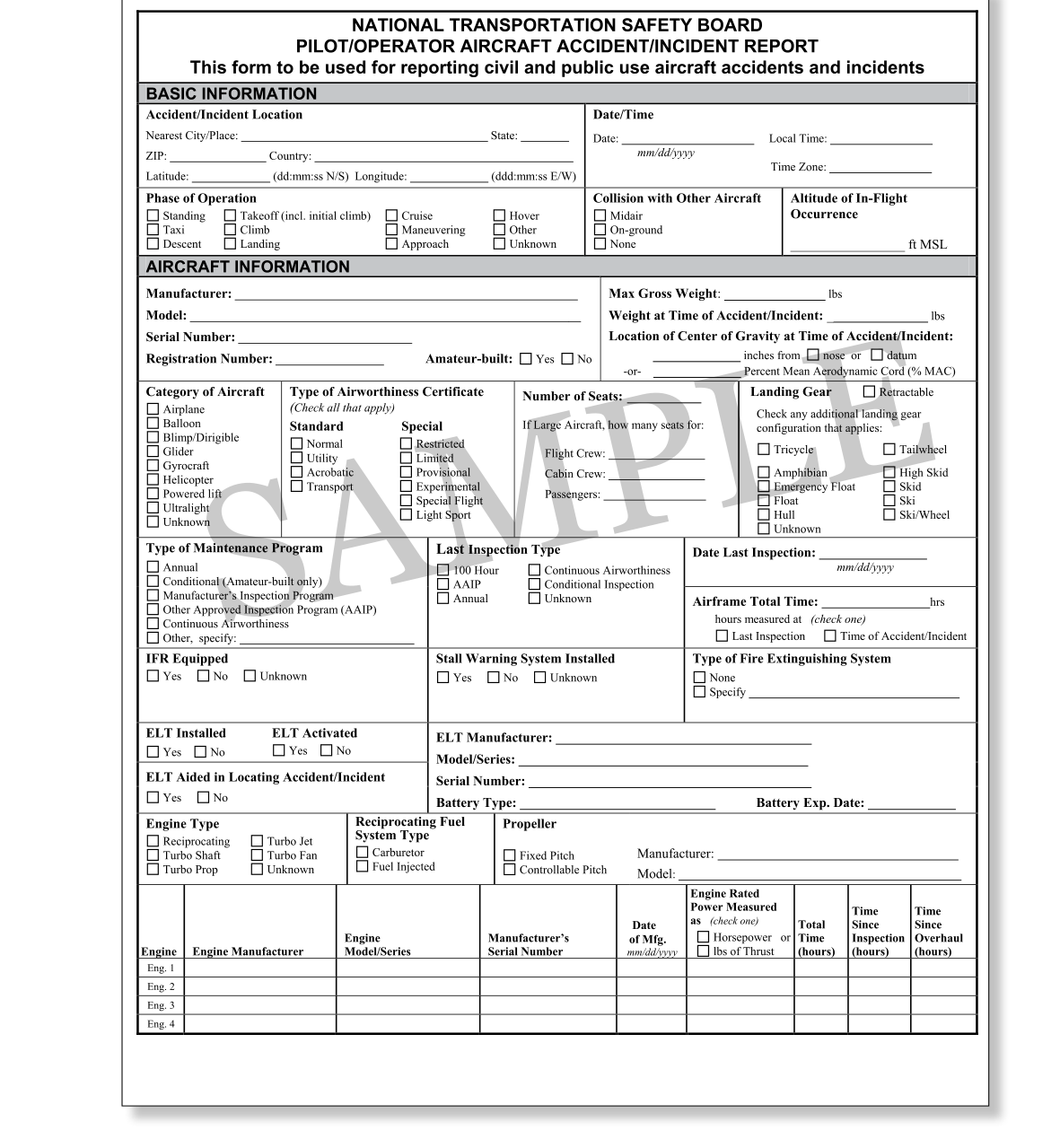
The FAA directs remote pilots to submit accident reports through its online portal. When filing, you will typically provide: your name and remote pilot certificate number, the date and location of the accident, a description of what happened, the nature of any injuries, an estimate of property damage, and information about the sUAS (make, model, registration number). There is no standardized paper form like the NTSB Form 6120.1 used in manned aviation; the sUAS process is handled separately through the FAA's designated digital system.
Filing the FAA accident report does not shield you from liability in civil proceedings, and it does not replace any obligation you may have to notify local emergency services if someone is injured. If there is a medical emergency, call 911 first — the FAA report follows within 10 days.
Relationship to NTSB Notification Requirements
Student pilots often wonder whether the NTSB must also be notified after a sUAS accident. Under 49 CFR Part 830, the NTSB requires immediate notification for accidents involving certain aircraft. Historically, Part 830 applied primarily to manned aircraft. The NTSB has clarified that its notification and reporting requirements apply to sUAS accidents that meet certain severity thresholds (such as serious injury or significant property damage), and the NTSB investigates sUAS accidents it deems significant. However, the FAA's Part 107 report to the FAA under § 107.9 is a separate, parallel obligation with its own 10-day deadline. For the Part 107 knowledge test, focus on the FAA § 107.9 requirement; be aware the NTSB has independent authority but understand that the exam tests the FAA reporting rule specifically.
Key Numbers and Rules
- 10 calendar days — the deadline to report a qualifying accident to the FAA after the operation.
- $500 — the property damage threshold (damage to property other than the sUAS) that triggers a report.
- Serious injury or loss of consciousness — the injury threshold, using NTSB injury classification definitions.
- Damage to the sUAS itself does not count toward the $500 threshold.
- The report is filed with the FAA (not local police, not the NTSB as a primary obligation under Part 107).
- The RPIC is personally responsible for filing — there is no provision to delegate this duty to a client or employer.
Memory Aid
Use the phrase "10-500-Serious" to lock in the three core elements of § 107.9:
- 10 — report within 10 calendar days.
- 500 — external property damage exceeding $500 triggers the duty.
- Serious — serious injury to any person (or loss of consciousness) also triggers the duty.
Recite this before every complex operation as a quick mental checklist of what would obligate you to file if things go wrong.
Common Test Traps
- Counting damage to the drone itself. Many students add up the cost of repairing the sUAS and compare it to $500. Wrong — only damage to external property counts. A destroyed $2,000 drone with no other damage is not reportable.
- Confusing the reporting deadline. The 10-day window is in calendar days, not business days. Weekends and holidays count. Do not wait until what you think is the 10th business day.
- Assuming minor injuries never require a report. The trigger is not just property damage — any serious injury or loss of consciousness independently mandates a report even if property damage is zero.
- Thinking only the NTSB handles accident reports. For sUAS under Part 107, the primary mandatory report goes to the FAA under § 107.9. The NTSB has separate authority, but the FAA report is the one you are tested on.
- Believing the report can wait if you are uncertain about damage costs. If there is reasonable doubt that damage may exceed $500, file the report. Failing to report when required is a violation of § 107.9 and can jeopardize your remote pilot certificate.
Mastering the accident reporting requirement is more than a test strategy — it reflects the professional responsibility that comes with operating an aircraft in the National Airspace System. The data gathered through these reports helps the FAA identify hazards, refine regulations, and ultimately make sUAS operations safer for everyone. File promptly, file accurately, and file every time the thresholds are met.