Every certificated pilot operates within a web of federal regulations, and among the most consequential are those that govern what happens after something goes wrong. The National Transportation Safety Board (NTSB) — not the FAA — is the federal agency responsible for investigating civil aviation accidents and certain serious incidents. The rules that define what must be reported, to whom, and on what timeline are found in Title 49 of the Code of Federal Regulations, Part 830 (commonly called "NTSB 830"). Understanding these rules thoroughly is essential for passing the FAA knowledge test and, more importantly, for acting correctly in the stressful moments following an unexpected event in the air or on the ground.
NTSB 830 covers three fundamental categories: accidents, incidents, and serious incidents. Each carries different reporting obligations and triggers different investigative responses. Knowing the distinctions cold — especially the precise definitions the NTSB uses — is one of the most reliably tested areas in FAA written exams.
Defining the Key Terms
The NTSB definitions are specific and must not be confused with everyday language. The regulation draws sharp lines between these categories, and the FAA knowledge test regularly exploits those lines.
Aircraft Accident: An occurrence associated with the operation of an aircraft that takes place between the time any person boards the aircraft with the intention of flight and the time all such persons have disembarked, and in which any person suffers death or serious injury, or in which the aircraft receives substantial damage. This definition has several layers worth unpacking.
Serious injury means an injury that involves hospitalization for more than 48 hours commencing within 7 days from the date of the injury; a fracture of any bone (except simple fractures of fingers, toes, or nose); severe hemorrhages, nerve, muscle, or tendon damage; damage to any internal organ; second or third degree burns or any burns affecting more than 5 percent of the body surface; or infectious substances or toxic chemicals injected into the body.
Substantial damage is defined as damage or failure that adversely affects the structural strength, performance, or flight characteristics of the aircraft, and that would normally require major repair or replacement of the affected component. Critically, NTSB 830 lists several types of damage that are excluded from the definition of substantial damage — even though they might sound serious to a layperson. These exclusions include: engine failure or damage limited to an engine if only one engine fails or is damaged; bent fairings or cowling; dented skin; small puncture holes in the skin or fabric; ground damage to rotor or propeller blades; and damage to landing gear, wheels, tires, flaps, engine accessories, brakes, or wingtips. The exam loves these exclusions.
Aircraft Incident: An occurrence other than an accident, associated with the operation of an aircraft, that affects or could affect the safety of operations. In short, it's something that went wrong — or nearly went wrong — but didn't meet the threshold of an accident. Incidents are generally not required to be immediately reported unless they fall into the specific category of "serious incidents."
Serious Incident: This is where reporting requirements kick in for non-accident events. NTSB 830.5 lists the specific types of incidents that must be reported immediately. These include, among others: flight control system malfunction or failure; inability of any required flight crew member to perform normal flight duties as a result of injury or illness; failure of structural components of a turbine engine (excluding compressor and turbine blades and vanes); in-flight fire; aircraft collision in flight; damage to property other than the aircraft estimated to exceed $25,000; a runway incursion that requires the operator or crew of another aircraft or vehicle to take immediate corrective action to avoid a collision; an overflight-related event; an ATC-reported near midair collision requiring evasive action; certain flight control system malfunctions specific to Part 121/125 operations; and other events enumerated in the regulation. This list is illustrative, not exhaustive — students should not assume the items mentioned here are the complete set found in 830.5.
Who Must Report and When
The operator of an aircraft — not necessarily the pilot-in-command, though they are often the same person for general aviation — is responsible for notification. In practice, for a private pilot flying a personally owned aircraft, the pilot is the operator and bears this duty directly.
Immediate Notification: The operator must notify the nearest NTSB field office immediately after an accident or after any of the listed serious incidents. "Immediate" is not defined as a specific number of hours in the regulation, but it is understood to mean as soon as reasonably practicable after ensuring the safety of survivors and securing the scene. Notification can be made by telephone.
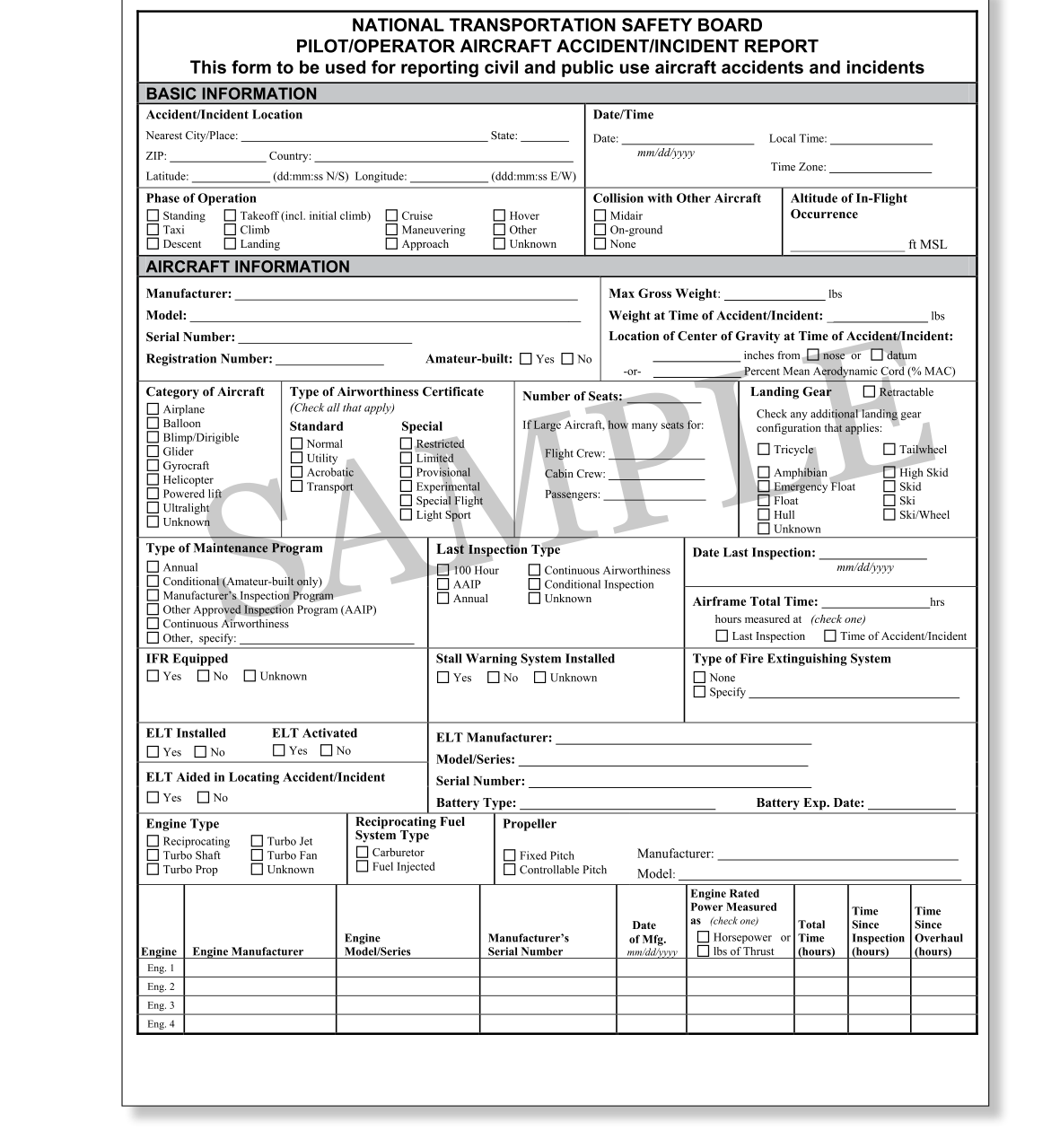
Written Report — the 10-Day Rule: Following an accident, the operator must file a written report within 10 days of the accident. This is one of the most tested numbers in this topic area. The written report must be filed on NTSB Form 6120.1 (for general aviation accidents). Note carefully: the 10-day requirement applies to accidents. For serious incidents, a written report is required only if specifically requested by an authorized NTSB representative.
Overdue Aircraft: When an aircraft is overdue and believed to be involved in an accident, the operator should notify the NTSB as well, although the initial search-and-rescue notification typically goes through FAA/Air Traffic Control and the Air Force Rescue Coordination Center.
Preserving the Accident Site and Aircraft
NTSB 830 also places obligations on the operator regarding preservation of evidence. The wreckage, cargo, and all records associated with the operation of the aircraft must not be disturbed or moved except to the extent necessary to remove persons injured or trapped, to protect the wreckage from further damage, or to protect the public from injury. Before moving wreckage for protective reasons, photographs and sketches should be made if at all possible.
The operator may not move or disturb the wreckage until authorized to do so by the NTSB. However, if the wreckage is located on a public road or other location where it poses a hazard to the public, it may be moved after making a record of its original position. This authorization requirement is frequently tested — students sometimes confuse it with FAA authority, but it is the NTSB that controls the wreckage.
Key Numbers and Rules
- 10 days: Deadline for filing the written accident report (NTSB Form 6120.1) after an aircraft accident.
- Immediate notification: Required for accidents and the listed serious incidents — no specific hour limit, but as soon as practicable.
- $25,000: The threshold for property damage (other than aircraft) that triggers serious incident reporting.
- 48 hours / 7 days: Part of the serious injury definition — hospitalization for more than 48 hours commencing within 7 days of the incident.
- 5% body surface: Burns affecting more than 5% of the body surface constitute serious injury.
- NTSB, not FAA: The NTSB administers Part 830. The FAA conducts certificate actions separately.
- Serious incidents require immediate notification but a written report only if specifically requested.
- Excluded damage: Engine failure (single engine only), bent fairings, dented skin, wingtip damage, tire damage — these do NOT constitute substantial damage.
Memory Aid
To remember the reporting timeline, use the phrase "Accidents need Ten Days on paper." — Accidents require a written report, and that report is due within Ten Days. Serious incidents require immediate phone notification but written reports only on request. This keeps the two categories and their paperwork requirements straight during exam pressure.
Common Test Traps
- Confusing the operator with the pilot: The regulation places the reporting duty on the operator. For most GA flights this is the same person, but rental aircraft create ambiguity — the exam may test whether the FBO or the renter pilot is responsible.
- Assuming all engine failures are accidents: If an engine fails but no serious injury occurs and there is no substantial damage beyond the engine itself, the event may be a serious incident rather than an accident. The single-engine exclusion from "substantial damage" is critical here.
- Misremembering the written report deadline: Students sometimes say "5 days" or "30 days." The correct answer is 10 days for accidents.
- Thinking the FAA controls the wreckage: It is the NTSB that must authorize movement of wreckage, not the FAA — a commonly missed distinction.
- Forgetting the serious incident list: Not every bad day in the cockpit qualifies as a reportable serious incident. Only those specific types enumerated in NTSB 830.5 require immediate notification. A hard landing with no injury or structural damage, for example, is generally just an ordinary incident with no immediate reporting requirement.