Emergency Approach & Landing (Engine Failure / Power-Off)
After a (simulated) engine failure, you must fly the airplane, pick the best landing site, glide to it, attempt a restart with the checklist, and set up a power-off approach. The priorities, in order, are: fly the airplane (best glide), navigate to a landing area, and run the checklist/communicate.
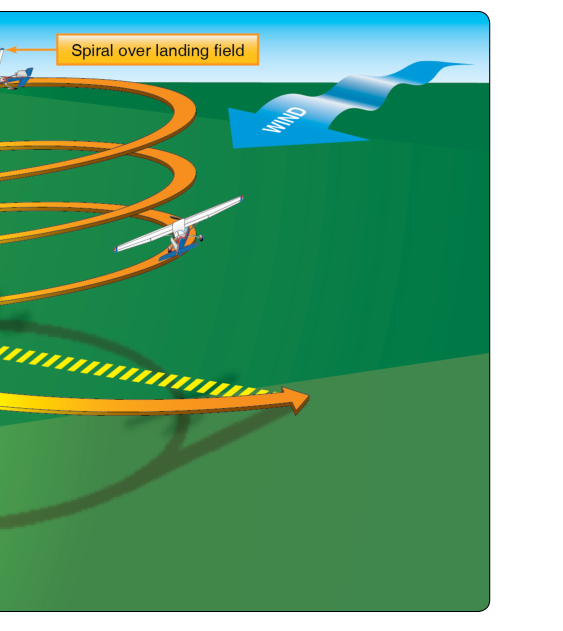
Step by step
- 1Pitch for best glide speed immediately and trim — flying the airplane comes first; do not pitch for the ground.
- 2Pick a suitable landing site within gliding range, considering wind, surface, obstacles, and slope; turn toward it.
- 3Run the engine-failure/restart checklist (fuel, mixture, carb heat, fuel pump, magnetos/ignition, primer, etc.) — flow then verify with the checklist.
- 4If no restart, declare an emergency (squawk 7700, call on the last/appropriate frequency) and brief any passengers.
- 5Plan a power-off approach to the chosen field — use a key position and adjust the pattern, flaps, and slips to land in the touchdown zone.
- 6Run the securing/shutdown checklist before landing (fuel off, mags off, master off, doors cracked) as time permits.
- 7Fly the approach to a landing in the field; touch down under control at minimum speed.
Tips & common errors
- Aviate, Navigate, Communicate — best glide and a landing site come before the radio.
- Best glide speed gives the most distance; trim for it and resist the urge to stretch the glide.
- Don’t fixate on a restart — set up the forced landing first, then troubleshoot if time allows.
- Common error: choosing a field too far away or not committing to the field early enough.
ACS completion standards
The commonly-tested tolerances for this maneuver. Always confirm the current ACS for your certificate.
- Establish and maintain the best-glide airspeed ±10 knots and trim.
- Select a suitable landing area and plan/fly a power-off approach to it.
- Complete the appropriate emergency checklist(s) and simulate the required communications/securing actions.
FAA source
FAA-S-ACS-6 (Private) / FAA-S-ACS-7 (Commercial), Task: Emergency Approach and Landing (Simulated); Airplane Flying Handbook FAA-H-8083-3, Chapter 18.
This is an original, plain-English study summary grounded in the public-domain FAA Airman Certification Standards and FAA handbooks cited above. It is a study aid, not flight instruction, and not a substitute for the official ACS, the handbooks, your aircraft’s POH/AFM, or a certificated flight instructor.
Related maneuvers
- Emergency DescentAn emergency descent is a maximum-rate descent to get the airplane down quickly — for example after an onboard fire, a pressurization problem, or a need to reach the surface fast. You configure for the highest safe descent rate (per the POH) while keeping the airplane under control and within limits.
- Systems & Equipment MalfunctionsYou must recognize and respond to in-flight system failures — electrical, vacuum/pitot-static, engine roughness, gear/flap problems, smoke/fire, etc. The examiner assesses whether you analyze the problem correctly, take the proper corrective action, use the checklist, and exercise sound judgment (including diverting or landing).
- Rejected (Aborted) TakeoffA rejected takeoff is the decision to abort the takeoff while still on the ground because of an abnormality — an engine that is not making full power, a warning, a door popping open, an animal on the runway. The key is a pre-briefed abort decision point and a prompt, controlled stop on the runway.
- Rectangular CourseThe rectangular course teaches you to fly a constant, equal distance from a square or rectangular ground feature while correcting for wind. It directly simulates the airport traffic pattern, so it builds the division of attention and wind-drift correction you use on every approach.
Keep studying
Turn maneuver knowledge into a passing checkride
Drill ACS-aligned questions and ask the AI tutor, Ace, anything — free to start, no account needed.
Take a free practice test →