Rectangular Course
The rectangular course teaches you to fly a constant, equal distance from a square or rectangular ground feature while correcting for wind. It directly simulates the airport traffic pattern, so it builds the division of attention and wind-drift correction you use on every approach.
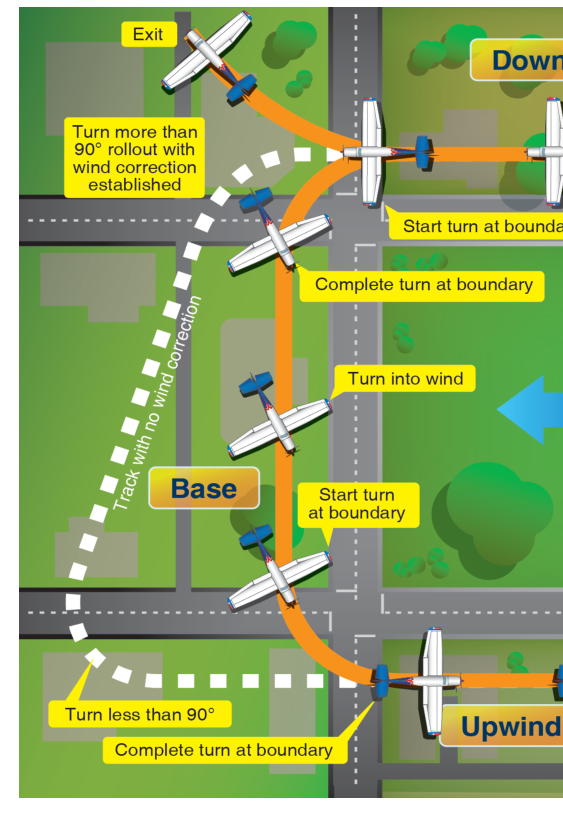
Step by step
- 1Pick a square section, field, or block of land. Enter the pattern at a 45° angle to the downwind side at a constant, low maneuvering altitude (commonly 600–1,000 ft AGL).
- 2Fly each leg a uniform distance from the boundary — about one-quarter to one-half mile — so your ground track is a rectangle offset outside the reference area.
- 3On a downwind leg the groundspeed is highest, so begin turns earlier and roll into a steeper bank.
- 4Turning from downwind to base (a downwind-to-crosswind turn), the wind is pushing you away from the field, so use the steepest bank and roll out with a wind-correction angle crabbing into the field.
- 5On the upwind leg groundspeed is lowest; hold a shallow crab and a gentle bank in the turns.
- 6Adjust the bank continuously through every turn so the radius keeps the track equidistant from the boundary; roll out with the correct crab on each straight leg.
- 7Maintain altitude and airspeed throughout, keeping your eyes outside for traffic and using the ground feature for reference.
Tips & common errors
- Steepest bank is always on the turn that starts from the leg with the highest groundspeed (a downwind leg).
- Common error: letting the wind blow you toward or away from the field on the straight legs — establish the crab promptly after each rollout.
- Common error: fixating on the ground feature and losing altitude. Keep dividing attention between the track and the instruments/horizon.
- Pick a feature with a clear boundary and choose a maneuvering altitude that is safe for the terrain and lets you recover from a stall.
ACS completion standards
The commonly-tested tolerances for this maneuver. Always confirm the current ACS for your certificate.
- Maintain altitude ±100 feet.
- Maintain airspeed ±10 knots.
- Apply adequate wind-drift correction to track a uniform, rectangular ground path.
- Clear the area; divide attention between aircraft control and the ground track.
FAA source
FAA-S-ACS-6 (Private Pilot ACS), Task: Rectangular Course; Airplane Flying Handbook FAA-H-8083-3, Chapter 6 (Ground Reference Maneuvers).
This is an original, plain-English study summary grounded in the public-domain FAA Airman Certification Standards and FAA handbooks cited above. It is a study aid, not flight instruction, and not a substitute for the official ACS, the handbooks, your aircraft’s POH/AFM, or a certificated flight instructor.
Related maneuvers
- S-Turns Across a RoadS-turns are a series of equal half-circles flown on opposite sides of a straight ground reference line. The goal is to keep each semicircle the same size despite the wind, which forces you to vary the bank continuously throughout each turn.
- Turns Around a PointYou fly two or more complete, constant-radius circles around a single ground reference point while correcting for wind. The bank angle must change continuously through every 360° so the distance from the point never varies.
- Eights on PylonsEights on pylons (also called eights-on) is the most advanced ground reference maneuver. Instead of holding a constant distance, you hold an imaginary line of sight from your eye, out the wingtip reference, onto each pylon — which requires flying at the pivotal altitude. The pivotal altitude changes with groundspeed, so you climb and descend slightly to keep the line of sight pinned to the pylon.
- Normal Takeoff & ClimbThe normal takeoff and climb is the baseline departure from a paved runway with little or no wind and no obstacles. You accelerate on the centerline, rotate at the recommended speed, and climb at the best-rate speed (Vy) while staying coordinated.
Keep studying
Turn maneuver knowledge into a passing checkride
Drill ACS-aligned questions and ask the AI tutor, Ace, anything — free to start, no account needed.
Take a free practice test →