Non-Precision Approach (LOC / VOR / RNAV)
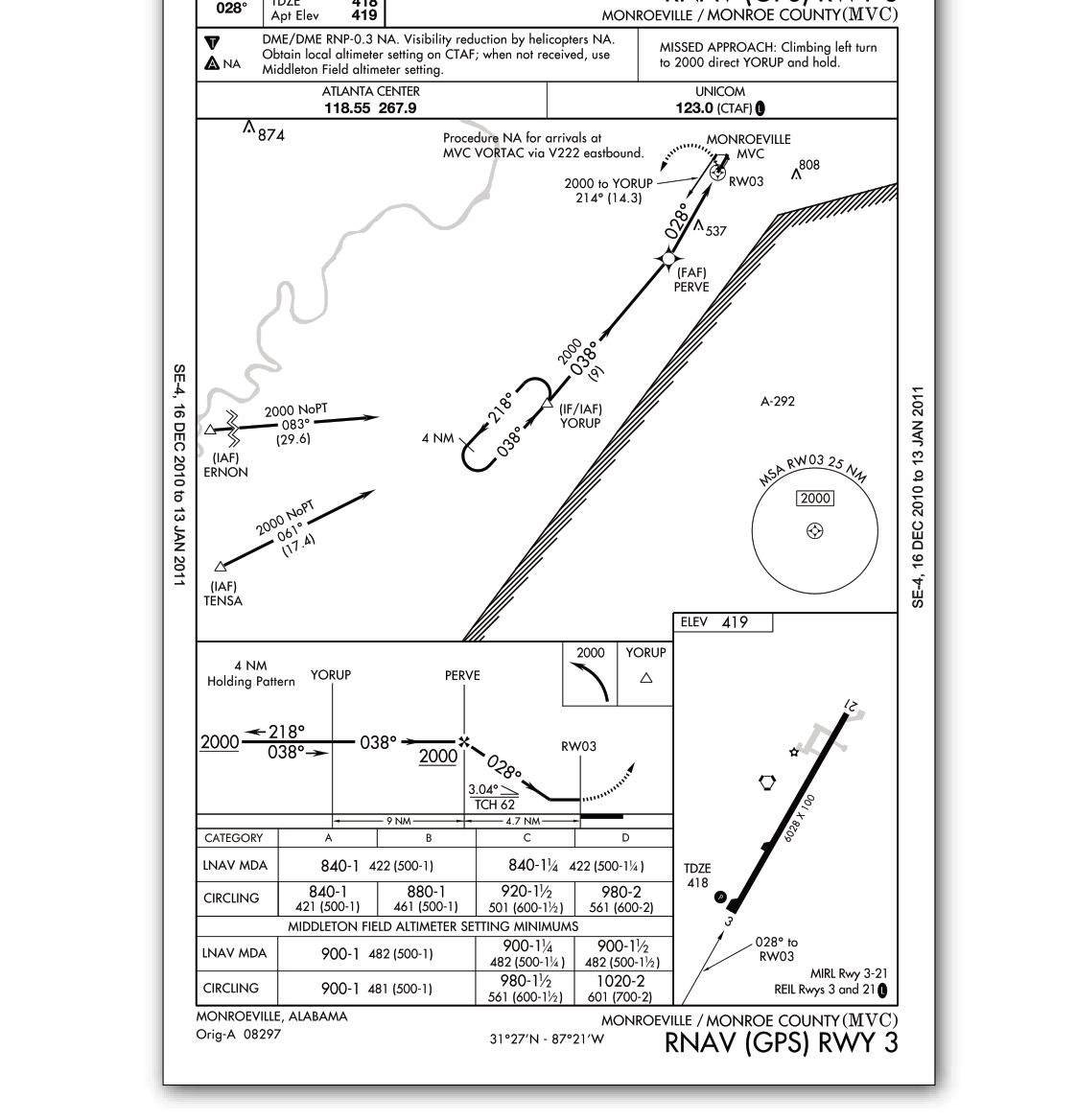
A non-precision approach provides lateral guidance but no electronic glidepath (LOC, VOR, RNAV/LNAV, etc.). You descend in steps to a minimum descent altitude (MDA), level at MDA, and continue to the missed approach point (MAP); you may descend below MDA only with the required visual references in sight. Many RNAV approaches offer an advisory glidepath (LNAV+V) to fly a stabilized descent.
Step by step
- 1Brief the approach: final approach course, step-down fixes, MDA, the MAP (and how it is identified — fix, time, or distance), and the missed approach.
- 2Configure and slow before the final approach fix; complete the approach checklist.
- 3Track the final approach course (LOC/VOR/GPS), keeping the CDI centered with wind correction.
- 4At the FAF, descend toward MDA — either as a continuous descent (CDFA, preferred) or via step-downs, respecting every minimum crossing altitude.
- 5Level off at MDA (do not go below) and continue toward the MAP, looking for the runway environment.
- 6If you reach the MAP without the required visual references, execute the published missed approach immediately.
- 7If you have the runway environment in sight in time to make a normal descent, continue to land.
Tips & common errors
- Fly a constant-angle (CDFA) descent when able — it is more stabilized and safer than dive-and-drive step-downs.
- Do not descend below MDA, and do not go below it until you can see the required references and can make a normal landing.
- Know exactly how the MAP is identified (time, DME, or GPS) before you start down.
- Common error: descending below a step-down altitude early, or busting MDA.
ACS completion standards
The commonly-tested tolerances for this maneuver. Always confirm the current ACS for your certificate.
- Track the final approach course within ¾-scale CDI deflection.
- Maintain MDA within +100/-0 feet and airspeed ±10 knots; identify the MAP correctly.
- Continue to land only with the required visual references, or execute the missed approach at the MAP.
FAA source
FAA-S-ACS-8 (Instrument Rating ACS), Task: Non-Precision Approach; Instrument Flying Handbook FAA-H-8083-15, Chapter 11; 14 CFR 91.175.
This is an original, plain-English study summary grounded in the public-domain FAA Airman Certification Standards and FAA handbooks cited above. It is a study aid, not flight instruction, and not a substitute for the official ACS, the handbooks, your aircraft’s POH/AFM, or a certificated flight instructor.
Related maneuvers
- Attitude Instrument Flying & the Instrument ScanAttitude instrument flying is the foundation of all instrument flight: you control the airplane by interpreting the instruments instead of looking outside. You set an attitude on the attitude indicator (control), verify the result on the other instruments (performance), and trim. A disciplined cross-check (scan) prevents fixation and keeps every parameter in tolerance.
- Constant-Airspeed Climbs & DescentsOn instruments you frequently change altitude at a constant airspeed. You set a pitch and power for the desired airspeed, hold it with the scan, and lead the level-off so you roll out exactly on the new altitude and back at cruise airspeed.
- Rate Climbs & Descents (Constant Vertical Speed)Sometimes you must hold a specific vertical speed (for example to meet a crossing restriction or to fly a constant descent rate on an approach). You adjust pitch and power to pin the VSI to a target rate while still controlling airspeed, then lead the level-off.
- Steep Turns (Instrument)On instruments, a steep turn (typically a sustained 45° bank) tests your cross-check and control as the higher bank increases the back-pressure and power needed to hold altitude. With no outside horizon, you must control everything by the attitude indicator and supporting instruments.
Keep studying
Turn maneuver knowledge into a passing checkride
Drill ACS-aligned questions and ask the AI tutor, Ace, anything — free to start, no account needed.
Take a free practice test →