Power-Off 180° Accuracy Approach & Landing
A Commercial maneuver: from a downwind position abeam the intended touchdown point at pattern altitude, you reduce the power to idle and fly a gliding approach — judging the wind and energy — to touch down within a tight tolerance of a specified point, with no power added.
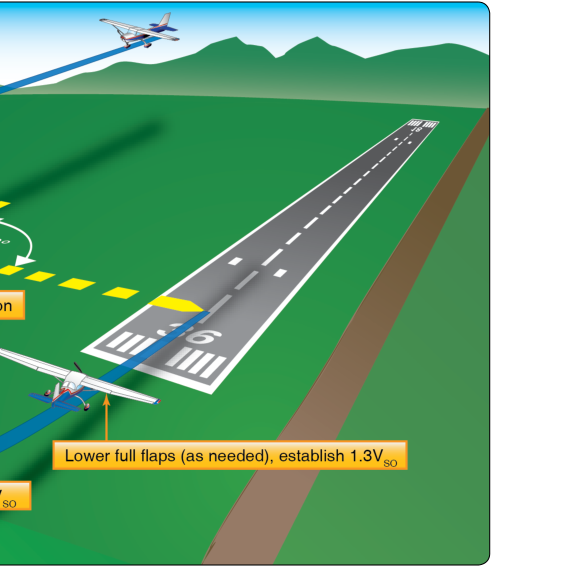
Step by step
- 1On downwind at pattern altitude, abeam the selected touchdown point, reduce throttle to idle and trim for the gliding (best-glide/approach) speed.
- 2Plan the 180° turn from downwind through base to final to arrive at the right energy state — use bank, flaps, slips, and the turn radius to manage glidepath, not power.
- 3Begin the turn to base and judge whether you are high or low: extend or tighten the pattern, add flaps, or slip to lose excess altitude.
- 4Roll onto final aligned with the runway, on a glidepath aimed at the touchdown point, with appropriate flaps for the energy you have.
- 5If high, use additional flaps or a forward slip; if low, stretch the glide only within safe airspeed limits and shallow the descent.
- 6Round out and touch down within the tolerance of the specified point, power at idle the entire time.
- 7Be prepared to go around if the approach cannot safely reach the point.
Tips & common errors
- You manage glidepath with drag (flaps/slips) and geometry (the turn), never with power — power stays at idle.
- Know your airplane’s gliding picture: pick the abeam point and key positions you can repeat.
- Common error: adding flaps too early (undershoot) or too late (overshoot). Stage flaps based on your energy.
- Do not stretch the glide below a safe airspeed trying to reach the point — go around instead.
ACS completion standards
The commonly-tested tolerances for this maneuver. Always confirm the current ACS for your certificate.
- Maintain the recommended approach/glide airspeed ±10 knots with power at idle.
- Touch down at or within 200 feet beyond a specified point, with no side drift and the axis aligned.
- Use proper wind-drift correction and a stabilized, power-off approach.
FAA source
FAA-S-ACS-7 (Commercial Pilot ACS), Task: Power-Off 180° Accuracy Approach and Landing; Airplane Flying Handbook FAA-H-8083-3, Chapter 8.
This is an original, plain-English study summary grounded in the public-domain FAA Airman Certification Standards and FAA handbooks cited above. It is a study aid, not flight instruction, and not a substitute for the official ACS, the handbooks, your aircraft’s POH/AFM, or a certificated flight instructor.
Related maneuvers
- ChandelleA chandelle is a maximum-performance 180° climbing turn that ends at the slowest controllable airspeed with wings level. It demonstrates planning, smooth coordination through changing airspeed and load, and precise control as you trade airspeed for altitude.
- Lazy EightThe lazy eight is a graceful maneuver of two opposite 180° climbing-and-descending turns, with constantly changing bank, pitch, and airspeed. It looks like a wing-tip tracing a slow figure-eight on the horizon and demands continuous, smoothly varying control coordination — no two instants are the same.
- Steep SpiralA steep spiral is a constant-radius gliding turn of at least three 360° turns around a ground reference point, with power at idle. It teaches power-off glide control and wind-drift correction (like a steep spiral down to an emergency landing site) while maintaining a safe, constant airspeed.
- Rectangular CourseThe rectangular course teaches you to fly a constant, equal distance from a square or rectangular ground feature while correcting for wind. It directly simulates the airport traffic pattern, so it builds the division of attention and wind-drift correction you use on every approach.
Keep studying
Turn maneuver knowledge into a passing checkride
Drill ACS-aligned questions and ask the AI tutor, Ace, anything — free to start, no account needed.
Take a free practice test →