The AMT Written Tests Explained: General, Airframe, and Powerplant
Understanding the AMT Written Tests: General, Airframe, and Powerplant
If you're on the path to becoming a certificated Aviation Maintenance Technician (AMT), one of the most important milestones you'll face is passing the FAA written knowledge tests. There are three of them: General, Airframe, and Powerplant. Each exam tests a distinct body of knowledge, and together they form the foundation of your journey toward an FAA Mechanic Certificate. Whether you're enrolled in an Aviation Maintenance Technician School (AMTS) or pursuing the experience-based route, understanding what's on each test—and how to study effectively—makes all the difference.
What Are the AMT Written Tests?
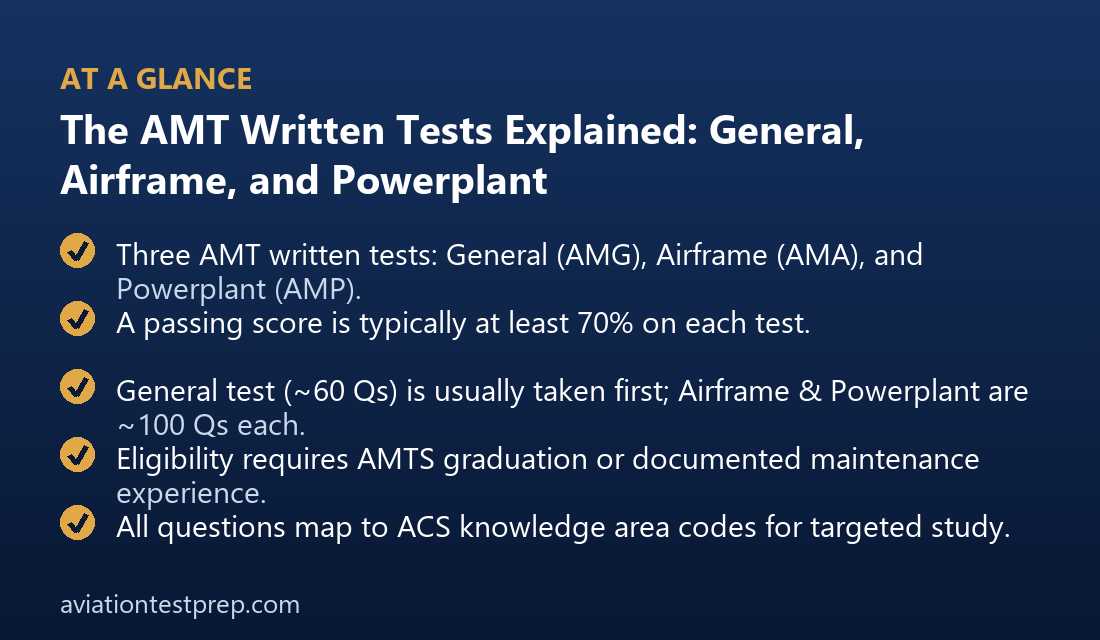
The FAA requires mechanic certificate applicants to demonstrate aeronautical knowledge through written testing. The three AMT written tests are:
- General (AMG) – Covers foundational knowledge that applies to all areas of aircraft maintenance.
- Airframe (AMA) – Focuses on the structural and systems knowledge required to maintain aircraft airframes.
- Powerplant (AMP) – Covers reciprocating and turbine engines, along with related systems.
Most applicants take the General test first, since it establishes the baseline knowledge that supports both the Airframe and Powerplant exams. You can apply for an Airframe certificate, a Powerplant certificate, or both (commonly called an A&P). Depending on your career goals, you may need to pass two or all three written tests.
Who Is Eligible to Take the AMT Written Tests?
Before sitting for the AMT knowledge tests, you'll need to meet FAA eligibility requirements. In general, you must be at least 18 years old to receive a mechanic certificate, though you can take the written tests before reaching that age. You must also be able to read, write, speak, and understand English. Eligibility is established either by graduating from an FAA-approved AMTS program or by documenting practical experience (typically 18 months for one rating or 30 months for both). Always verify current eligibility requirements directly at faa.gov/mechanics, as specifics can change.
Breaking Down Each AMT Written Test
The General Test (AMG)
The General test is the starting point for most AMT candidates. It covers knowledge that transcends any single rating and is fundamental to safe maintenance practice. Key subject areas include:
- Basic electricity and electronics
- Aircraft drawings, blueprints, and technical publications
- Weight and balance calculations
- Fluid lines and fittings
- Aircraft materials, hardware, and processes
- Ground operations and servicing
- Cleaning and corrosion control
- Mathematics and physics as applied to aviation maintenance
- Regulations applicable to maintenance (FAR Part 43, 65, and related parts)
The General test typically consists of around 60 questions, and you'll need a score of at least 70% to pass. However, always verify the current question count and passing threshold with your testing center or at faa.gov, as these details can be updated.
The Airframe Test (AMA)
The Airframe test digs into the structures, systems, and components that make up the non-engine portions of an aircraft. This is a broad and detailed exam covering both wood/fabric construction (still tested!) and modern composite and metal structures. Key subject areas include:
- Aircraft structures (wood, fabric, metal, composite)
- Aircraft systems and components (landing gear, hydraulics, pneumatics)
- Heating and ventilation systems
- Aircraft instrument systems
- Communication and navigation systems
- Aircraft fuel systems
- Position and warning systems
- Ice and rain control systems
- Fire protection systems
The Airframe test is typically around 100 questions. The breadth of material means candidates need a well-organized study plan that addresses systems they may not encounter daily in their training environment.
The Powerplant Test (AMP)
The Powerplant test focuses on aircraft engines—both reciprocating (piston) and turbine—along with all associated systems. Subject areas commonly covered include:
- Reciprocating engine theory and construction
- Turbine engine theory and construction
- Engine inspection and maintenance
- Engine fuel and fuel metering systems
- Induction, exhaust, and cooling systems
- Lubrication systems
- Ignition and starting systems
- Propellers
- Auxiliary power units (APUs)
Like the Airframe test, the Powerplant exam is typically around 100 questions. Engine systems are notoriously technical, and many candidates find the turbine engine sections particularly challenging if their training was focused primarily on piston aircraft.
How the AMT Tests Are Aligned to the ACS
The FAA structures its knowledge tests around Airman Certification Standards (ACS) and knowledge test standards. Each question you encounter can be traced back to a specific knowledge area code. Understanding these codes helps you identify exactly where your study gaps are, rather than guessing which topics to review. Our platform maps every practice question to its ACS code—you can explore that structure at aviationtestprep.com/acs-codes. When you miss a question, you'll know precisely which knowledge area needs more attention.
How to Study for the AMT Written Tests
Passing all three AMT written tests requires a structured, consistent approach. Here's a proven 5-step study method used by successful AMT candidates on our platform:
- Assess your baseline. Take a free practice test to identify your strongest and weakest subject areas before investing time in broad review. Try one now at aviationtestprep.com/free-practice-test.
- Study by subject area. Don't jump randomly between topics. Work through one major subject area at a time—for example, complete all of the electricity questions for the General test before moving to weight and balance.
- Practice with FAA-aligned questions. Our platform features ACS-aligned practice questions designed to mirror the format and content of the actual FAA exams. These are not the FAA's official questions, but they are carefully crafted to prepare you for the real exam experience.
- Use Ace, our AI tutor. When you miss a question or encounter a concept you don't fully understand, Ace can walk you through the reasoning step-by-step, explain the underlying principle, and suggest related topics to review. It's like having a knowledgeable study partner available 24/7.
- Track your progress and review weak areas. Consistent performance tracking lets you see improvement over time and ensures you're spending study time where it matters most. Aim for consistent scores well above 70% before scheduling your actual exam.
Tips Specific to Each Test
For the General test, pay extra attention to electrical theory and regulations. Many candidates underestimate the depth of the regulatory questions on Part 43 and Part 65. For the Airframe test, don't skip the older construction methods (wood, fabric, and dope). They're still on the exam and easy points if you study them. For the Powerplant test, make sure you understand why turbine engines operate the way they do—not just the terminology. Conceptual understanding helps you answer questions you've never seen before.
Scheduling and Taking the AMT Written Tests
AMT knowledge tests are administered at FAA-approved testing centers. You'll need to bring valid identification and, depending on your eligibility path, documentation from your AMTS or logbook records of your maintenance experience. Testing fees are set by the testing vendor and can change, so check directly with your chosen testing center for current pricing. You can find authorized testing centers through the FAA's website.
There is no mandatory waiting period between the three tests, so many candidates schedule them close together to maintain study momentum. However, give yourself adequate preparation time for each—cramming for a 100-question exam the night before rarely produces the results you need.
Start Preparing for Your AMT Written Tests Today
The AMT written tests—General, Airframe, and Powerplant—are challenging, but they're absolutely passable with the right study strategy and quality practice materials. By understanding what each exam covers, mapping your preparation to the ACS knowledge areas, and using tools like our AI tutor Ace, you can walk into the testing center confident and ready. Browse all available AMT practice exams and study resources at aviationtestprep.com/browse-exams, and explore more study tips and guides on our aviation blog.
Ready to find out where you stand? Take a free AMT practice test right now and let Ace guide you toward the score you need.
Ready to pass your FAA written exam?