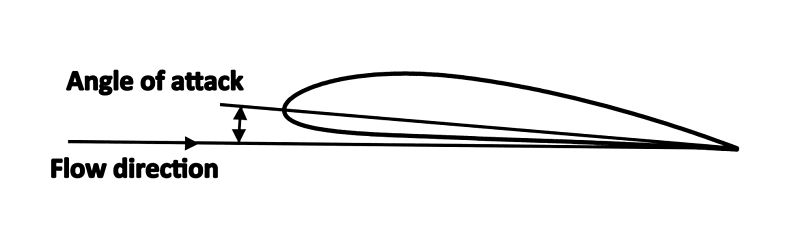
Angle of attack (AOA) is the angle between the chord line of the wing and the relative wind — the direction of the air flowing toward the wing. It is not the same as pitch attitude, which is measured relative to the horizon. An airplane can have a high pitch attitude and a low angle of attack, or a low pitch attitude and a dangerously high angle of attack, depending on its flight path.
Angle of attack and lift
As angle of attack increases, the wing produces more lift — up to a point. Beyond a certain critical angle of attack, the smooth airflow over the upper surface of the wing separates and breaks down, lift decreases rapidly, and the wing stalls. This critical angle is a property of the wing’s shape and does not change with weight, bank, or airspeed.
The key insight
Because the critical angle of attack is fixed, a wing always stalls at the same angle of attack, not at a single fixed airspeed. The airspeed at which a stall occurs changes with weight, load factor, and configuration, but the angle does not. This is why an airplane can stall at a high airspeed in a steep turn or during an abrupt pull-up: the pilot has exceeded the critical angle of attack even though the airspeed is well above the published stall speed for level flight.
Controlling angle of attack
- The pilot controls angle of attack primarily with the elevator. Pulling back raises the nose relative to the relative wind and increases AOA.
- Recovery from a stall is always the same in principle: reduce the angle of attack by lowering the nose to restore smooth airflow over the wing.
Many airplanes provide a stall warning a few knots before the critical angle is reached, and some are equipped with an angle-of-attack indicator that shows AOA directly rather than inferring it from airspeed.