Under 14 CFR Part 121, air carriers operating large aircraft in scheduled or supplemental service carry a dual obligation before every departure: deliver a complete passenger safety briefing and staff the cabin with a minimum number of qualified flight attendants. Both requirements exist for the same fundamental reason — to maximize the probability that every occupant survives a survivable accident. The ATP knowledge exam tests these rules in precise detail, so a surface-level reading of the regulation is not enough. You need to understand the exact content requirements, the timing rules, the staffing thresholds, and the reasoning behind each element.
Regulatory Foundation
Passenger safety briefing requirements for domestic, flag, and supplemental operations under Part 121 are codified primarily in 14 CFR §121.571. Minimum flight attendant staffing is addressed in 14 CFR §121.391. Together, these two sections form the backbone of cabin safety compliance for certificated air carriers. Both sections apply to the certificate holder — the airline — not just to individual crew members, so violations expose the carrier to certificate action as well as civil penalties.
Required Passenger Safety Briefing: Content and Delivery
Section 121.571 mandates that, before each takeoff, the certificate holder must ensure every passenger receives a briefing that covers a specific list of items. The regulation is explicit: the briefing must be completed before the aircraft moves for takeoff. This is not a suggestion about the taxi phase; it means the full briefing must be delivered before the aircraft begins its takeoff roll.
Required Briefing Elements
- Seat belt operation: Passengers must be shown how to fasten, adjust, and unfasten their seat belts. This sounds basic, but the regulation specifies all three actions because unfastening quickly in an emergency is just as critical as fastening before takeoff.
- Smoking rules: The applicable smoking prohibition or restriction for that specific flight must be stated. Under 14 CFR §121.317 and related DOT rules, smoking is prohibited on virtually all domestic flights, but the briefing must still reference the rule in force.
- Location of emergency exits: Each exit must be identified. On larger aircraft with multiple exit types, the briefing must address all of them. Passengers seated far from the nearest exit have been shown to fare worse in evacuations when they are unaware of alternatives.
- Emergency flotation equipment — overwater operations: When the flight involves overwater segments as defined by the applicable operations specifications, the location and use of flotation equipment (life vests or flotation seat cushions, if equipped) must be demonstrated or described. This item is conditional — it applies only to overwater operations, not universally to every flight.
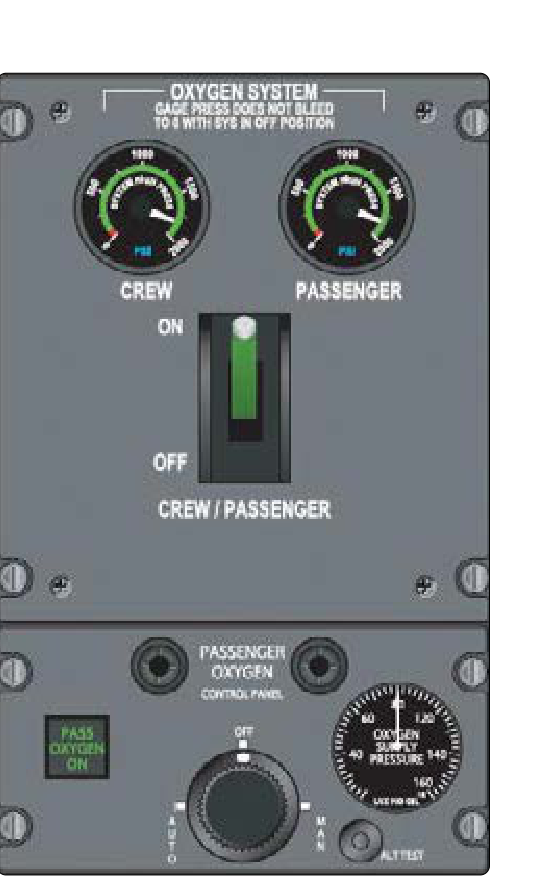
- Passenger oxygen equipment: The location and use of passenger oxygen masks must be covered, including the instruction to don and adjust one's own mask before assisting others — a point that is frequently misunderstood by passengers.
- Carry-on baggage stowage: Passengers must be informed of when and how carry-on items must be properly stowed, because improperly stowed bags become projectiles in turbulence and can block aisle evacuation paths.
- Portable electronic device (PED) restrictions: Passengers must be informed of any applicable restrictions on the use of PEDs. The specific restriction depends on the carrier's operations specifications and FAA-accepted PED policy.
- Passenger safety information card: Passengers must be directed to the safety card in their seat pocket and advised to read it. The card serves as a reference that reinforces the oral or video briefing.
Delivery Methods
The briefing may be delivered by a crew member orally, by an FAA-approved video presentation, or by a combination of both. Many major carriers use pre-recorded video systems, which satisfies the regulation provided the system has been approved and the content meets §121.571 requirements. Regardless of the delivery method, a crew member must be available to answer questions and must visually verify that passengers are attending to the briefing. Simply pressing play on a video and walking away is not sufficient compliance.
Minimum Cabin Crew Requirements Under §121.391
Flight attendant staffing minimums under §121.391 are tied directly to the aircraft's passenger seating configuration — meaning the number of passenger seats installed in the aircraft, not the number of revenue passengers actually on board for a given departure. This distinction is critical and is a frequent source of test errors.
The Staffing Thresholds
- More than 9 but not more than 50 passenger seats: At least one flight attendant is required.
- More than 50 but not more than 100 passenger seats: At least two flight attendants are required.
- More than 100 passenger seats: At least two flight attendants, plus one additional flight attendant for each unit — or part of a unit — of 50 passenger seats above 100. So an aircraft with 101–150 seats requires three; 151–200 requires four; 201–250 requires five; and so forth.
The phrase part of a unit is important. An aircraft configured with 151 seats requires four flight attendants — not three — because the single seat above 150 constitutes a partial unit of 50 that still triggers an additional required crew member. Exam questions often exploit this rounding-up rule with numbers like 151, 201, or 251.
Why Configuration, Not Load
The rationale for basing minimums on seating configuration rather than actual passenger load is straightforward: the number of exits and the physical dimensions of the cabin do not change based on how many passengers are seated. An aircraft with 60 installed seats has the same evacuation geometry whether 10 or 60 passengers are on board. The minimum crew requirement reflects the evacuation demand of the worst-case scenario — a full aircraft — not the most convenient or economical scenario for a given flight.
Flight Attendants as Required Crewmembers
When §121.391 mandates flight attendant presence, those individuals become required crewmembers under Part 121. This is not a semantic distinction. Required crewmember status means flight attendants are subject to the duty time and rest requirements applicable to crewmembers, carry authority to enforce regulations in the cabin under 14 CFR §121.575 and related sections, and cannot be removed from a flight without creating a regulatory violation. Airlines cannot substitute an additional passenger service agent for a required flight attendant, nor can they waive the minimum because the flight is lightly loaded.
Key Numbers and Rules
- Briefing must be complete before the aircraft begins the takeoff roll — not at cruise, not during taxi.
- Flotation equipment briefing is required only for overwater operations — not for all Part 121 flights.
- Staffing minimums use configured seats: 9 seats or fewer — no flight attendant required by §121.391; 10–50 seats — one required; 51–100 — two; 101+ — two plus one per 50 seats (or fraction) above 100.
- Flight attendants who are required by §121.391 are required crewmembers with full regulatory status.
Common Test Traps
- Lightly loaded aircraft: If a question describes a 737 with 120 configured seats carrying only 22 passengers, the minimum flight attendant requirement is still three — based on configuration, not load.
- Briefing timing: The briefing must be completed before takeoff begins, not simply before the aircraft leaves the gate. Questions sometimes insert language like "during initial climb" or "before pushback" to mislead.
- Overwater flotation — applying it universally: Flotation equipment briefing applies only when the flight involves overwater operations. Do not select it as a required element on a purely domestic, overland route.
- Fraction-of-50 rounding: Any fraction of the 50-seat increment above 100 requires an additional flight attendant. An aircraft with 151 seats needs four attendants, not three.
- Video vs. live briefing equivalence: An approved video briefing satisfies §121.571, but unapproved or incomplete video content does not. Knowing the regulation allows a video option prevents you from marking "video is prohibited" on an exam question.