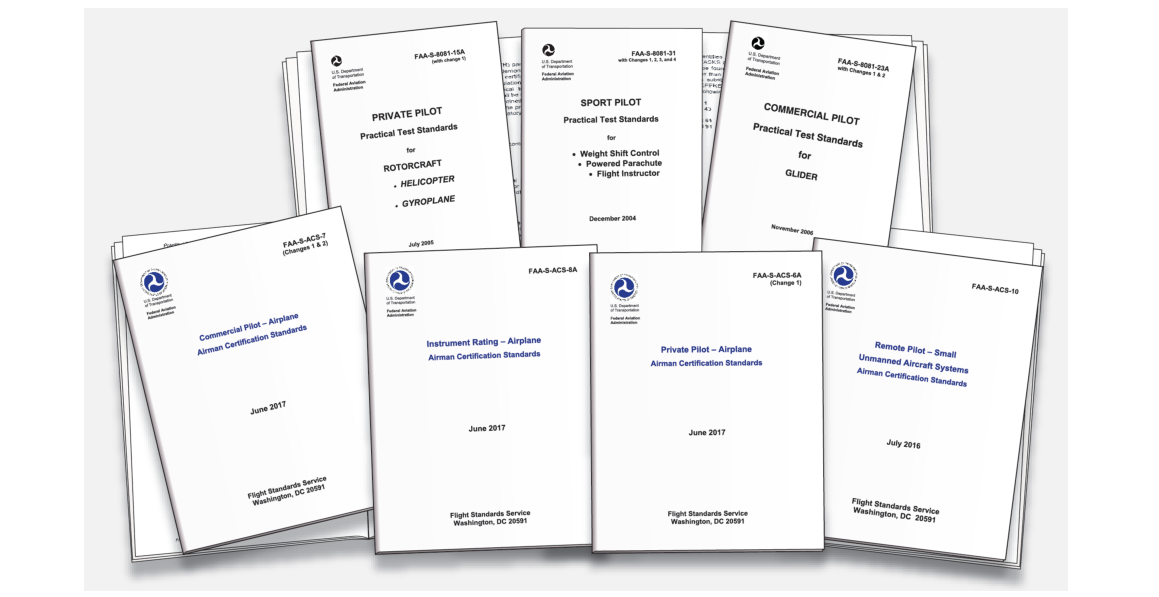
The Airline Transport Pilot (ATP) certificate is the pinnacle of FAA airman certification, and earning it demands more than flying skill. It demands a thorough command of regulations, aeronautical decision-making, crew resource management, and the specific performance standards codified in the FAA's Airman Certification Standards (ACS) — the document that defines exactly what an examiner will evaluate on your ATP checkride. For the multiengine airplane ATP, the FAA has fully transitioned from the older Practical Test Standards (PTS) format to the ACS format, integrating knowledge, risk management, and skill into a single unified framework. Understanding the architecture of this document, why it was redesigned, and how examiners apply it in an air carrier context is not background noise — it is core exam preparation.
From PTS to ACS: Why the Change Matters
The traditional PTS evaluated pilots primarily on skill: could you hold altitude within ±100 feet, intercept a radial within a specified tolerance, or execute a missed approach at the correct point? Those tolerances still exist in the ACS, but the old PTS left an important gap. A pilot could execute a maneuver mechanically while having no understanding of the aeronautical decision-making context behind it — a dangerous profile for someone who will soon occupy the left seat of a transport-category aircraft carrying revenue passengers.
The ACS closes that gap by adding two explicit evaluation columns alongside skill: knowledge and risk management. Every Task in the ACS requires the applicant to demonstrate all three elements to an acceptable standard. An examiner cannot simply watch your hands; they must also probe your understanding of why the procedure exists and how you would identify, assess, and mitigate the hazards associated with it. This three-part standard reflects the operational reality of Part 121 air carrier flying, where Crew Resource Management (CRM), threat and error management (TEM), and systems knowledge are as mission-critical as stick-and-rudder precision.
Structure of the ATP ACS
The ATP ACS is organized into Areas of Operation, each subdivided into individual Tasks. For the multiengine airplane, representative Areas of Operation include: Preflight Preparation; Preflight Procedures; Takeoff and Departure Phase; Inflight Maneuvers; Instrument Procedures; Landings and Approaches to Landings; Normal and Abnormal Procedures; Emergency Procedures; Postflight Procedures; and Crew Resource Management. CRM is not siloed as a single scored section — it is threaded through every Area of Operation, and an examiner assesses communication, task prioritization, situational awareness, and leadership continuously from the pre-brief through engine shutdown.
Within each Task, the three evaluation columns appear as: K (Knowledge), R (Risk Management), and S (Skills). The Knowledge column identifies the concepts, regulations, and aeronautical principles the applicant must be able to explain or apply. The Risk Management column identifies the hazards, threats, and errors associated with the Task that the applicant must demonstrate awareness of and mitigation strategies for. The Skills column lists the observable, measurable actions the applicant must perform to the stated tolerances. All three are graded equally — overlooking the R column because it is harder to quantify than airspeed tolerances is one of the most common checkride preparation mistakes at the ATP level.
Regulatory Foundation and Eligibility
The ATP certificate and its prerequisites are governed primarily by 14 CFR Part 61, Subpart G. For a first-time ATP multiengine airplane applicant, the regulation imposes several layered prerequisites beyond flight hours:
- ATP Certification Training Program (ATP-CTP): Required before an applicant may take the ATP multiengine airplane knowledge test. The ATP-CTP is an FAA-approved training program that includes a minimum of 30 hours of ground training and 10 hours of flight training (which may include flight simulation training device hours). It introduces applicants to the aerodynamics of transport-category aircraft, including upset prevention and recovery training (UPRT), automation management, and high-altitude operations — subject matter not required at the commercial certificate level.
- Knowledge test passing score: Applicants must achieve a score of 70 percent or higher on the ATP Airplane knowledge test. The test covers a broad spectrum: regulations (Parts 61, 91, 121, 135), meteorology, aerodynamics, aircraft systems, flight planning, and instrument procedures, all at a depth commensurate with air carrier operations.
- Flight experience minimums: Under 14 CFR §61.159, the standard requirement is 1,500 hours total time, including 500 hours of cross-country, 100 hours of night, 75 hours of instrument time, and 250 hours as pilot in command (which may include certain second-in-command time). Reduced minimums — as low as 1,000 hours for graduates of certain four-year aviation degree programs or 1,250 hours for graduates of approved two-year programs — exist under §61.160.
- Medical certificate: An ATP certificate requires a first-class FAA medical certificate, issued under 14 CFR Part 67, to exercise ATP privileges.
Grading, Task Failure, and Retest Scope
One of the most consequential structural features of the ATP ACS is its grading logic. Each Task receives either a satisfactory or unsatisfactory grade. A single unsatisfactory grade on any Task renders the entire practical test unsatisfactory — there is no averaging across Tasks or Areas. This is called a Task failure.
When a Task failure occurs, the applicant must return for a retest. However, the retest does not automatically cover only the failed Task. Under FAA policy, the examiner has authority to include on the retest any Area of Operation that is logically connected to the failed Task. For example, a failure in the Instrument Procedures Area due to poor decision-making about weather minimums might prompt an examiner to include Preflight Preparation and Risk Management elements on the retest. This interconnected grading philosophy is intentional: it reflects the systemic nature of air carrier operations, where a breakdown in one phase of flight is rarely isolated from the others.
Examiners conducting ATP practical tests are held to the same ACS document. They may not introduce tasks, tolerances, or evaluation criteria outside the ACS, nor may they arbitrarily expand a retest beyond Tasks that are logically connected to the failure. Knowing this protects applicants and creates predictability — everything that can be tested is in the ACS.
Key Numbers and Rules
- ATP-CTP: minimum 30 hours ground + 10 hours flight/simulation training, FAA-approved
- Knowledge test minimum passing score: 70%
- Standard total time minimum: 1,500 hours (reduced paths available under §61.160)
- Instrument time requirement: 75 hours (actual or simulated) under §61.159
- Night time requirement: 100 hours
- PIC time requirement: 250 hours (certain SIC time may be credited)
- Cross-country requirement: 500 hours
- Medical: first-class required to exercise ATP privileges
Common Test Traps
- Studying only skill tolerances: Many applicants memorize ±100 feet altitude and ±5 knots airspeed tolerances while giving no attention to Risk Management column items. An examiner can fail a Task based entirely on inadequate risk identification, even if the maneuver was flown perfectly.
- Confusing PTS with ACS: The ATP multiengine airplane checkride is governed by the ACS. The older PTS may still govern some certificate or rating combinations, but using the wrong document for your specific checkride is a preparation error with real consequences.
- Underestimating CRM evaluation: CRM is not a standalone oral question — it is assessed through every exchange with the examiner, every callout, every resource you use or fail to use. Silence when an anomaly appears can itself constitute a CRM failure.
- Assuming a knowledge test score exempts ATP-CTP: The ATP-CTP is a prerequisite to sitting for the knowledge test, not a consequence of passing it. Scheduling the knowledge test without an ATP-CTP completion certificate is a regulatory violation under Part 61.
- Overlooking the retest scope: Applicants sometimes prepare only the failed Task for the retest. Because the examiner may expand scope to logically connected Areas, the correct preparation strategy after a partial failure is to re-review the entire ACS.
Memory Aid
The ACS evaluation columns form a three-legged stool: Knowledge, Risk Management, Skill — KRS. Every leg must bear equal weight. A stool missing one leg does not partially stand; it falls. An ATP applicant who can fly precisely but cannot articulate hazard identification or regulatory authority has a missing leg — and the examiner will find it.