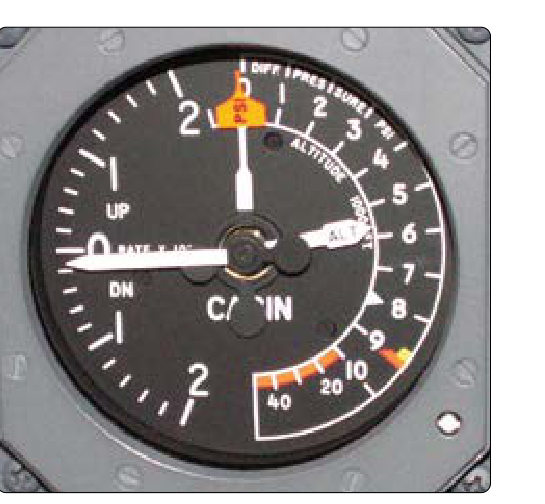
When a pressurized aircraft climbs to cruise altitude, the cabin is not left at the ambient outside pressure — that would be instantly incapacitating for occupants. Instead, the pressurization system pumps bleed air into the fuselage and regulates an outflow valve so that the interior pressure stays well above the ambient value outside. The result is that occupants breathe air equivalent to a much lower altitude than the aircraft's actual flight level. That interior pressure condition, expressed as an altitude, is called the cabin altitude. Understanding how cabin altitude is established, how it is calculated, and why the related concept of equivalent cabin altitude (ECA) matters is essential knowledge for any aviation maintenance technician working on environmental and pressurization systems — and it is tested directly on the FAA AMT Airframe knowledge examination.
This article walks through the physics of aircraft pressurization, the step-by-step calculations you will encounter on the exam, physiological thresholds that drive regulatory limits, and the common errors students make when working through cabin altitude problems.
How Pressurization Works
Aircraft pressurization systems use engine bleed air (or, on some modern designs, electrically driven compressors) to continuously supply conditioned air to the cabin. An outflow valve — usually located near the aft pressure bulkhead — exhausts a controlled amount of that air overboard. By varying how much air leaves, the system controller maintains a preset differential pressure, which is simply the difference between cabin interior pressure and the outside ambient pressure at cruise altitude.
Differential pressure is typically expressed in pounds per square inch differential (psid) or sometimes in inches of mercury. Transport-category aircraft commonly maintain a maximum differential of roughly 8.6 to 9.0 psid, depending on the airframe design limit. That value is not arbitrary — it represents the maximum structural load the pressurized fuselage skin, frames, and bulkheads are certified to carry continuously. Exceeding it can cause fatigue cracking over repeated cycles; sudden exceedance could rupture the structure entirely.
Standard sea-level atmospheric pressure is 29.92 in Hg (14.696 psi). At a typical jet cruise altitude of FL350 (35,000 feet), ambient pressure drops to approximately 7.04 in Hg (3.46 psia). If the system maintains 8.6 psid, the cabin pressure is 3.46 + 8.6 ≈ 12.06 psia. Converting that back to altitude using the standard atmosphere table, 12.06 psia corresponds to roughly 2,000 to 3,000 feet cabin altitude. That is why passengers on a typical airliner feel as if they are sitting at a mountain city, not at the edge of the stratosphere.
Calculating Cabin Altitude
The fundamental relationship used in cabin altitude problems is drawn from the International Standard Atmosphere (ISA) and its associated pressure-altitude tables, which appear in the FAA's Aviation Maintenance Technician Handbook — Airframe (FAA-H-8083-31) as well as in the Pilot's Handbook of Aeronautical Knowledge (FAA-H-8083-25). The process follows these steps:
- Identify the aircraft's pressure altitude (flight level). Read the actual flight altitude in feet or find the ambient pressure in psia from a standard atmosphere table.
- Identify the maximum differential pressure limit. This is a certified airframe limit found in the Aircraft Flight Manual (AFM) or maintenance manual — typically expressed in psid.
- Calculate cabin absolute pressure. Add ambient absolute pressure (psia at cruise altitude) to the differential pressure limit: Pcabin = Pambient + ΔP.
- Convert cabin absolute pressure back to altitude. Using the standard atmosphere table, find which altitude corresponds to the computed cabin pressure. That altitude is your cabin altitude.
Example: An aircraft cruises at FL380 (38,000 ft). Standard atmosphere gives ambient pressure at 38,000 ft as approximately 2.87 psia. The aircraft's maximum differential is 8.77 psid. Cabin pressure = 2.87 + 8.77 = 11.64 psia. Looking up 11.64 psia in a standard atmosphere table yields a pressure altitude of approximately 5,000 feet. So occupants effectively breathe air equivalent to 5,000 ft MSL — well within comfortable limits.
Equivalent Cabin Altitude (ECA)
Equivalent cabin altitude is a closely related but slightly different concept. While cabin altitude simply describes the current interior pressure expressed as an altitude, ECA is specifically used when evaluating what the occupants physiologically experience relative to standard atmospheric conditions — particularly for oxygen requirement determinations and for situations where the cabin atmosphere differs from standard air (for instance, enriched oxygen or nitrogen atmospheres in test environments). In most practical AMT exam contexts, cabin altitude and equivalent cabin altitude are calculated by the same method: finding the standard-atmosphere altitude that matches the measured or computed cabin absolute pressure.
Where ECA becomes distinctly important is in the evaluation of unpressurized or partially pressurized flight. If a pressurization system partially fails and cabin altitude climbs above normal limits, the technician or crew must determine the ECA to assess whether supplemental oxygen is required and for how long safe consciousness can be maintained — a concept related to Time of Useful Consciousness (TUC). The FAA's Aviation Maintenance Technician Handbook references these physiological thresholds as the basis for regulatory requirements found in 14 CFR Part 91 and Part 25.
Key Numbers and Rules
- Sea-level pressure: 29.92 in Hg / 14.696 psia — the baseline for all pressure-altitude conversions.
- Maximum cabin altitude for transport operations (14 CFR Part 25.841): The cabin altitude must not exceed 8,000 feet under normal operating conditions. At this altitude, healthy passengers are comfortable without supplemental oxygen.
- Supplemental oxygen requirement (14 CFR 91.211): Required minimum flight crew must use supplemental oxygen for that part of the flight at cabin pressure altitudes above 12,500 feet MSL up to and including 14,000 feet MSL that is of more than 30 minutes duration, and at all times when cabin pressure altitude exceeds 14,000 feet MSL. Above 15,000 feet MSL cabin pressure altitude, each occupant of the aircraft must be provided with supplemental oxygen.
- Rapid decompression / maximum differential: Typical transport jets are certified to approximately 8.6–9.0 psid maximum differential. The maintenance manual states the exact limit for each airframe type.
- Time of Useful Consciousness (TUC): At 25,000 feet, TUC is roughly 3–5 minutes; at 40,000 feet, it drops to 15–20 seconds. While TUC itself is not directly calculated on the AMT exam, understanding it explains why 8,000-foot cabin altitude limits exist.
- Isobaric vs. differential control modes: In isobaric mode, the system holds cabin altitude constant (a fixed pressure) regardless of aircraft climb — until the differential limit is reached, at which point it switches to differential mode and cabin altitude climbs slowly with the aircraft.
Why It Matters for AMT Work
Aircraft pressurization system maintenance directly impacts passenger and crew safety at high altitudes. A leaking door seal, a faulty outflow valve, or an incorrectly calibrated cabin pressure controller can allow cabin altitude to climb unnoticed until occupants experience hypoxia. As an AMT, you must be able to verify that the system is performing within its certified envelope by reading cabin altitude indicators, cross-checking with differential pressure gauges, and confirming that automatic safety systems (such as positive-pressure relief valves, negative-pressure relief valves, and dump valves) are functional and correctly set.
Cabin altitude calculations are also used during pressurization system functional tests performed after maintenance. Ground leak checks pressurize the cabin to a specific differential and hold it, verifying the structure and seals maintain pressure within acceptable decay limits. The technician must calculate the expected cabin altitude equivalent to the test pressure to confirm correct instrument indications.
Common Test Traps
- Confusing absolute pressure with differential pressure. The exam often gives you ambient pressure and a differential, expecting you to add them to get cabin absolute pressure before converting to altitude. Forgetting the addition step produces a wildly wrong cabin altitude.
- Using gauge pressure instead of absolute pressure. All standard-atmosphere conversions require absolute pressure (psia). Differential pressure by itself cannot be looked up in an altitude table.
- Misreading the standard atmosphere table direction. Higher altitudes have lower pressures. If your computed cabin pressure is higher than sea-level pressure (which never happens in normal operations), you have made an arithmetic error.
- Assuming cabin altitude equals flight altitude. A common distractor answer on the exam sets cabin altitude equal to the aircraft's cruise altitude. Remember: the whole point of pressurization is that cabin altitude is far lower than flight altitude.
- Ignoring the 8,000-foot regulatory limit. Exam questions sometimes describe a scenario where cabin altitude is given as 10,000 feet and ask whether a system is operating normally. That value exceeds the Part 25 limit, which should trigger corrective action — not be accepted as routine.