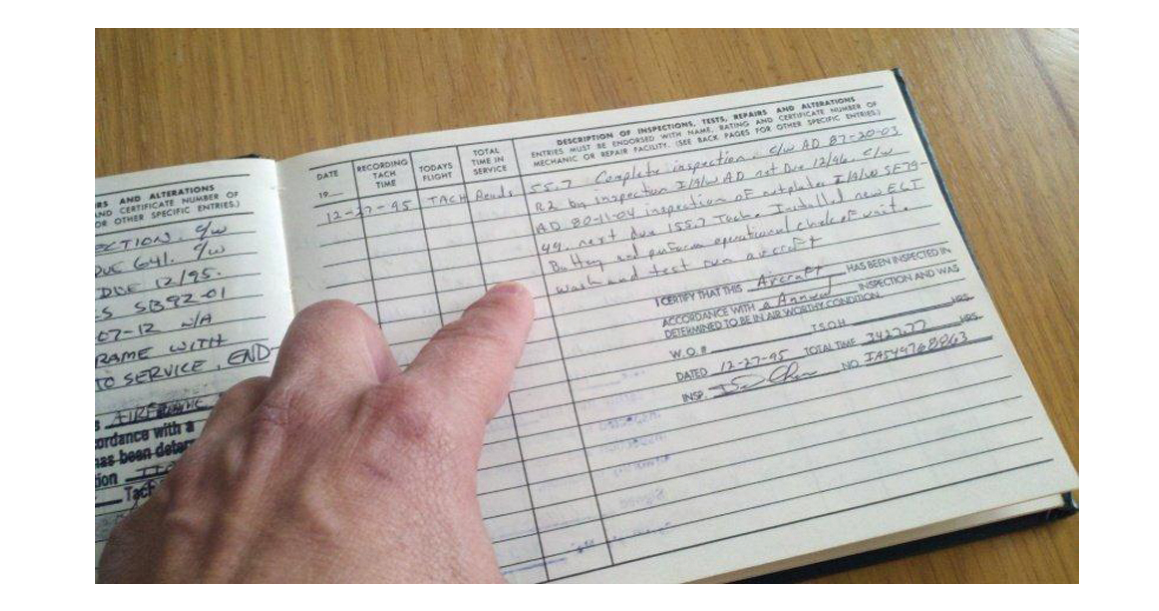
Every time a certificated mechanic completes maintenance, a preventive maintenance task, a repair, or an alteration on an aircraft, engine, propeller, or appliance, the job is not finished until a proper record is made and the aircraft is officially returned to service. This is not a paperwork formality — it is a legal requirement under 14 CFR Part 43 and a cornerstone of the entire airworthiness system. Without a valid logbook signoff, the work performed has no legal standing, and the aircraft may not be legally flown. Understanding exactly what the regulations require, and why each element exists, is essential knowledge for any AMT candidate preparing for the FAA General knowledge test.
This article focuses specifically on the return-to-service (RTS) entry — the written record that closes out a maintenance event — and distinguishes it from the separate approval-for-return-to-service authority. Both concepts are tested on the knowledge exam and, more importantly, both matter every day on the shop floor.
The Regulatory Foundation
14 CFR Part 43 governs the maintenance, preventive maintenance, rebuilding, and alteration of civil aircraft. Within Part 43, two sections are especially relevant to return-to-service entries:
- 14 CFR §43.9 — specifies the content requirements for maintenance records when work is performed by certificated mechanics, repair stations, or manufacturers.
- 14 CFR §43.11 — specifies additional record requirements specifically for inspections, including annual inspections and 100-hour inspections.
Additionally, 14 CFR §43.7 defines who is authorized to approve an aircraft for return to service after maintenance or an inspection. These three sections work together: §43.7 tells you who can sign, §43.9 tells you what that signature must accompany, and §43.11 adds requirements when the work was an inspection. Knowing which section covers which requirement is a common exam focus.
Who Is Authorized to Approve Return to Service (14 CFR §43.7)
Not every person who touches an aircraft can sign it back into service. The FAA limits this authority to specific certificate holders:
- Certificated mechanic with an Airframe rating — may approve for return to service airframe work he or she personally performed or supervised.
- Certificated mechanic with a Powerplant rating — may approve for return to service powerplant work he or she personally performed or supervised.
- Certificated mechanic with Inspection Authorization (IA) — may approve for return to service after an annual inspection or a major repair or major alteration (Form 337 work).
- Certificated repair station — may approve for return to service work within the scope of its certificate and operations specifications (but not an annual inspection).
- Manufacturer — may approve for return to service aircraft it manufactures, under certain conditions (but not an annual inspection).
- Pilot certificate holder (private or higher) — may approve for return to service only the specific preventive maintenance tasks listed in Part 43 Appendix A that he or she personally performed on an aircraft owned or operated by that pilot.
A critical distinction for exam candidates: a mechanic without an IA cannot approve a return to service after an annual inspection, even if that mechanic performed all the physical inspection work. The IA holder must make the RTS entry for annuals. Similarly, a mechanic with only an Airframe rating cannot sign off powerplant work, and vice versa.
Required Content of the Maintenance Record Entry (14 CFR §43.9)
Once authorized to sign, the mechanic must make an entry in the aircraft's maintenance record — typically the airframe logbook, engine logbook, or propeller logbook, depending on what was maintained. Under §43.9(a), every such entry must contain six specific elements:
- Description of work performed — enough detail that someone reading the record later can determine exactly what was done. Vague entries like "repaired engine" do not satisfy the regulation. Reference to a manufacturer's maintenance manual, a work order, or a technical data document attached to or referenced in the record is an acceptable way to provide sufficient detail.
- Date of completion — the calendar date the work was completed, not the date it was started.
- Name of the person performing the work — the individual who did the work, which may differ from the person approving for return to service when a certificated mechanic supervised others.
- Certificate number of the approving person — the FAA certificate number of the person making the RTS entry (not necessarily the person who performed the work, if different).
- Certificate type of the approving person — for example, "A&P Mechanic" or "IA."
- Signature of the approving person — a handwritten or, where permitted, electronic signature confirming the entry's accuracy and the approval for return to service.
Notice that the regulation requires both who performed the work and who approved the return to service. When both are the same individual — as is common — the entry satisfies both requirements simultaneously. When a senior mechanic supervised apprentices or unlicensed assistants, the certificated mechanic is still the one who signs, but the entry should be clear about who physically performed the task.
Additional Requirements for Inspections (14 CFR §43.11)
When the maintenance event is a required inspection — an annual inspection, a 100-hour inspection, or a progressive inspection — §43.11 adds important requirements beyond the §43.9 baseline.
For an annual or 100-hour inspection that is approved for return to service, the entry must include a statement that the aircraft has been inspected in accordance with the applicable inspection and was found to be in airworthy condition. Specifically, it must reference the type of inspection (e.g., annual inspection IAW 14 CFR §91.409) and affirm airworthiness.
If the inspecting mechanic or IA holder finds the aircraft not airworthy — that is, discrepancies exist that prevent approval — a different entry is required: a list of discrepancies and unairworthy items must be provided to the aircraft owner or operator. The aircraft is not approved for return to service, and the record reflects this. The owner then decides whether to have the discrepancies corrected before the next flight or, in limited circumstances, ferry the aircraft to a maintenance facility under a special flight permit (ferry permit) issued under 14 CFR §21.197.
Major Repairs and Alterations: FAA Form 337
When a mechanic with an IA, a certificated repair station, or a manufacturer performs a major repair or major alteration — as defined in Part 43 Appendix A — the return-to-service process also involves FAA Form 337 (Major Repair and Alteration). The Form 337 serves as both a record of the work and an approval document. It must be completed, signed, and a copy retained in the aircraft records, with another copy sent to the FAA within 48 hours of the aircraft's return to service. Note that a standard A&P mechanic without an IA cannot approve a major repair or major alteration for return to service — that authority belongs to the IA holder, repair station, or manufacturer.
Why the Signoff Matters: Safety and Legal Accountability
The return-to-service entry is far more than a bureaucratic checkbox. It creates a traceable chain of accountability: if an airworthiness problem is later discovered, investigators can identify exactly who performed the work, who approved it, and what they certified. This accountability incentivizes careful work and provides legal protection when work was performed correctly. Conversely, a mechanic who signs off work that was never performed, or who approves work beyond his or her rating, faces certificate action and potential criminal liability. The logbook is a legal document — falsification is a federal offense.
From a practical standpoint, aircraft logbooks travel with the aircraft and are reviewed during every subsequent annual inspection, during aircraft sales, and by the FAA during ramp inspections. A missing entry, an incomplete entry, or an entry signed by someone without the proper authority can ground an aircraft and create significant legal exposure for the owner, the operator, and the mechanic involved.
Key Numbers and Rules
- A mechanic without an IA cannot approve return to service after an annual inspection, regardless of ratings held.
- The six required elements of a §43.9 maintenance entry: description of work, date of completion, name of person performing work, certificate number, certificate type, and signature of approving person.
- Form 337 copy must be submitted to the FAA within 48 hours of return to service for major repairs and major alterations.
- A pilot may sign off only the preventive maintenance tasks listed in Part 43 Appendix A — no other maintenance.
- An entry listing discrepancies (rather than approving airworthiness) satisfies the inspection record requirement when the aircraft cannot be approved for return to service.
- Record requirements apply to all civil aircraft subject to Part 43, including amateur-built aircraft for which the builder holds a repairman certificate, within the scope of that certificate.
Common Test Traps
- Confusing §43.9 and §43.11: §43.9 covers all maintenance entries; §43.11 covers inspections specifically. The exam may ask which section governs a 100-hour inspection entry — that is §43.11 (plus §43.9 for baseline content).
- Assuming any A&P can sign off an annual: Only a mechanic holding an Inspection Authorization (IA) can approve return to service after an annual inspection. A plain A&P cannot, even if highly experienced, and repair stations/manufacturers are also not authorized to sign off annuals.
- Missing one of the six required entry elements: The exam may present a sample logbook entry and ask whether it is complete. Check for all six elements — description, date, performer's name, certificate number, certificate type, and signature.
- Misidentifying who performs vs. who approves: The mechanic who did the work and the mechanic who approves the RTS can be different individuals. The certificate number and signature on the entry belong to the approving person, but the performer's name must also appear.
- Forgetting the Form 337 filing deadline: Candidates sometimes know that a 337 is required for major work but forget the 48-hour submission window to the FAA. This is a specifically testable detail.