Go-Around / Rejected Landing
A go-around (rejected landing) is the decision to abandon an approach and climb away. The priority order is power, pitch, configuration — add full power, arrest the descent and establish a climb, then clean up the airplane in stages while tracking the runway.
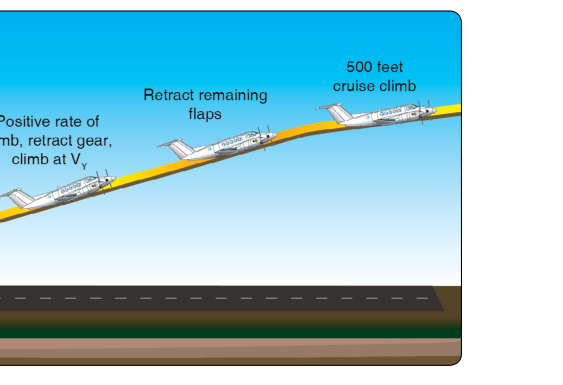
Step by step
- 1Decide early and commit: at any sign of an unsafe or unstable approach, initiate the go-around without hesitation.
- 2Apply full power smoothly and promptly.
- 3Pitch to arrest the descent and establish a positive climb attitude (Vx or Vy as appropriate for obstacles).
- 4Retract flaps in stages per the POH — typically a partial retraction first to reduce drag without sinking.
- 5Once a positive rate of climb is confirmed, retract the landing gear (if retractable).
- 6Offset to the side of the runway as needed to keep traffic and the runway in sight.
- 7Trim, continue the climb at the appropriate speed, retract remaining flaps, and re-enter the pattern.
Tips & common errors
- Power, Pitch, Configuration — in that order. Retracting all the flaps at once near the ground can cause a dangerous sink.
- Expect a strong pitch-up and left-turning tendency when full power is applied; lead with right rudder and forward pressure.
- Common error: indecision — going around late wastes altitude and energy. Decide and commit.
- Keep the runway/traffic in sight by sidestepping rather than climbing directly over a departing aircraft.
ACS completion standards
The commonly-tested tolerances for this maneuver. Always confirm the current ACS for your certificate.
- Make a timely decision and apply takeoff/maximum power.
- Establish the proper climb attitude and airspeed (VX or VY +10/-5 knots as appropriate).
- Retract flaps/gear at the appropriate sequence; maintain centerline/track and coordination.
FAA source
FAA-S-ACS-6 (Private Pilot ACS), Task: Go-Around/Rejected Landing; Airplane Flying Handbook FAA-H-8083-3, Chapter 8.
This is an original, plain-English study summary grounded in the public-domain FAA Airman Certification Standards and FAA handbooks cited above. It is a study aid, not flight instruction, and not a substitute for the official ACS, the handbooks, your aircraft’s POH/AFM, or a certificated flight instructor.
Related maneuvers
- Normal Takeoff & ClimbThe normal takeoff and climb is the baseline departure from a paved runway with little or no wind and no obstacles. You accelerate on the centerline, rotate at the recommended speed, and climb at the best-rate speed (Vy) while staying coordinated.
- Normal Approach & LandingThe normal approach and landing is a stabilized descent to a flare and touchdown on the main wheels at minimum controllable airspeed, with the airplane aligned with and tracking the centerline. Everything else (crosswind, short field, soft field) is a variation on this.
- Crosswind Takeoff & ClimbA crosswind takeoff adds wind from the side. You hold aileron into the wind during the ground roll to keep the upwind wing from rising, then transition to a wind-correction crab once airborne so the airplane tracks the extended centerline.
- Crosswind Approach & LandingIn a crosswind landing you neutralize sideways drift and keep the longitudinal axis aligned with the runway at touchdown. The two common techniques are the crab (corrected to a slip just before touchdown) and the wing-low (sideslip) method held throughout the approach.
Keep studying
Turn maneuver knowledge into a passing checkride
Drill ACS-aligned questions and ask the AI tutor, Ace, anything — free to start, no account needed.
Take a free practice test →