Normal Takeoff & Climb
The normal takeoff and climb is the baseline departure from a paved runway with little or no wind and no obstacles. You accelerate on the centerline, rotate at the recommended speed, and climb at the best-rate speed (Vy) while staying coordinated.
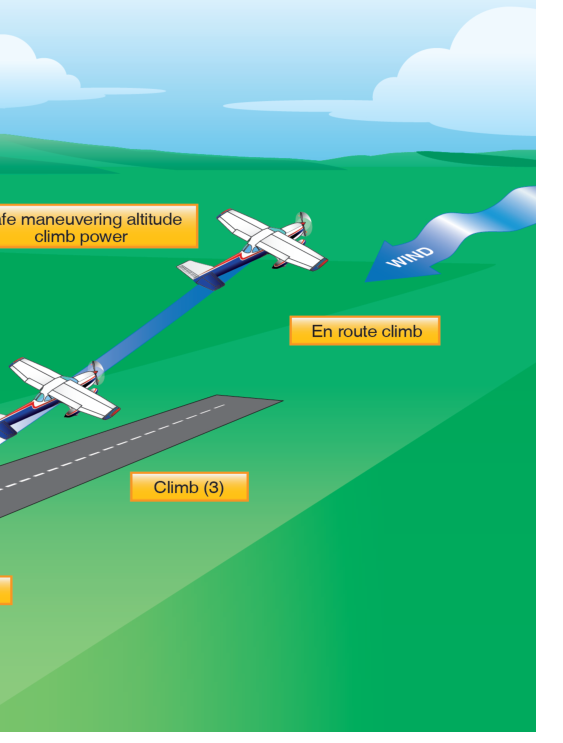
Step by step
- 1Complete the before-takeoff checklist; verify the runway is clear and confirm the correct runway via heading indicator.
- 2Taxi onto the centerline and smoothly advance the throttle to full power, checking RPM/MP and engine instruments in the green.
- 3Maintain directional control with rudder; keep slight back-pressure to reduce nosewheel load as appropriate.
- 4At the manufacturer-recommended rotation speed, smoothly raise the nose to the climb attitude and let the airplane fly off.
- 5Establish and hold the pitch for Vy; retract flaps/gear (if applicable) per the POH after a positive rate of climb.
- 6Maintain runway centerline extended (track) with rudder, staying coordinated with the ball centered.
- 7Trim to relieve control pressure and complete the climb checklist at a safe altitude.
Tips & common errors
- Keep the airplane straight with rudder, not aileron, during the ground roll; expect right rudder to counter left-turning tendencies.
- Rotate smoothly to the known climb attitude rather than chasing the airspeed — pitch + power = performance.
- Common error: over-rotating and settling, or under-rotating and overstressing the nosewheel.
- Trim early; an out-of-trim climb makes precise pitch control much harder.
ACS completion standards
The commonly-tested tolerances for this maneuver. Always confirm the current ACS for your certificate.
- Climb at VY +10/-5 knots.
- Maintain takeoff power and proper pitch attitude; stay coordinated.
- Track the runway centerline and the extended centerline.
FAA source
FAA-S-ACS-6 (Private Pilot ACS), Task: Normal Takeoff and Climb; Airplane Flying Handbook FAA-H-8083-3, Chapter 6 (Takeoffs and Departure Climbs).
This is an original, plain-English study summary grounded in the public-domain FAA Airman Certification Standards and FAA handbooks cited above. It is a study aid, not flight instruction, and not a substitute for the official ACS, the handbooks, your aircraft’s POH/AFM, or a certificated flight instructor.
Related maneuvers
- Normal Approach & LandingThe normal approach and landing is a stabilized descent to a flare and touchdown on the main wheels at minimum controllable airspeed, with the airplane aligned with and tracking the centerline. Everything else (crosswind, short field, soft field) is a variation on this.
- Crosswind Takeoff & ClimbA crosswind takeoff adds wind from the side. You hold aileron into the wind during the ground roll to keep the upwind wing from rising, then transition to a wind-correction crab once airborne so the airplane tracks the extended centerline.
- Crosswind Approach & LandingIn a crosswind landing you neutralize sideways drift and keep the longitudinal axis aligned with the runway at touchdown. The two common techniques are the crab (corrected to a slip just before touchdown) and the wing-low (sideslip) method held throughout the approach.
- Short-Field Takeoff & Maximum-Performance ClimbThe short-field (maximum-performance) takeoff gets the airplane off the ground in the least distance and over a 50-foot obstacle. You use the full runway, the POH flap setting, full power before brake release, and climb at Vx until the obstacle is cleared.
Keep studying
Turn maneuver knowledge into a passing checkride
Drill ACS-aligned questions and ask the AI tutor, Ace, anything — free to start, no account needed.
Take a free practice test →