Short-Field Takeoff & Maximum-Performance Climb
The short-field (maximum-performance) takeoff gets the airplane off the ground in the least distance and over a 50-foot obstacle. You use the full runway, the POH flap setting, full power before brake release, and climb at Vx until the obstacle is cleared.
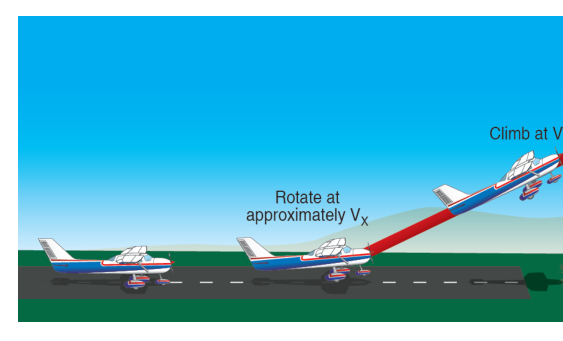
Step by step
- 1Set the POH short-field flap configuration and taxi to the very beginning of the usable runway, aligned on centerline.
- 2Hold the brakes and apply full power; verify engine instruments are in the green before releasing.
- 3Release the brakes and maintain centerline; keep the nosewheel light for minimum drag.
- 4Rotate at the recommended short-field speed and immediately establish the Vx pitch attitude.
- 5Climb at Vx (best angle) to clear the obstacle, accepting the steeper deck angle and lower airspeed.
- 6After clearing the obstacle (or 50 ft), lower the nose to accelerate to Vy and retract flaps/gear per the POH.
- 7Continue the normal climb, trimmed and coordinated.
Tips & common errors
- Vx gives the most altitude per distance — use it only until the obstacle is cleared, then go to Vy.
- Full power before brake release ensures the shortest ground roll.
- Common error: rotating too early (settling back) or climbing at the wrong speed (Vy instead of Vx).
- Use every available foot of runway behind you — there is no benefit to leaving runway behind.
ACS completion standards
The commonly-tested tolerances for this maneuver. Always confirm the current ACS for your certificate.
- Lift off at the recommended airspeed and climb at VX +10/-5 knots until clear of the obstacle, then VY.
- Use maximum available takeoff distance; rotate and climb at the proper speeds.
- Maintain centerline and coordination.
FAA source
FAA-S-ACS-6 (Private Pilot ACS) / FAA-S-ACS-7 (Commercial), Task: Short-Field Takeoff and Maximum Performance Climb; Airplane Flying Handbook FAA-H-8083-3, Chapter 6.
This is an original, plain-English study summary grounded in the public-domain FAA Airman Certification Standards and FAA handbooks cited above. It is a study aid, not flight instruction, and not a substitute for the official ACS, the handbooks, your aircraft’s POH/AFM, or a certificated flight instructor.
Related maneuvers
- Normal Takeoff & ClimbThe normal takeoff and climb is the baseline departure from a paved runway with little or no wind and no obstacles. You accelerate on the centerline, rotate at the recommended speed, and climb at the best-rate speed (Vy) while staying coordinated.
- Normal Approach & LandingThe normal approach and landing is a stabilized descent to a flare and touchdown on the main wheels at minimum controllable airspeed, with the airplane aligned with and tracking the centerline. Everything else (crosswind, short field, soft field) is a variation on this.
- Crosswind Takeoff & ClimbA crosswind takeoff adds wind from the side. You hold aileron into the wind during the ground roll to keep the upwind wing from rising, then transition to a wind-correction crab once airborne so the airplane tracks the extended centerline.
- Crosswind Approach & LandingIn a crosswind landing you neutralize sideways drift and keep the longitudinal axis aligned with the runway at touchdown. The two common techniques are the crab (corrected to a slip just before touchdown) and the wing-low (sideslip) method held throughout the approach.
Keep studying
Turn maneuver knowledge into a passing checkride
Drill ACS-aligned questions and ask the AI tutor, Ace, anything — free to start, no account needed.
Take a free practice test →