Aircraft Mechanic Salary: How Much Do A&P Mechanics Make?
By Aviation Test Prep Team · · Updated
Aviation Maintenance Careers: A High-Demand Path for A&P Mechanics
Few careers in aviation are as foundational — or as consistently in demand — as that of the aircraft mechanic holding an Airframe and Powerplant (A&P) certificate. Whether you dream of keeping regional jets airworthy, supporting military fleets, or wrenching on business aircraft at a private FBO, the A&P certificate opens doors that few other credentials can match. In this guide, we'll break down what an A&P mechanic salary looks like, what the aircraft mechanic career outlook is through 2033, how to become an A&P / AMT, and how ACS-aligned test prep sets you up for long-term success in this field.
What Is an A&P Mechanic?
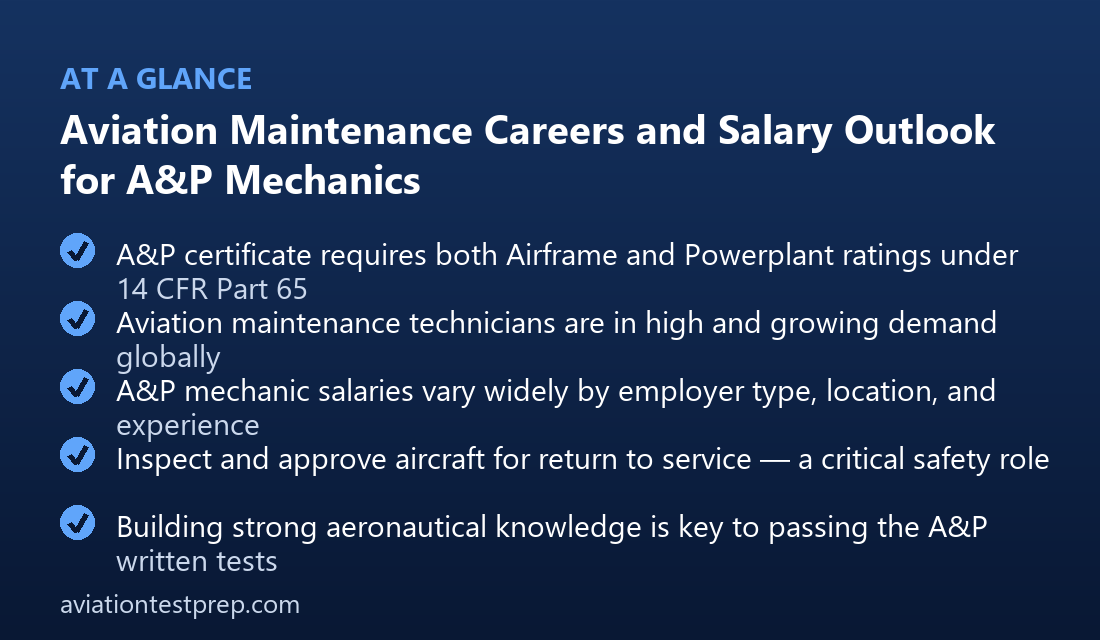
An Airframe and Powerplant (A&P) mechanic is an FAA-certificated aviation maintenance technician (AMT) authorized to inspect, repair, alter, and approve aircraft for return to service. The certificate is governed by 14 CFR Part 65 and consists of two ratings:
- Airframe: Covers the structure of the aircraft — fuselage, wings, landing gear, hydraulic systems, and avionics basics.
- Powerplant: Covers engines and related systems, including reciprocating and turbine engines, fuel systems, and propellers.
Most employers expect candidates to hold both ratings, which is why the combined "A&P" designation is what nearly every job posting asks for. The two ratings together, paired with hands-on experience, are what let a technician sign off maintenance work legally under federal aviation regulations.
A&P Mechanic Salary (2026)
The most common question aspiring technicians ask is simple: how much does an aircraft mechanic make? The best neutral source is the U.S. Bureau of Labor Statistics (BLS), which tracks pay for the occupation Aircraft Mechanics and Service Technicians (SOC 49-3011) in its Occupational Employment and Wage Statistics (OEWS) program, and reports broader career data in its Occupational Outlook Handbook (OOH).
- Median pay: According to the BLS, the median annual wage for aircraft and avionics equipment mechanics and technicians was about $79,000 per year — roughly $38 per hour in the most recent release. Half of workers earn more than this figure and half earn less.
- Typical range: BLS OEWS data for Aircraft Mechanics and Service Technicians (49-3011) shows the lowest 10% earning under about $47,000 and the highest 10% earning more than about $109,000 per year.
- Employment: BLS estimates well over 130,000 people work specifically as aircraft mechanics and service technicians in the United States.
Figures reflect the U.S. Bureau of Labor Statistics' most recent published data and are rounded; wages vary by employer, region, and experience. Always confirm the latest numbers directly at bls.gov OEWS 49-3011 and the BLS Occupational Outlook Handbook.
What Drives an Aircraft Mechanic Salary Higher
Several factors move a technician toward the top end of the BLS range:
- Holding both ratings: A full A&P (Airframe and Powerplant) is worth more than a single rating.
- Inspection Authorization (IA): An IA lets you approve annual inspections and major repairs for return to service, expanding both your responsibilities and your earning potential.
- Employer and sector: Scheduled airlines, aerospace manufacturers, and MRO facilities often pay more than smaller general-aviation shops; the federal government and airlines are among the highest-paying employers reported by BLS.
- Location: Metro areas with major maintenance bases and higher costs of living typically report higher wages.
- Shift and overtime: Line maintenance, night shifts, and AOG (aircraft-on-ground) work frequently carry premiums.
Aircraft Mechanic Career Outlook
The aircraft mechanic career outlook is stable and steady. In its Occupational Outlook Handbook, the BLS projects employment of aircraft and avionics equipment mechanics and technicians to grow about 5% from 2023 to 2033 — roughly the average for all occupations — with on the order of 13,000 openings per year projected on average over the decade. Most of those openings come from the need to replace workers who retire or move to other occupations.
Two structural forces support the demand:
- An aging workforce: A large share of the current A&P population is nearing retirement age, creating a persistent replacement need that new technicians step into.
- Fleet growth and utilization: As air travel and cargo volume grow, airlines and operators need more technicians to keep aircraft airworthy on tight maintenance schedules.
Because the certificate is issued by the FAA and does not expire, an A&P is a durable, portable credential — you can move between employers, states, and sectors of the industry without re-earning it.
How to Become an A&P / AMT
Becoming an aircraft maintenance technician follows a well-defined FAA path. Here is the short version — you can read the full step-by-step guide in our companion article, How to Become an FAA Aviation Maintenance Technician (A&P): The Complete Path.
Airplane Mechanic Education Requirements & Eligibility
The FAA sets a core set of eligibility requirements you can verify at faa.gov/mechanics:
- Age: You must be at least 18 years old to be issued a mechanic certificate.
- Language: You must be able to read, write, speak, and understand English.
- Experience or training: You must qualify either by graduating from an FAA-approved Aviation Maintenance Technician School (AMTS) or through documented hands-on work experience.
There is no four-year-degree requirement. The two accepted routes to aircraft maintenance technician certification are:
- Part 147 school: An FAA-approved Aviation Maintenance Technician School under 14 CFR Part 147 — typically 18 to 24 months for both ratings. Community colleges, technical schools, and aviation academies offer these programs.
- Documented experience: A minimum of 18 months of practical experience for a single rating, or 30 months working on both airframe and powerplant concurrently, verified in writing by a supervising A&P.
The A&P Test: Three Knowledge Tests Plus Oral & Practical
Every candidate — regardless of path — must pass the same FAA examination process. The A&P test is really a set of three separate knowledge tests, followed by an oral and practical exam:
- AMT General (AMG) knowledge test — mathematics, physics, basic electricity, regulations, ground operation, and weight and balance.
- AMT Airframe (AMA) knowledge test — aircraft structures, hydraulics, landing gear, instruments, and related systems.
- AMT Powerplant (AMP) knowledge test — reciprocating and turbine engines, fuel, lubrication, ignition, and propellers.
Each knowledge test is multiple choice and requires a score of 70% or higher to pass. After the written tests, a Designated Mechanic Examiner (DME) administers an oral exam and a hands-on practical test before the FAA issues your certificate.
How to Prepare for the A&P Knowledge Tests
The FAA publishes Airman Certification Standards (ACS) that define exactly which knowledge areas each test evaluates. Studying with ACS-aligned practice questions means every question you work maps to a tested objective — no wasted study time. Aviation Test Prep offers full practice-question libraries for the General, Airframe, and Powerplant knowledge tests, each tagged with its ACS code, plus Ace, our AI tutor, which explains why an answer is right or wrong in plain language.
The fastest way to start is a diagnostic:
- Diagnose: Take a free practice test to find your weakest ACS areas — no credit card required.
- Focus & practice: Follow a structured schedule built around your results. Our per-exam study plans lay this out week by week:
- Simulate: Finish with full-length timed practice exams to build test-day confidence. You can explore everything on our AMT test prep hub.
Where A&P Mechanics Work
A&P mechanics work across a broad range of aviation environments, which is part of why the career outlook stays resilient:
- Commercial airlines and regional carriers
- Corporate and business aviation flight departments
- General aviation repair stations (Part 145)
- Military contract maintenance organizations
- Aircraft manufacturers and MRO (Maintenance, Repair & Overhaul) facilities
- Helicopter operators and rotorcraft specialists
Frequently Asked Questions
How much does an A&P mechanic make?
Per the U.S. Bureau of Labor Statistics, the median wage for aircraft and avionics equipment mechanics and technicians is about $79,000 per year (roughly $38 per hour), with the lowest 10% under about $47,000 and the top 10% over about $109,000 for Aircraft Mechanics and Service Technicians (SOC 49-3011). Pay rises with both ratings, an Inspection Authorization, and higher-paying sectors such as airlines and manufacturers.
Is aircraft mechanic a good career?
It is a hands-on, well-compensated skilled trade with a steady outlook — BLS projects about 5% employment growth from 2023 to 2033 and roughly 13,000 openings per year — plus an FAA credential that does not expire and transfers across employers and states.
What are the education requirements to become an airplane mechanic?
No four-year degree is required. You either graduate from an FAA-approved Part 147 Aviation Maintenance Technician School (typically 18–24 months) or document 18–30 months of supervised practical experience, then pass the FAA knowledge, oral, and practical tests.
What is the A&P test?
The A&P test consists of three FAA knowledge tests — AMT General (AMG), Airframe (AMA), and Powerplant (AMP) — each requiring 70% to pass, followed by an oral exam and a practical skills test given by a Designated Mechanic Examiner.
How long does it take to get an A&P certificate?
Most students finish a Part 147 program in 18–24 months for both ratings; the experience route requires at least 18 months (single rating) or 30 months (both) of documented work before testing.
Start Your A&P Journey Today
A career as an aircraft mechanic combines meaningful, hands-on work with solid pay and a durable FAA credential the industry keeps needing. Wherever you are on the path — deciding whether to enroll, or actively preparing for the AMT knowledge tests — Aviation Test Prep is built to get you exam-ready with ACS-aligned questions and clear explanations. Take a free practice test to see where you stand, then follow your AMT study plan to test day.
Ready to pass your FAA written exam?