How to Get Your FAA Part 107 Remote Pilot Certificate: Requirements and Steps
By Aviation Test Prep Team · · Updated
What Is the FAA Part 107 Remote Pilot Certificate?
The FAA Part 107 Remote Pilot Certificate is the federal license required to fly drones commercially in the United States. Whether you want to shoot real-estate photos, inspect infrastructure, deliver packages, or launch a full-time aerial services business, Part 107 is your gateway. Introduced under Title 14 CFR Part 107, it replaced a patchwork of waivers and exemptions with a single, streamlined certification pathway — and today it is one of the fastest-growing aviation credentials in the country.
📖 Studying for the written test? See the full reference in our library: Remote Pilot Certificate Requirements and Eligibility →
In this guide you will learn every eligibility requirement, each step of the application process, and how to build a study plan that puts you in the best position to pass the FAA aeronautical knowledge test on your first attempt.
Part 107 Remote Pilot Certificate Eligibility Requirements
Before you book a test appointment, confirm you meet the FAA's baseline eligibility criteria. According to well-established FAA guidance, you must:
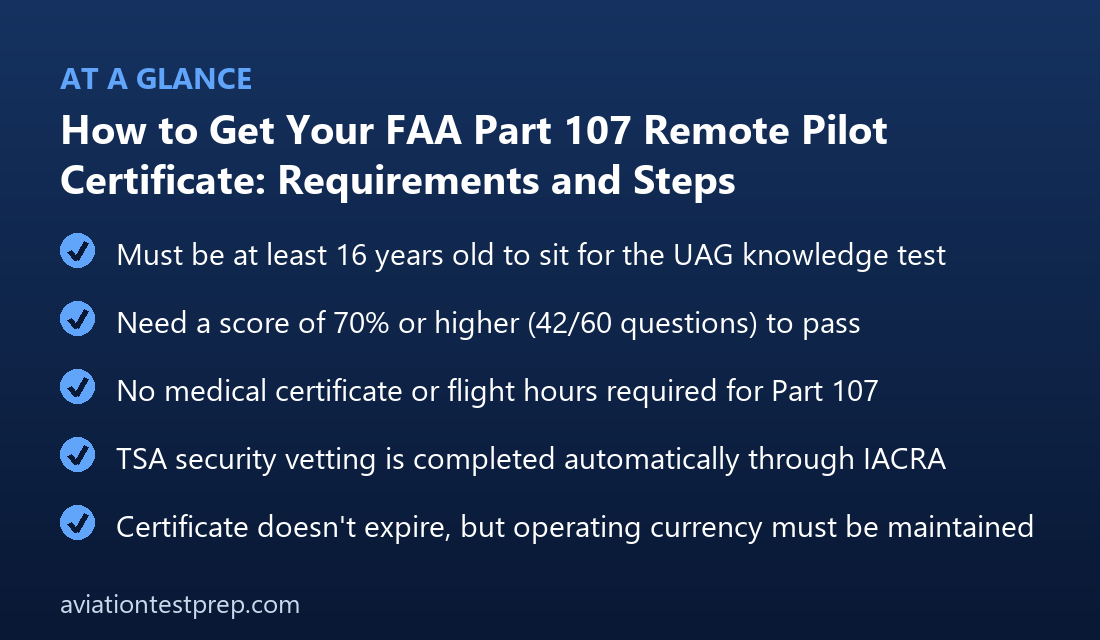
- Be at least 16 years old on the day you take the knowledge test.
- Be able to read, speak, write, and understand English. Limited English proficiency waivers exist but are rare in practice.
- Be in a physical and mental condition sufficient to safely operate a small unmanned aircraft system (sUAS).
- Pass the FAA Unmanned Aircraft General (UAG) aeronautical knowledge test administered at an FAA-approved testing center.
- Complete a TSA security vetting as part of the IACRA (Integrated Airman Certification and Rating Application) process.
There is no medical certificate requirement and no flight hours requirement — the credential is knowledge-based. Testing fees are set by the approved testing centers (Pearson VUE and PSI Services); check current fees directly with the testing provider or at faa.gov/uas before you budget for the exam.
Step-by-Step: How to Earn Your Part 107 Certificate
Step 1 — Create an FAA Tracking Number (FTN) in IACRA
Your first administrative task is to register at the FAA's IACRA portal (iacra.faa.gov). IACRA will generate a unique FAA Tracking Number (FTN) that ties all your application data together. Write it down — you will need it when you register for the knowledge test.
Step 2 — Register at an Approved Testing Center
The UAG knowledge test is administered by FAA-approved testing organizations. Visit the Pearson VUE or PSI Services website to find a test center near you, schedule a date, and pay the testing fee. Bring a valid government-issued photo ID and your FTN on test day.
Step 3 — Study Thoroughly for the UAG Knowledge Test
This step deserves the most of your time. The FAA evaluates applicants against the Airman Certification Standards (ACS) for the Remote Pilot certificate. Topics covered include:
- Applicable regulations relating to sUAS rating privileges, limitations, and flight operation
- Airspace classification and operating requirements, including Temporary Flight Restrictions (TFRs)
- Aviation weather sources and effects of weather on sUAS performance
- Small unmanned aircraft loading, performance, and emergency procedures
- Crew resource management and decision-making
- Radio communication procedures
- Airport operations and the effect of wake turbulence
- Physiological effects of drugs and alcohol on pilots
- Aeronautical decision-making (ADM) and judgment
- Maintenance and preflight inspection procedures
Many of these topics will feel familiar if you have a manned-aircraft background, but first-time aviation students will need dedicated study time for airspace concepts and weather interpretation in particular.
Step 4 — Pass the UAG Knowledge Test
The test consists of 60 multiple-choice questions, and you need a score of 70% or higher (42 correct answers) to pass. You are given 2 hours to complete it. The test center will print your Airman Knowledge Test Report (AKTR) immediately after you finish — keep this document safe; you will need it for your application.
If you do not pass on the first attempt, FAA regulations require a waiting period before you can retest. Thorough preparation the first time around is the most efficient path forward.
Step 5 — Complete Your IACRA Application
Within 24 months of passing the UAG test, log back into IACRA and complete the Remote Pilot Certificate application. Upload or reference your AKTR results. The TSA security vetting happens automatically as part of this process — you do not need to contact TSA separately.
Step 6 — Receive Your Temporary Certificate and Permanent Plastic Card
Once the FAA approves your application, a temporary certificate is available for download directly from IACRA. This document is legally valid and allows you to begin flying commercially while your permanent plastic certificate is manufactured and mailed to the address on file. Processing times vary; check faa.gov for current estimates.
How to Build a Winning Study Plan for the Part 107 Exam
Passing the UAG knowledge test is about consistent, structured preparation — not last-minute cramming. Here is a proven framework to organize your studying:
- Audit what you already know. Take a diagnostic practice session before committing to any study schedule. Identify weak topic areas so you can allocate time efficiently.
- Study the ACS codes. The FAA publishes the exact task areas and knowledge codes the exam covers. Reviewing these codes ensures you never study a topic that is out of scope. You can explore how ACS codes map to exam questions at aviationtestprep.com/acs-codes.
- Work through ACS-aligned practice questions. Repetition with quality questions builds pattern recognition. At Aviation Test Prep, our free practice test lets you experience FAA-aligned questions before you commit to a full study plan.
- Use an AI tutor for tough concepts. Our AI tutor, Ace, is built specifically for aviation students. When a practice question trips you up, ask Ace to break down the underlying concept — whether that is decoding a METAR, reading a sectional chart, or understanding Class B airspace dimensions.
- Review and repeat. After every study session, revisit the questions you got wrong. Spaced repetition of weak areas is the most research-backed technique for retaining technical information.
Aviation Test Prep's 5-step study method — Diagnose, Learn, Practice, Review, and Test — is built around this exact cycle. It works equally well for drone students tackling aeronautical concepts for the first time and for certificated pilots seeking their Part 107 add-on.
Common Mistakes to Avoid When Preparing for Part 107
Even motivated students stumble on avoidable pitfalls. Watch out for these:
- Skipping airspace study. Airspace classification questions consistently trip up new students. Spend extra time on the difference between Class B, C, D, E, and G airspace, and understand when and how to request LAANC authorization.
- Ignoring weather products. METARs, TAFs, and winds-aloft forecasts appear regularly on the test. Practice decoding these until they feel automatic.
- Memorizing without understanding. The UAG test is designed to test application of knowledge, not rote recall. Make sure you understand why an answer is correct, not just which letter to choose.
- Waiting too long to start. Many students underestimate the breadth of material. Give yourself at least two to four weeks of consistent daily study — more if aviation is entirely new to you.
- Using outdated study materials. Regulations and airspace procedures change. Always verify that your study resources reference current FAA publications and ACS standards.
Maintaining and Recertifying Your Part 107 Certificate
A Remote Pilot Certificate does not expire, but your operating privileges do require periodic renewal. Currently, the FAA requires remote pilots to complete a recurrent knowledge training or testing requirement to remain current. The specific recurrency pathway has evolved since Part 107 was introduced, so always verify the latest requirements at faa.gov/uas before your currency lapses.
Staying current also means keeping up with regulatory updates — airspace rules, waiver procedures, and operational limitations for sUAS continue to develop as the industry matures.
Start Your Part 107 Journey Today
Earning your FAA Part 107 Remote Pilot Certificate opens doors to a rapidly expanding industry where demand for skilled drone operators continues to grow. The pathway is straightforward: meet the eligibility requirements, prepare diligently for the UAG knowledge test, and follow the IACRA application process step by step.
Aviation Test Prep is designed to support every stage of that journey. Browse the full library of available exams — including the UAG — at aviationtestprep.com/browse-exams, and read more aviation study tips on our blog. Our ACS-aligned practice questions, detailed answer explanations, and AI tutor Ace are here to help you walk into test day with real confidence.
Ready to begin? Take a free Part 107 practice test right now and see exactly where you stand before you ever set foot in a testing center.
Ready to pass your FAA written exam?