Navigating controlled airspace around busy airports is one of the most tested and most operationally critical skills a sport pilot can develop. Class B, C, and D airspace each carry distinct entry requirements, communication rules, weather minimums, and certificate-specific limitations. Getting any one of these wrong — on the FAA Private Pilot or Sport Pilot Knowledge Test or in actual flight — can mean an airspace violation, a certificate action, or far worse. This article breaks down all three classes in the depth you need to fly legally and confidently.
Class B Airspace: The Busiest Hubs
Class B airspace is established around the nation's busiest commercial airports — places handling the highest volume of instrument flight rules (IFR) traffic. On a VFR sectional chart, Class B is depicted as solid blue lines forming a series of shelves that, in profile, resemble an upside-down wedding cake. Each shelf has a defined floor and ceiling expressed in MSL altitude (for example, "SFC–10,000" or "3,000–10,000"). The outer shelves begin at higher altitudes, letting lower-flying traffic pass beneath them without entering the airspace.
Entry Requirements for Class B
To enter Class B airspace, a pilot must receive an explicit ATC clearance before crossing the boundary. Establishing radio contact alone is not sufficient — you must hear words to the effect of "cleared into the Bravo" or "cleared into the Class Bravo airspace." If the controller simply acknowledges your call without issuing a clearance, you may not enter. This is a bright-line rule under 14 CFR 91.131.
14 CFR 91.131 itself does not impose a specific pilot-certificate minimum to enter Class B airspace with the required clearance. However, student pilots need a specific logbook endorsement from an authorized instructor covering both the specific Class B airspace and the primary airport within it, per 14 CFR 61.95. For a sport pilot operating a light-sport aircraft (LSA), an endorsement is required AND the pilot must verify that the particular Class B is not listed as excluded for sport pilot operations. The FAA publishes this exclusion list, and certain high-density Class B airports are off-limits to LSA operations regardless of endorsements. Always check before flight planning a Class B transit.
Class B Weather Minimums
Inside Class B airspace, the VFR weather minimums are 3 statute miles visibility and clear of clouds. Because ATC provides radar separation between all aircraft operating in Class B, you do not need a specific vertical or horizontal buffer from clouds — you simply must not be inside one. This makes Class B the easiest cloud-clearance standard to remember, even though its entry procedure is the most demanding.
Class C Airspace: Moderate-Traffic Airports
Class C airspace surrounds airports that have an operating control tower, a radar approach control facility, and a significant volume of IFR operations. On a sectional chart, Class C is shown as solid magenta lines. The standard configuration is two concentric circles: an inner ring typically extending 5 nautical miles from the airport, running from the surface up to approximately 4,000 feet AGL; and an outer ring extending to about 10 nautical miles, with a floor of roughly 1,200 feet AGL and the same 4,000-foot ceiling. These dimensions can vary — always read the actual chart depiction and the Chart Supplement entry for the specific airport.
Entry Requirements for Class C
To enter Class C airspace, a pilot must establish two-way radio communication with the appropriate ATC facility before entering the airspace, per 14 CFR 91.130. "Establishing" communication means ATC has responded using your aircraft's callsign. If the controller says "N12345, standby," your callsign has been used and communication has been established in that sense — but the AIM cautions that a "standby" reply does not by itself authorize you to enter the airspace. Pilots should not enter until they are certain communications have been established and entry is appropriate, exercising caution if the controller has not affirmatively acknowledged the request to enter. However, if the controller responds with a generic phrase that does not include your callsign — such as "all aircraft, standby" — communication has not been established, and you must not enter.
No explicit clearance is required for Class C (unlike Class B). There is also a "Class C service area" or outer area that typically extends to 20 NM — pilots are encouraged to contact approach control in this outer area, but it is not legally required for entry there.
Class C Weather Minimums
Class C VFR weather minimums are 3 statute miles flight visibility, plus cloud clearances of 500 feet below, 1,000 feet above, and 2,000 feet horizontally from clouds. This is the standard "500-1,000-2,000" rule that applies broadly in controlled airspace below 10,000 feet MSL.
Class D Airspace: Towered Airports Without Radar Approach Control
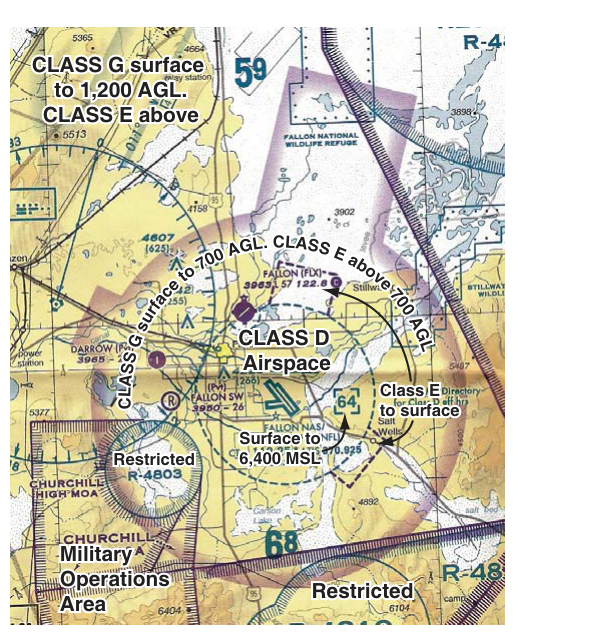
Class D airspace is established at airports with an operating control tower that do not have an associated radar approach control. It appears on sectional charts as dashed blue lines, generally in a roughly circular shape extending 4 to 5 nautical miles from the airport. The vertical limit is typically 2,500 feet AGL above the airport elevation, though the exact ceiling is printed in a blue dashed box on the chart (for example, "[25]" indicating 2,500 feet MSL as the ceiling). The floor is the surface.
Entry Requirements for Class D
Class D has the same communication requirement as Class C: establish two-way radio communication before entry, per 14 CFR 91.129. The same callsign rule applies — the controller must use your N-number or aircraft identifier, and the same caution about a "standby" reply not automatically authorizing entry applies here as well. No explicit clearance is required to enter, but ATC may issue instructions you are required to follow once inside.
When the Tower Closes
Class D airspace only exists when the associated control tower is in operation. When the tower closes — whether for the night or for maintenance — the Class D designation is suspended. The airspace typically reverts to Class E (if an instrument approach procedure or other reason for Class E exists) or Class G. The Chart Supplement (formerly the Airport/Facility Directory) lists the tower operating hours and specifies what the airspace becomes after hours. Always check NOTAMs as well, since hours can change temporarily. Flying as though Class D is still in effect when the tower is closed is a common real-world mistake.
Class D Weather Minimums
Class D uses the identical weather minimums as Class C: 3 statute miles visibility, 500 feet below clouds, 1,000 feet above clouds, and 2,000 feet horizontally from clouds.
Key Numbers and Rules at a Glance
- Class B entry: Explicit ATC clearance required (14 CFR 91.131); sport pilots need endorsement and must confirm LSA access.
- Class C entry: Two-way radio communication established before entry (callsign must be used by ATC); no explicit clearance needed (14 CFR 91.130).
- Class D entry: Same two-way communication requirement as Class C before entry (14 CFR 91.129).
- Class B weather minimums: 3 SM visibility; clear of clouds.
- Class C and D weather minimums: 3 SM visibility; 500 below, 1,000 above, 2,000 horizontal from clouds.
- Class D ceiling: Typically 2,500 feet AGL — read the chart box for the exact MSL figure.
- Tower closed: Class D airspace is suspended; check Chart Supplement and NOTAMs.
- Sport pilot Class B restrictions: Some Class B airports are excluded from LSA operations; endorsement alone does not guarantee access.
Common Test Traps
- Clearance vs. communication: The single most-tested distinction — Class B requires a clearance; Class C and D require only communication. The word "clearance" on a test question is your signal to think Class B.
- "Standby" is not automatic entry authorization: If ATC says "N12345, standby," your callsign has been used, but the AIM cautions this does not by itself authorize you to proceed into Class C or D airspace. Wait until you are certain communication has been established and entry is appropriate.
- Generic responses do not count: "All aircraft, standby" does not establish two-way communication because your callsign was not used. You must not enter until ATC acknowledges you by name.
- Class B clouds vs. C/D clouds: Class B is "clear of clouds" — no buffer distances. Class C and D use 500-1,000-2,000. Students sometimes apply the wrong standard to the wrong airspace class.
- Sport pilot endorsements: An endorsement is necessary but not always sufficient for Class B — the specific airport must not be on the FAA's LSA exclusion list.
- Upside-down wedding cake floors: Questions sometimes describe an aircraft at a given altitude and distance and ask whether it is inside Class B. Read each shelf's floor altitude carefully; you can legally fly under Class B without a clearance if you remain below the floor of the shelf above your position.
Memory aid
Use "B = Be Cleared" to lock in that Class B demands an explicit clearance. For Class C and D, remember "C and D = Contact and Depart only if no reply with your N-number." For cloud clearances, the phrase "B is clear; C and D share 500-1,000-2,000" covers all three classes in one breath.
Mastering these rules transforms airspace from an abstract chart symbol into a concrete, predictable framework. When you know exactly what ATC needs to hear from you — and what you need to hear back — operating near busy airports becomes a matter of procedure rather than guesswork.