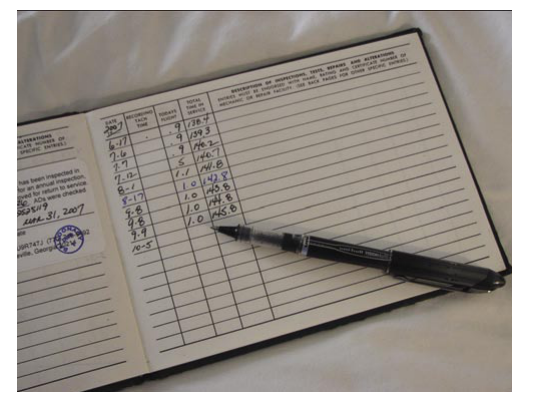
Walk into almost any general aviation hangar and you will hear the words "logbook" and "aircraft records" used interchangeably. In practice, however, they describe overlapping but legally distinct sets of documents. For an Aviation Maintenance Technician (AMT), understanding exactly which records must exist, what information they must contain, who may make entries, and how long they must be kept is not just a matter of professional pride — it is a federal regulatory obligation that directly affects the airworthiness of every aircraft you touch.
This article breaks down the two categories, explains the governing regulations, covers the specific content requirements the FAA demands, and highlights the practical differences that show up on the AMT General knowledge test and in real maintenance shops every day.
What Are Aircraft Maintenance Logbooks?
The term "logbook" in the maintenance world typically refers to the bound or loose-leaf record books kept for each major component category of the aircraft — commonly the airframe logbook, the engine logbook (one per engine), and the propeller logbook (one per propeller). These books record the ongoing maintenance history of a specific piece of hardware from manufacture through retirement.
Logbooks are not specifically mandated by name in Title 14 of the Code of Federal Regulations (14 CFR). Instead, 14 CFR Part 43 and Part 91 require that certain records be kept — and the industry uses logbooks as the most practical way to satisfy that requirement. The FAA does not dictate a specific format, so manufacturers, operators, and maintenance organizations have latitude in how the physical book is organized, as long as the required information is present.
Each logbook entry for a maintenance action must, per 14 CFR Part 43, Section 43.9, include: a description of the work performed (or reference to acceptable data), the date the work was completed, the aircraft total time in service, the name and certificate number of the person approving the aircraft for return to service, and the person's signature. For 100-hour and annual inspections, Section 43.11 adds specific requirements for the inspection entry itself, including a statement that the inspection was performed in accordance with a particular inspection program.
What Are Aircraft Records (Maintenance Records)?
"Aircraft records" is a broader category. Under 14 CFR Part 91, Section 91.417, the owner or operator of an aircraft is legally required to retain specific maintenance records. These records include:
- Records of current status: total time in service of the airframe, each engine, each propeller, and each rotor; current status of life-limited parts; the time since last overhaul of components that must be overhauled on a specified time basis; the current inspection status of the aircraft; and the current status of applicable Airworthiness Directives (ADs), including the method of compliance and the next due date or time.
- Records of the last annual inspection and 100-hour inspection (if applicable).
- Records related to major repairs and major alterations — specifically, FAA Form 337 (Major Repair and Alteration) is required for major repairs and major alterations performed on type-certificated products. The owner keeps the original as a permanent aircraft record; a copy is forwarded to the FAA.
- Records documenting compliance with Airworthiness Directives and manufacturers' mandatory service bulletins (when incorporated as part of an AD).
In short, "aircraft records" is the legal umbrella; logbooks are the most common physical tool used to satisfy that umbrella requirement. But the records category also explicitly includes documents like FAA Form 337s, which are never "in" a logbook — they are separate sheets kept with the aircraft.
FAA Form 337 — A Critical Standalone Record
FAA Form 337 deserves special attention because it is among the most commonly tested and most commonly mishandled records in general aviation. Whenever an AMT or a repair station performs a major repair or major alteration (as defined in 14 CFR Part 43, Appendix A), a Form 337 must be completed. The form documents the approved data used, describes the work, and is signed by the person approving the return to service.
The completed Form 337 is handled as follows: under 14 CFR Section 43.9(d), the owner retains the original Form 337 as a permanent part of the aircraft records, and the person approving the work for return to service forwards a copy to the FAA within 48 hours of the aircraft's return to service. This original travels with the aircraft for the life of the repair or alteration — it does not get transferred to a logbook entry and then discarded.
For an AMT performing a major alteration that installs, for example, a Supplemental Type Certificate (STC) kit, the STC holder's approved data (drawings, instructions) referenced on the Form 337 becomes a permanent part of that aircraft's records package. Future mechanics and inspectors use that form to verify that the alteration was legally accomplished using approved data.
Retention Requirements
One of the most tested areas in this subject is how long records must be kept. Under 14 CFR Section 91.417(b), maintenance records fall into two retention categories:
- Retain until the work is superseded or for one year: Records of routine maintenance, preventive maintenance, and alterations that do not rise to the level of a major repair or alteration. Once a subsequent inspection or maintenance action supersedes the earlier record, the older record may be discarded — but in practice most shops keep them longer.
- Retain permanently (or until transferred with the aircraft): Records of total time in service for the airframe, engines, and propellers; records of current status of life-limited parts; current AD compliance records; and records of major repairs and major alterations (the original Form 337). When an aircraft is sold, these permanent records must be transferred to the new owner.
This distinction matters on the test. The one-year retention rule applies to routine work records. The permanent records must follow the aircraft. An AMT who advises an owner to discard AD compliance records or old Form 337s is giving dangerously wrong guidance.
Who Makes Logbook Entries?
Only the person who approves the aircraft for return to service makes the required maintenance record entry and signs it. Under 14 CFR Part 43, an appropriately rated AMT (Airframe and/or Powerplant), a certificated repair station, or — for certain preventive maintenance — a certificated pilot-owner may make these entries. An AMT who performs work but does not hold the return-to-service authority (for example, a technician working under a repair station's supervision) does not personally sign the return-to-service entry; the repair station's authorized representative does.
A common area of confusion involves inspections. An IA (Inspection Authorization) holder performs and signs the annual inspection entry. An AMT without an IA may perform the physical inspection work but cannot sign the approval for return to service after an annual inspection. This is a critical legal distinction.
Key Numbers and Rules
- 14 CFR Part 43, Section 43.9 — Content requirements for all maintenance record entries.
- 14 CFR Part 43, Section 43.11 — Specific entry requirements for 100-hour, annual, and progressive inspections.
- 14 CFR Part 91, Section 91.417 — Owner/operator record retention requirements and minimum content of aircraft records.
- 48 hours — Maximum time after return to service within which a copy of FAA Form 337 must be forwarded to the FAA.
- 1 year minimum — Retention period for routine maintenance records after they are superseded.
- Permanent / life of the aircraft — Retention period for total time records, life-limited part status, AD compliance records, and the original Form 337.
- An entry must include: description of work, date, total time in service, approving person's certificate number, and signature.
Common Test Traps
- Confusing "logbook" with "aircraft records." The FAA regulations require records, not specifically logbooks. A logbook is simply the most common format. Form 337s are records but are NOT part of the logbook.
- Assuming all records can be discarded after one year. Only routine maintenance records may be discarded once superseded, with a one-year minimum. Major repair/alteration records, AD compliance, and total-time records are permanent.
- Who signs the entry vs. who does the work. The person who approves return to service signs — not necessarily every technician who touched the aircraft. An AMT without an IA cannot sign an annual inspection return-to-service entry.
- Form 337 routing. The owner keeps the original as a permanent aircraft record; a copy goes to the FAA within 48 hours. Many students incorrectly believe the original goes to the FAA and only a copy stays with the aircraft, or that only a logbook entry is needed for a major repair.
- Omitting required entry elements. A common trap question asks which element is NOT required. Remember: total time in service, date, description of work, certificate number, and signature are all required. The aircraft registration number is NOT a required element of a Part 43.9 maintenance entry (it is on the Form 337, but not in every logbook entry).
Mastering the distinction between logbooks and aircraft records — and knowing exactly what goes where, who signs, and how long everything is kept — will serve you not just on the AMT General knowledge test but throughout your maintenance career. Every aircraft's airworthiness chain depends on records that are accurate, complete, and properly retained.