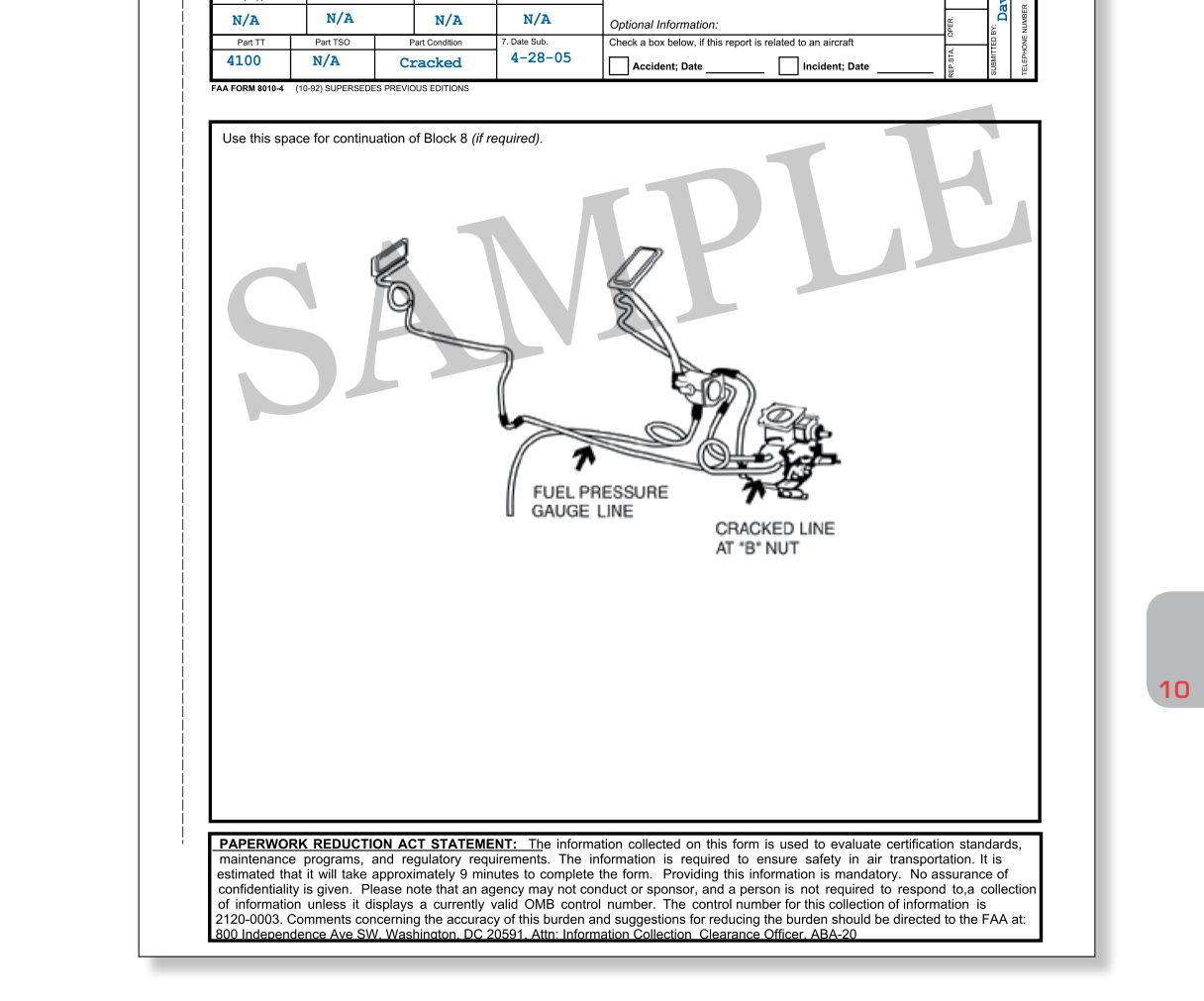
Every time an aircraft component fails unexpectedly, behaves erratically, or proves defective in service, that event carries information that could prevent the next accident. The FAA's voluntary reporting system for these occurrences centers on FAA Form 8010-4, the Malfunction or Defect (M&D) Report. This form is one of the most important feedback tools in aviation maintenance, allowing certificated mechanics, pilots, manufacturers, and others to communicate safety-relevant findings directly to the FAA's data collection infrastructure. Understanding how this form works, who files it, what triggers its use, and how the FAA uses the resulting data is essential knowledge for any AMT candidate sitting for the General knowledge test.
The 8010-4 is distinct from the required maintenance records and airworthiness release entries you make in logbooks. It is a voluntary reporting mechanism — no regulation mandates that every discrepancy be reported on this form — yet it is one of the most powerful instruments the aviation maintenance community has for improving safety across entire fleets. The FAA's Service Difficulty Reporting System (SDRS) lives and breathes on the data this form generates.
What the Form Is and Where It Comes From
FAA Form 8010-4 is published and maintained by the FAA and serves as the standardized document for reporting service difficulties — instances where an aircraft, engine, propeller, or appliance has malfunctioned or been found defective during operation or maintenance. The information submitted flows into the Service Difficulty Reporting System (SDRS), a national database administered by the FAA's Aircraft Certification Service. Engineers, airworthiness inspectors, and the FAA's accident prevention program managers review SDRS data continuously to spot emerging trends.
When a particular part or design starts appearing repeatedly in the SDRS database — for example, a specific carburetor heat box cracking at the same weld point across dozens of reports — the FAA has the analytical foundation to investigate, contact manufacturers, and potentially issue an Airworthiness Directive (AD) under 14 CFR Part 39. In this sense, every Form 8010-4 submitted is a small act of safety stewardship that extends beyond the individual aircraft to the entire fleet.
Who Should File and When
The FAA encourages reports from a broad range of individuals who discover or experience malfunctions and defects:
- Certificated airframe and powerplant (A&P) mechanics who discover a defect during inspection, maintenance, or repair that they believe other operators or the FAA should know about.
- Pilots who experience an in-flight or ground malfunction not already captured by another mandatory reporting channel.
- Repairmen working under Repair Station certificates or sport-pilot repairman certificates.
- Manufacturers and distributors who become aware of defects in parts they produced or supplied.
- Air carriers and operators, though large operators under Part 121 and Part 135 may have parallel mandatory reporting obligations under their operations specifications; the 8010-4 supplements, not replaces, those requirements.
There is no strict legal deadline imposed on voluntary 8010-4 submissions the way there is for mandatory accident/incident reports, but the FAA guidance emphasizes filing as soon as practicable after the discovery. Timely reporting maximizes the utility of the data, especially when a defect may be appearing across multiple aircraft simultaneously.
What Qualifies as a Reportable Event
The guidance accompanying the form identifies a wide range of conditions worth reporting. These include — but are not limited to:
- Structural failures or cracks in airframe components (spars, longerons, fittings, skins).
- Engine failures, excessive wear, or internal component failures discovered during teardown.
- Propeller defects, including blade cracking, hub failures, or governor malfunctions.
- Fuel system deficiencies, including fuel cap failures, tank leaks, or selector valve problems.
- Electrical system failures — alternator, generator, or wiring issues that caused or could have caused an unsafe condition.
- Landing gear malfunctions, including retraction system failures or gear-not-down indication discrepancies.
- Flight control problems such as binding, excessive play, or cable failures.
- Avionics and instrument anomalies that could affect the safety of flight.
- Defects found in replacement or overhauled parts that suggest a manufacturing or overhaul quality problem.
The guiding principle is this: if the malfunction or defect could affect the airworthiness of the aircraft or the safety of flight — even if it was caught before it caused an accident — it is worth reporting. The FAA does not penalize reporters for submitting events that turn out to be minor; the cost of over-reporting is low compared to the cost of missing a systemic defect.
How to Complete and Submit the Form
Form 8010-4 requests specific identifying information to make each report as useful as possible. The filer must provide:
- Aircraft information: make, model, series, registration number (N-number), and serial number.
- Component information: part name, part number, serial number, time in service (total time and time since overhaul), and the manufacturer of the affected part.
- Nature of the difficulty: a clear, specific narrative description of the malfunction or defect — what was found, how it was found, and what flight phase or maintenance activity revealed it.
- Corrective action taken: what the mechanic or operator did to resolve the discrepancy, including part replacement or repair.
- Reporter information: name, address, certificate number, and certificate type. Note that while the FAA accepts reports and maintains them in the SDRS, the system is designed to be non-punitive in intent; mechanics are encouraged to report without fear of certificate action solely for the act of reporting a defect.
Completed forms can be submitted to the local FAA Flight Standards District Office (FSDO) or mailed directly to the FAA's data collection center. The FAA also provides online submission options through its web-based SDR system, which has become the preferred method because it accelerates data entry into the SDRS database.
The Service Difficulty Reporting System (SDRS) and Its Impact
Once submitted, the data from Form 8010-4 is entered into the SDRS, which is publicly searchable. Mechanics, engineers, operators, and manufacturers can query the database by aircraft make and model, part number, or type of defect. This makes SDRS a valuable pre-purchase inspection research tool and a way for mechanics to check whether the anomaly they just discovered on their aircraft has been seen elsewhere.
On the regulatory side, FAA engineers at the Aircraft Certification Offices review SDRS entries and correlate them with other data streams — accident reports, manufacturer service bulletins, and military aviation feedback — to determine whether a pattern rises to the level requiring an Airworthiness Directive. An AD issued under 14 CFR Part 39 carries the force of law and mandates corrective action across all affected aircraft. In this way, a single mechanic's Form 8010-4 submission can ultimately trigger mandatory safety action affecting thousands of aircraft worldwide.
Key Numbers and Rules
- Form 8010-4 reporting is voluntary — no specific FAR mandates filing for every defect found outside of special circumstances covered by other rules (e.g., Part 121 mandatory SDR requirements for air carriers).
- Mandatory SDR reporting for Part 121 and certain Part 135 operators is governed by 14 CFR §121.703 and §135.415, which require reporting within 24 hours of discovery for specified serious defects.
- All U.S.-registered aircraft, engines, propellers, and appliances are within scope of the 8010-4 voluntary system.
- The SDRS database is publicly accessible through the FAA's website, searchable by part number, aircraft type, and defect category.
- Submissions should be made as soon as practicable after discovering the defect for maximum safety benefit.
Common Test Traps
- Confusing voluntary with mandatory: Form 8010-4 itself is a voluntary reporting tool for most certificated mechanics and pilots. Students sometimes assume all defect reports are mandatory. Remember that mandatory SDR requirements fall under specific operating rules (Parts 121 and 135), not on the general mechanic certificate holder.
- Mixing up forms: AMT candidates sometimes confuse Form 8010-4 (malfunction/defect reports) with NTSB Form 6120.1 (accident/incident reports) or FAA Form 337 (major repair and alteration). Each serves a completely different purpose and goes to a different authority.
- Thinking only mechanics can file: Pilots and other aviation personnel may also submit Form 8010-4. The form is not exclusive to A&P certificate holders.
- Assuming reporting implies enforcement action: The voluntary nature of the system is designed to encourage candid reporting. Filing an 8010-4 because you found a crack in a part is not an admission of wrongdoing — it is a professional safety act.
- Overlooking the SDRS as a research tool: Test questions may probe whether you understand that the data collected by the 8010-4 is stored in a publicly searchable database (SDRS), usable by mechanics for trend research — not just filed away internally by the FAA.