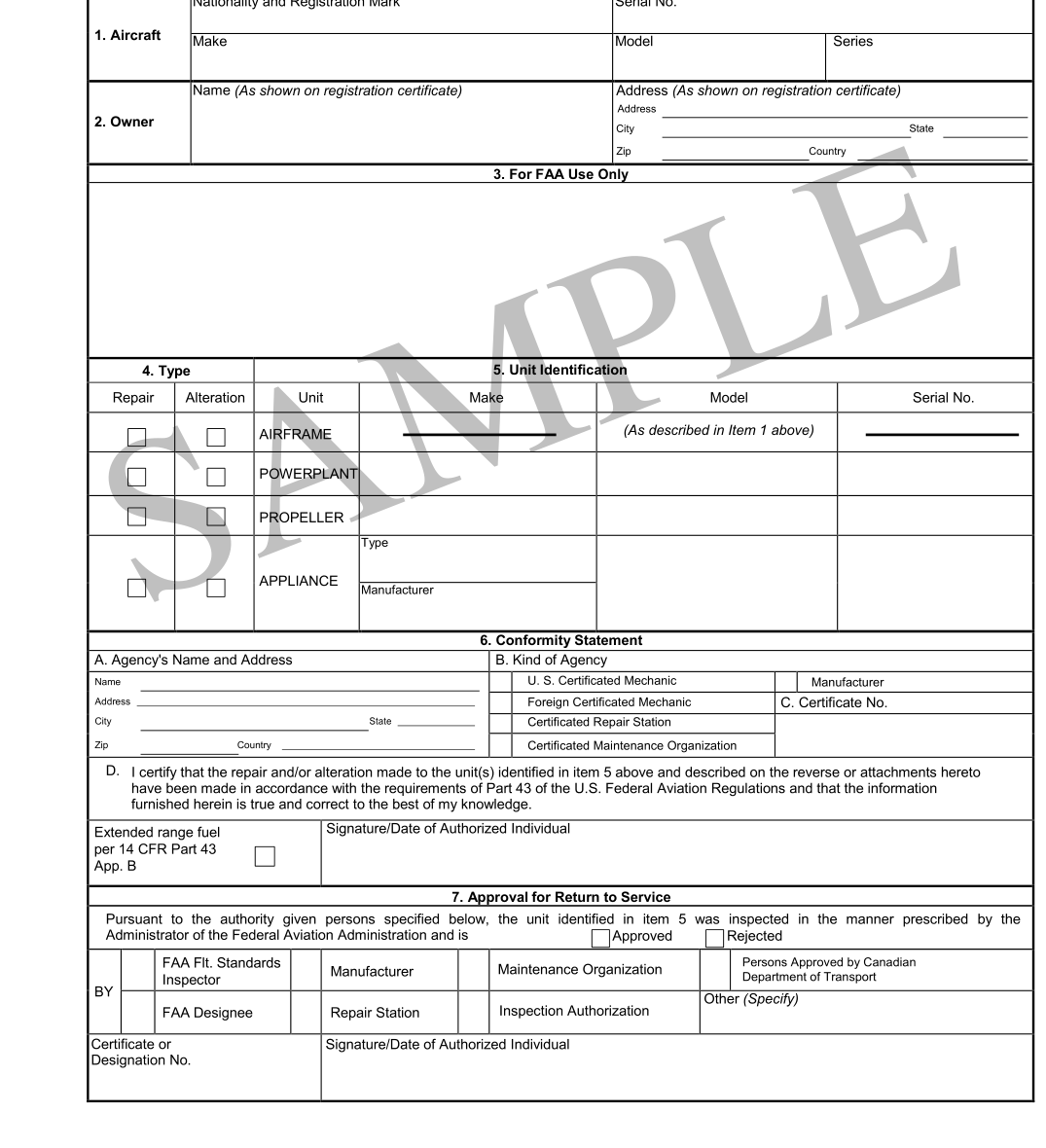
When an aircraft mechanic or repair station performs routine maintenance, the work is recorded in the aircraft logbooks and the airplane is returned to service with a simple sign-off. But certain jobs go well beyond routine — welding a cracked primary structural member, installing a supplemental type certificate (STC) modification, or rebuilding an engine component in a way not described by the manufacturer's maintenance manual. These are major repairs and major alterations, and they require a specific, standardized paper trail: FAA Form 337, Major Repair and Alteration. Understanding when Form 337 is required, how it is completed, who can approve it, and where it ultimately goes is essential knowledge for any aviation maintenance technician (AMT) and a cornerstone of the FAA AMT General knowledge test.
Form 337 is not merely a bureaucratic formality. It creates an official, permanent record that the work was performed to FAA-accepted data and that the aircraft was properly returned to service. Without it, a major repair or alteration has no legal authorization, and the aircraft may not legally fly.
Regulatory Foundation
14 CFR Part 43 governs maintenance, preventive maintenance, rebuilding, and alteration of civil aircraft. Appendix A to Part 43 defines what constitutes a major repair or major alteration by listing the categories for airframes, powerplants, propellers, and appliances. Appendix B specifies who can approve and how to record major repairs and alterations — and it is Appendix B that makes Form 337 mandatory for this class of work. Section 43.9 covers the general record-keeping requirements for all maintenance, while Section 43.11 and Appendix B specifically address the return-to-service entry and Form 337 requirements for major work.
What Counts as Major?
Not every repair or modification requires a 337. The regulations distinguish between minor and major work based on the potential effect on structural strength, flight characteristics, or other airworthiness qualities.
- Major repair: A repair that, if improperly done, might appreciably affect structural strength, flight characteristics, or other airworthiness qualities of the aircraft, or that is not done according to accepted practices or cannot be done by elementary operations. Examples include repairing primary load-bearing structures, welding of the engine mount, and fabric covering of primary flight control surfaces.
- Major alteration: An alteration not listed in the aircraft, engine, or propeller specifications that might appreciably affect structural strength, flight characteristics, powerplant operation, or other airworthiness qualities, or that is not done in accordance with accepted practices. Classic examples include installing an STC modification, changing the engine to a different model, or cutting a new door opening in the fuselage.
Part 43 Appendix A provides detailed lists for each category — airframe, powerplant, propeller, and appliances — so the AMT must consult those lists carefully rather than rely on intuition alone. When in doubt, contacting the local Flight Standards District Office (FSDO) for guidance is always appropriate.
Who Can Approve Major Repairs and Alterations?
The authority to sign off major repair and alteration work is more restricted than for routine maintenance. The following persons may approve major repairs and alterations for return to service:
- An FAA-certificated Airframe and Powerplant (A&P) mechanic with Inspection Authorization (IA) — this is the most common approver for field maintenance on U.S.-registered general aviation aircraft.
- A certificated repair station (holding the appropriate rating) under 14 CFR Part 145, using its quality system and authorized personnel.
- The aircraft manufacturer, when it performs work on its own product.
- An FAA Aviation Safety Inspector (ASI), who may issue a field approval for work performed to FAA-acceptable data when no other approved data exists.
A standard A&P mechanic without an IA may perform the work but cannot approve it for return to service — a crucial distinction that appears frequently on knowledge tests.
Approved Data: The Technical Backbone
Before a Form 337 can be completed, the person performing the work must have approved data authorizing the specific repair or alteration. Approved data comes from several sources:
- FAA-approved manufacturer's data, such as Structural Repair Manuals (SRMs) or maintenance manuals that explicitly describe the repair procedure.
- Airworthiness Directives (ADs) issued under 14 CFR Part 39, which may also specify repair methods.
- Supplemental Type Certificates (STCs), which carry FAA-approved installation and maintenance instructions for alterations.
- FAA Advisory Circulars that are incorporated by reference into an approved method, such as AC 43.13-1 (Acceptable Methods, Techniques, and Practices — Aircraft Inspection and Repair), which may be used as approved data for certain repairs when no other approved data exists.
- Field approvals granted by an FAA ASI on Form 337 itself — the inspector reviews engineering data, makes a finding of airworthiness, and approves the Form 337 in Block 3 on behalf of the FAA.
Completing FAA Form 337
Form 337 has a standard two-page format. The AMT or repair station completing the form must fill in all required blocks accurately. Key blocks include:
- Block 1 — Aircraft identification: Nationality and registration marks, aircraft serial number, make, and model.
- Block 2 — Owner information: Name and address of the aircraft owner.
- Block 3 — For FAA use only (Field Approval): Completed by an FAA inspector if a field approval is being granted. If approved data already exists and no field approval is needed, this block is left to the FAA's use after submission.
- Block 4 — Unit identification: Identify the specific unit (airframe, engine, propeller, appliance) affected, including make, model, and serial number.
- Block 5 — Type of work: Check whether the work is a repair or an alteration, and identify it as a major repair, major alteration, or both.
- Block 6 — Conformity statement: A narrative description of the work performed, the approved data used, and how the item conforms to that data. This is the technical heart of the form. Descriptions must be clear enough that another qualified mechanic could understand exactly what was done and verify conformity.
- Block 7 — Approval for return to service: The IA, repair station, or other authorized person signs and certifies the work was completed and the article is approved for return to service.
- Block 8 — Certification by manufacturer: Used when the work is performed by the manufacturer.
Additional pages or supplemental data sheets may be attached to Block 6 when the description requires more space, which is common for complex structural repairs or STC installations. These attachments become part of the official 337 record.
Distribution and Record Retention
Under 14 CFR Part 43, Appendix B, Form 337 disposition works as follows:
- Original: Must be given to the aircraft owner, who keeps it as part of the aircraft's permanent maintenance records; it must remain with the aircraft and be made available for inspection upon request.
- Copy: Must be forwarded by the person approving the work to the local FSDO within 48 hours after the aircraft is approved for return to service. This copy becomes part of the FAA's permanent aircraft records.
These record retention requirements flow from 14 CFR Part 43 Appendix B and are frequently tested. The 48-hour rule and the requirement that the owner's original be kept permanently are details that many test-takers confuse or overlook.
Why Form 337 Matters
From a safety standpoint, the Form 337 system ensures that any significant departure from the aircraft's type design is reviewed, documented, and traceable. A future owner, mechanic, or inspector can pull the aircraft's records and know exactly what major work has been done, what data authorized it, and who approved it. This traceability is vital during accident investigations, pre-purchase inspections, and annual inspections. An IA performing an annual inspection on an aircraft that had undocumented major work done may be unable to certify airworthiness — a serious consequence for both the owner and any mechanic who originally failed to file the form.
Key Numbers and Rules
- Form 337 is required for all major repairs and major alterations as defined in 14 CFR Part 43, Appendix A.
- A copy must be forwarded to the FSDO within 48 hours after return to service.
- The original must be given to the owner and retained permanently with the aircraft records.
- An A&P mechanic without an IA can perform major repair/alteration work but cannot approve it for return to service.
- Approved data must exist before the work begins (or a field approval must be obtained).
- AC 43.13-1 may serve as approved data for repairs where no manufacturer data exists, but the AMT must still document this data source on the Form 337.
- Repair stations under Part 145 use their own quality system but must still generate Form 337 for major work.
Common Test Traps
- A&P vs. IA confusion: Many questions try to trick you into thinking any certificated A&P can approve major repair work. Remember: performing and approving are two different acts. Only an IA, repair station, manufacturer, or FAA inspector can approve major work for return to service.
- The 48-hour rule: Students frequently forget that a copy of Form 337 must reach the FSDO within 48 hours of return to service — not 30 days, not at annual time, but within two days.
- Original vs. copy, two destinations: The original goes to the aircraft owner and stays with the aircraft's permanent records; a copy goes to the FSDO within 48 hours. A common distractor reverses this, claiming the original goes to the FSDO and a copy stays with the aircraft.
- Minor vs. major classification: The test will present scenarios and ask whether a Form 337 is needed. Always refer mentally to Part 43 Appendix A definitions. Painting an aircraft (usually minor), recovering a primary flight control surface (major) — the distinction matters.
- Field approval on the 337 itself: Some students think a field approval is a separate document. In practice, the FAA ASI's approval is entered directly in Block 3 of Form 337, making the form itself the instrument of approval. There is no separate field approval certificate.