Effective IFR route selection is one of the most consequential decisions an aircraft dispatcher makes before every flight. Filing a route that ATC will accept without amendment saves time, fuel, and operational disruption. Three planning tools sit at the core of this process: Preferred IFR Routes, Tower Enroute Control (TEC) Routes, and Coded Departure Routes (CDRs). Each tool serves a distinct purpose, and together they form the foundation of a professional, ATC-compatible flight plan. Understanding how and when to apply each one is essential knowledge for the FAA Aircraft Dispatcher Certificate written examination and for daily dispatch practice.
These routes are published by the FAA and updated regularly in official sources including the Chart Supplement U.S. (formerly Airport/Facility Directory), the Aeronautical Information Manual (AIM), and the FAA's National Flight Data Center (NFDC). Dispatchers must know where to find them, how to read them, and why they exist in the first place.
Preferred IFR Routes
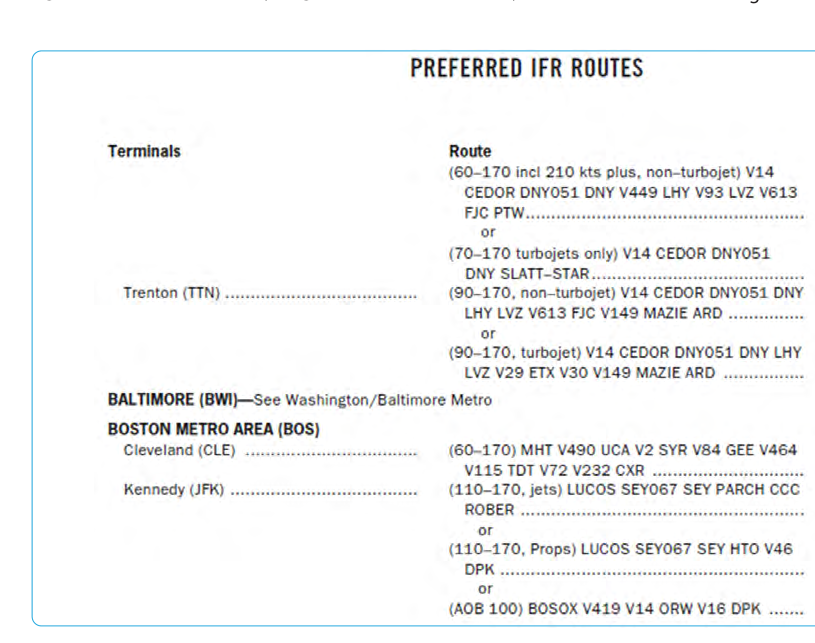
Preferred IFR Routes are pre-established, ATC-approved routings between pairs of airports that the FAA has determined best accommodate the flow of traffic through the National Airspace System (NAS). They are divided into High Altitude Preferred Routes (for jet routes and RNAV routes above FL 180) and Low Altitude Preferred Routes (for Victor airways and RNAV routes below FL 180). Some routes are further designated as Preferred Departure Routes or Preferred Arrival Routes, specifying directionality.
When a preferred route exists for a city pair, ATC expects dispatchers and pilots to file it. Failure to do so may result in a flight plan amendment, a ground delay, or a reroute clearance after departure — all of which waste fuel and disrupt schedule integrity. The AIM notes that these routes are listed in the Chart Supplement U.S. and reflect the most efficient flow considering traffic volume, airspace structure, and ARTCC boundary crossings. Dispatchers should query available routes before building any IFR flight plan for a city pair that might have a preferred routing on file.
The notation in the Chart Supplement identifies the departure airport, the arrival airport, the route string (using fixes, airways, and navaids), and sometimes a restriction such as an altitude floor or a time of day. For example, a route might be listed only for westbound operations or only during specific hours when traffic flow on that corridor is heaviest. Reading these qualifiers carefully is as important as identifying the route itself.
How to Use Preferred Routes Operationally
Before building a flight plan, a dispatcher should check the Chart Supplement for preferred routes between the origin and destination. If a matching route exists and the aircraft's equipment and cruise altitude are compatible, the dispatcher should file that route. If the published route uses navaids the aircraft is not equipped to use, or if performance constraints prevent the listed altitude, the dispatcher should contact ATC or file the closest compatible alternative and note the deviation reason in the flight release documentation.
Tower Enroute Control (TEC) Routes
Tower Enroute Control routes — universally called TEC routes — are a specialized subset of IFR routing that allow instrument flights to proceed entirely within the jurisdiction of TRACON (Terminal Radar Approach Control) facilities, without being handed off to an ARTCC en route center. Because TEC flights never enter ARTCC-controlled airspace, they require less coordination and often result in faster, more predictable clearances.
TEC routes are designed for relatively short flights — typically between airports that are close enough to remain within overlapping TRACON coverage throughout the flight. They are particularly common in areas with densely overlapping terminal airspace, such as Southern California (SoCal TRACON), the New York metropolitan area, and the Dallas–Fort Worth corridor. A flight from Los Angeles International (KLAX) to San Diego International (KSAN), for instance, may qualify for a TEC route entirely within SoCal TRACON without ever contacting Los Angeles Center.
TEC routes are also listed in the Chart Supplement U.S. under the IFR Takeoff Minimums and (Obstacle) Departure Procedures section and within the TEC route listings for each applicable TRACON region. The listing specifies the departure and arrival airport, the route string, and the maximum altitude. Most TEC routes have an altitude cap, often at or below FL 230, because the route must remain within TRACON jurisdiction. Dispatchers filing TEC routes must ensure the filed altitude does not exceed the listed maximum.
From a dispatch perspective, TEC routes offer a meaningful operational advantage: they tend to receive priority processing and are less susceptible to EDCT (Expect Departure Clearance Time) ground delay programs that affect ARTCC-controlled traffic. However, they are generally unsuitable for flights requiring high cruise altitudes or flights that would benefit from ARTCC direct routing for fuel efficiency. The dispatcher must weigh these trade-offs for each operation.
Coded Departure Routes (CDRs)
Coded Departure Routes are pre-coordinated rerouting options that the FAA Traffic Management Unit (TMU) can assign to flights as Traffic Management Initiatives (TMIs) during periods of airspace congestion, severe weather deviations, or system outages. CDRs are especially valuable during convective weather events when primary routing through affected airspace becomes unavailable and large numbers of flights must be rerouted simultaneously.
Each CDR is identified by a coded alphanumeric identifier that generally begins with the three-character departure airport identifier followed by the three-character destination airport identifier, plus a route/suffix identifier that distinguishes the specific alternative routing. The exact length of this suffix portion is not rigidly fixed across the National Playbook, so dispatchers should not assume every CDR follows a strict eight-character format. For example, ORDDFWNW would represent a CDR from Chicago O'Hare (ORD) to Dallas/Fort Worth (DFW) with a specific northwest-deviation routing.
CDRs are stored in the FAA's National Playbook and are filed in advance by airline operations centers and dispatch departments. A carrier that has pre-filed a CDR for a given city pair has effectively pre-negotiated an alternative route string with the FAA. When the TMU activates that CDR, ATC can issue the coded amendment to all affected flights quickly and uniformly — instead of building custom reroutes flight by flight. This dramatically reduces controller workload and speeds clearance delivery during high-demand events.
To take advantage of CDRs, a dispatcher must include the CDR code in the remarks section of the IFR flight plan before departure, using the format CDR/XXXXXXXX matching the specific code assigned to that routing. If the CDR is not pre-filed, ATC cannot use it as a rapid amendment tool during a traffic management initiative, and the flight must wait for a manually negotiated reroute. Carriers operating under Part 121 with active dispatch agreements are strongly encouraged to pre-file applicable CDRs whenever convective weather or airspace constraints are forecast along the planned route.
Why These Tools Matter to the Dispatcher
The dispatcher's legal responsibility under 14 CFR Part 121 is to jointly share authority over flight release with the pilot-in-command. Route selection is central to that responsibility. A dispatcher who ignores preferred routes, fails to consider TEC alternatives for short-haul operations, or neglects to pre-file CDRs during convective weather forecasts is not meeting the standard of a competent, safety-conscious dispatcher. Each of these tools exists to reduce uncertainty, improve predictability, and keep flights moving safely through a complex national system.
Beyond legal compliance, these routing tools have a direct economic impact. Unanticipated reroutes burn additional fuel. Ground delay programs triggered by non-preferred route filings disrupt passenger connections and crew scheduling. A dispatcher who files preferred routes, uses TEC where appropriate, and arms flights with CDRs is actively protecting the airline's operational and financial interests while also reducing controller workload — a benefit to the entire NAS.
Key Numbers and Rules
- Preferred IFR Routes: Published in the Chart Supplement U.S.; divided into high altitude (at or above FL 180) and low altitude (below FL 180) routes.
- TEC Routes: Confined to TRACON airspace; typically capped at or below FL 230; published in the Chart Supplement under TEC route listings.
- CDR Code Format: Generally begins with a three-character departure airport identifier and a three-character destination airport identifier, followed by a route/suffix identifier; the National Playbook does not enforce a single rigid total character count across all CDRs.
- CDR Filing: Must be pre-filed in the remarks section of the IFR flight plan as CDR/XXXXXXXX using the specific code assigned to the routing before the flight departs to be usable as a traffic management tool.
- CDR Activation Authority: FAA Traffic Management Units (TMUs) activate CDRs; individual ATC facilities and airlines cannot activate them unilaterally.
- Chart Supplement Updates: Published every 56 days; preferred routes and TEC listings are updated accordingly and dispatchers must use current editions.
Common Test Traps
- Confusing TEC routes with RNAV Q-routes: TEC routes are specifically designed to remain within TRACON airspace; Q-routes are high-altitude RNAV airways in ARTCC airspace. They are entirely different structures.
- Assuming preferred routes are mandatory for all operations: They are strongly recommended and operationally expected, but the FAA does not legally prohibit filing a non-preferred routing — however, doing so significantly increases the chance of amendment or delay.
- Forgetting the altitude cap on TEC routes: Exam questions often present a TEC scenario with a requested cruise altitude above the published maximum; the dispatcher must recognize the TEC route is invalid at that altitude.
- Misidentifying the CDR code structure: Some candidates assume every CDR strictly follows an eight-character departure (3) + destination (3) + suffix (2) pattern; in practice the departure and destination identifiers are consistent, but the suffix portion is not a fixed universal length across the National Playbook.
- Not pre-filing the CDR: Simply knowing a CDR exists is not enough. If the code is not in the filed flight plan remarks before departure, ATC cannot use it during a traffic management initiative.