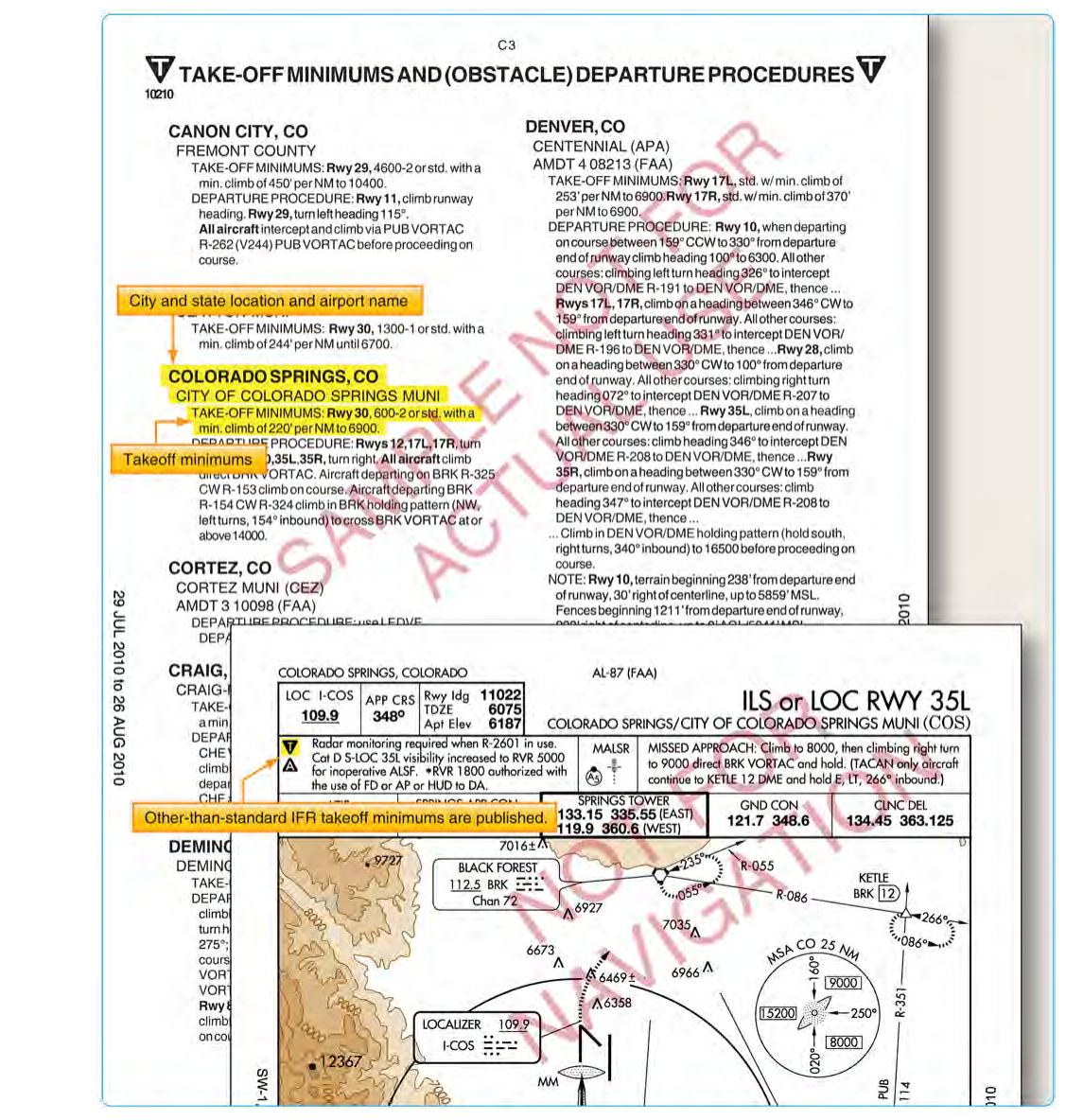
When you file an IFR flight plan and taxi to the runway, the weather outside may or may not meet the conditions required to legally and safely depart. Takeoff minimums are the official weather standards—expressed in terms of ceiling and/or visibility—that govern whether an IFR departure may begin. Unlike VFR weather minimums, which are spelled out clearly in 14 CFR Part 91.155, takeoff minimums for IFR operations are addressed under 14 CFR Part 91.175 for Part 91 operators and under more stringent rules for commercial operators flying under Parts 121 and 135.
Understanding the difference between standard and non-standard takeoff minimums is a core instrument rating topic. It touches on chart reading, regulatory awareness, and the kind of aeronautical decision-making that keeps an IFR pilot from departing into conditions that offer no realistic path to a safe outcome. This article walks through both categories in depth, explains where and how these minimums are published, and highlights the practical cockpit implications.
Standard Takeoff Minimums
The FAA has established a baseline—a default set of conditions that apply when no other specific minimums have been prescribed for a particular runway and airport. These are called the standard takeoff minimums, and they differ based on the number of engines on the aircraft:
- One or two engines: 1 statute mile visibility
- Three or more engines: ½ statute mile visibility
Notice that standard minimums are expressed purely in terms of visibility—there is no ceiling requirement built into the standard. This means a legal standard-minimum departure could theoretically occur in an overcast at 100 feet AGL, provided visibility is at or above the applicable threshold. In practice, of course, a departure in those conditions requires careful planning and a thorough understanding of the departure environment, obstacle clearance, and what happens if an engine fails immediately after liftoff.
These minimums exist because the FAA determined that they provide an acceptable baseline level of obstacle avoidance capability for typical aircraft performance. A multi-engine aircraft with three or more engines has more performance margin to climb away from obstacles even with a power unit lost, hence the lower visibility requirement. A single or light twin has less reserve performance, so a greater visibility cushion is required so the pilot has more time and reference to react.
Non-Standard Takeoff Minimums
Not every airport environment is the same. Some runways have rising terrain immediately off the departure end, tall towers in the climb corridor, or other obstacles that make the standard minimums inadequate. In these cases, the FAA publishes non-standard takeoff minimums, which may include a higher visibility requirement, an explicit ceiling requirement, specific climb gradients, or restrictions tied to particular runways or departure routes.
Non-standard minimums are also published when a runway simply has no published takeoff minimums at all—for instance, when a runway is not authorized for IFR departures under instrument meteorological conditions. Pilots must know both possibilities: a runway can carry higher-than-standard requirements, or it can be restricted outright.
How to Find Non-Standard Minimums
Non-standard takeoff minimums are published in the front section of the Terminal Procedures Publication (TPP)—the booklet or digital equivalent that contains all instrument approach procedure (IAP) charts for a given geographic region. This front section is formally titled Takeoff Minimums and Obstacle Departure Procedures, often called the "front matter" or the "TPP introduction."
On individual instrument approach charts, a bold "T" in a black triangle (▲T) appears in the notes section of the airport's approach chart when non-standard takeoff minimums or departure procedures exist for any runway at that airport. This symbol is your cue to look up the specifics in the front matter before departing. Critically, the triangle-T appears on the approach chart, not on a separate departure chart—so even if you are only using the airport for departure, you must check the relevant approach chart for that symbol and then consult the front matter.
Similarly, an ▲D symbol (bold "D" in a black triangle) indicates that a textual Obstacle Departure Procedure (ODP) exists for the airport. Both symbols can appear together or independently.
Obstacle Departure Procedures and Climb Gradients
Non-standard minimums frequently include a minimum climb gradient expressed in feet per nautical mile. The standard instrument departure climb gradient assumed by the FAA is 200 feet per nautical mile (roughly equivalent to a 3.3% climb), which provides the baseline obstacle clearance for published procedures. When an airport's terrain or obstacle environment demands more, the procedure will specify a higher gradient—for example, 300 or 400 feet per nautical mile—sometimes up to a specified altitude.
To use these climb gradients practically, a pilot must know their aircraft's climb performance. Ground speed affects the rate of climb required: the faster the aircraft flies, the higher the climb rate in feet per minute needed to achieve the required gradient. The formula is straightforward: Required climb rate (fpm) = Climb gradient (ft/NM) × Ground speed (NM/min). For example, a 300 ft/NM gradient at a ground speed of 120 knots (2 NM/min) requires a climb rate of 600 fpm. Checking the aircraft's Pilot Operating Handbook to confirm it can achieve this—especially on a hot day, at high density altitude, or at maximum gross weight—is an essential preflight step.
Some non-standard minimums also specify that a certain visibility or ceiling must exist before a specific climb gradient is required. For instance, a procedure might state: "With a minimum climb gradient of 350 ft/NM to 1,800 feet, takeoff minimums are standard; otherwise, takeoff is not authorized." This means the pilot may only depart if the aircraft can meet 350 ft/NM or, if it cannot, the departure from that runway is simply not permitted under instrument conditions.
Part 91 vs. Commercial Operators
Here is an important regulatory distinction the written test loves to probe: Part 91 operators (private pilots and most general aviation flight) are not legally required to comply with published takeoff minimums. Under 14 CFR 91.175(f), Part 91 pilots may legally depart even when weather is below the published takeoff minimums or even in zero-zero conditions, as long as no specific regulation prohibits it. The FAA places the responsibility for safety on the pilot-in-command.
This is in sharp contrast to Part 121 and Part 135 operators (airlines and commercial/charter operators), who are legally bound by published takeoff minimums and may not depart below them. These operators also frequently apply alternate takeoff minimums—higher values required when certain conditions exist—as specified in their operations specifications.
For instrument rating students, the key lesson is this: even though Part 91 legally allows departing below minimums, it rarely makes aeronautical sense. If you cannot see far enough to identify and avoid obstacles, return to the runway environment if something goes wrong, or navigate the initial climb safely, the departure is dangerous regardless of its technical legality. The standard and non-standard minimums represent carefully calculated safety thresholds—ignoring them demands exceptional justification.
Key Numbers and Rules
- 1 SM visibility — standard takeoff minimum for 1- and 2-engine aircraft (Part 91 baseline).
- ½ SM visibility — standard takeoff minimum for aircraft with 3 or more engines.
- 200 ft/NM — standard assumed climb gradient for obstacle clearance on departure.
- ▲T symbol on approach charts — signals non-standard takeoff minimums exist; check the front matter of the TPP.
- ▲D symbol on approach charts — signals a textual Obstacle Departure Procedure exists.
- Part 91 pilots are NOT legally required to comply with published takeoff minimums, but safety demands that they do.
- Part 121/135 pilots are legally required to comply with published takeoff minimums.
- Non-standard minimums may include a ceiling requirement, higher visibility, specific climb gradients, or a combination of all three.
Common Test Traps
- Assuming standard minimums always apply. If the approach chart shows a ▲T, there are non-standard minimums. Many students skip the front matter and depart without knowing their actual requirements.
- Confusing the ▲T and ▲D symbols. The T means non-standard takeoff minimums; the D means an Obstacle Departure Procedure exists. Both can appear simultaneously, and each has a different implication. Know both.
- Thinking Part 91 is exempt from planning for minimums. The exam often tests whether students know Part 91 operators are not legally required to follow takeoff minimums—but it also tests whether students understand that failing to plan for obstacles is operationally dangerous. The answer depends on which angle the question is probing.
- Misapplying the engine count rule. The ½ SM standard applies to three or more engines, not to twins. A twin (two engines) still requires 1 SM under standard minimums.
- Forgetting climb gradient arithmetic. Test questions may give a required climb gradient in ft/NM and a ground speed, then ask for the required climb rate in fpm. Practice the formula: gradient × ground speed in NM/min = required fpm.