S-Turns Across a Road
S-turns are a series of equal half-circles flown on opposite sides of a straight ground reference line. The goal is to keep each semicircle the same size despite the wind, which forces you to vary the bank continuously throughout each turn.
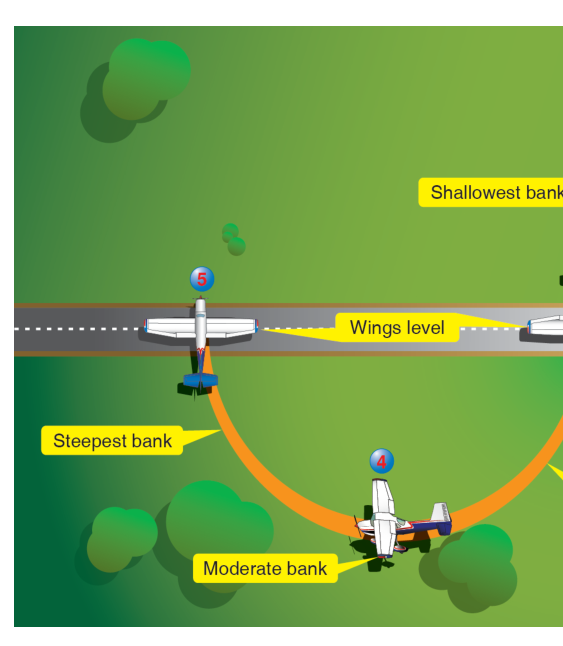
Step by step
- 1Choose a straight road or section line that is roughly perpendicular to the wind. Set a constant low maneuvering altitude.
- 2Cross the road with wings level, flying directly downwind so the first turn begins where groundspeed is highest.
- 3Immediately roll into the steepest bank as you cross, because the tailwind component is greatest there.
- 4As the turn progresses and the wind becomes a crosswind then headwind, gradually shallow the bank so the radius stays constant.
- 5Arrive back at the road wings level, flying perpendicular to it, then roll into the opposite-direction turn.
- 6On the upwind half-circle, start with the shallowest bank and steepen it as groundspeed increases toward the road.
- 7Each crossing of the road should be at a 90° angle with wings level; each semicircle should be the same diameter.
Tips & common errors
- Think "steepest bank where groundspeed is highest" — that is the downwind side, right as you cross the road.
- Common error: unequal semicircles, usually from not varying the bank fast enough — bank changes are continuous, not stepped.
- Common error: crossing the road at an angle other than 90° with the wings not level.
- Keep altitude constant; new pilots tend to climb in the shallow part of the turn and descend in the steep part.
ACS completion standards
The commonly-tested tolerances for this maneuver. Always confirm the current ACS for your certificate.
- Maintain altitude ±100 feet.
- Maintain airspeed ±10 knots.
- Cross the reference line with wings level and at a constant distance from the turn radius (equal semicircles).
- Reverse the direction of turn directly over the reference line.
FAA source
FAA-S-ACS-6 (Private Pilot ACS), Task: S-Turns; Airplane Flying Handbook FAA-H-8083-3, Chapter 6 (Ground Reference Maneuvers).
This is an original, plain-English study summary grounded in the public-domain FAA Airman Certification Standards and FAA handbooks cited above. It is a study aid, not flight instruction, and not a substitute for the official ACS, the handbooks, your aircraft’s POH/AFM, or a certificated flight instructor.
Related maneuvers
- Rectangular CourseThe rectangular course teaches you to fly a constant, equal distance from a square or rectangular ground feature while correcting for wind. It directly simulates the airport traffic pattern, so it builds the division of attention and wind-drift correction you use on every approach.
- Turns Around a PointYou fly two or more complete, constant-radius circles around a single ground reference point while correcting for wind. The bank angle must change continuously through every 360° so the distance from the point never varies.
- Eights on PylonsEights on pylons (also called eights-on) is the most advanced ground reference maneuver. Instead of holding a constant distance, you hold an imaginary line of sight from your eye, out the wingtip reference, onto each pylon — which requires flying at the pivotal altitude. The pivotal altitude changes with groundspeed, so you climb and descend slightly to keep the line of sight pinned to the pylon.
- Normal Takeoff & ClimbThe normal takeoff and climb is the baseline departure from a paved runway with little or no wind and no obstacles. You accelerate on the centerline, rotate at the recommended speed, and climb at the best-rate speed (Vy) while staying coordinated.
Keep studying
Turn maneuver knowledge into a passing checkride
Drill ACS-aligned questions and ask the AI tutor, Ace, anything — free to start, no account needed.
Take a free practice test →