The FAA Part 107 Knowledge Test: What’s on It and How to Pass
What Is the FAA Part 107 Knowledge Test?
If you want to fly a drone commercially in the United States, the FAA Part 107 knowledge test stands between you and your Remote Pilot Certificate. Officially known as the Unmanned Aircraft General – Small (UAG) exam, it is administered at FAA-approved testing centers nationwide and covers a surprisingly broad range of aeronautical topics. Whether you are a hobbyist looking to turn your passion into a profession or a seasoned manned-aircraft pilot adding a new credential, understanding exactly what is on this test — and how to study for it — is the first step toward earning your certificate.
Who Needs to Take the FAA Part 107 Knowledge Test?
Under FAA regulations, anyone who wants to operate a small unmanned aircraft system (sUAS) for compensation or hire must hold a Remote Pilot Certificate with a small UAS rating. To qualify for the test, applicants must meet several well-established requirements:
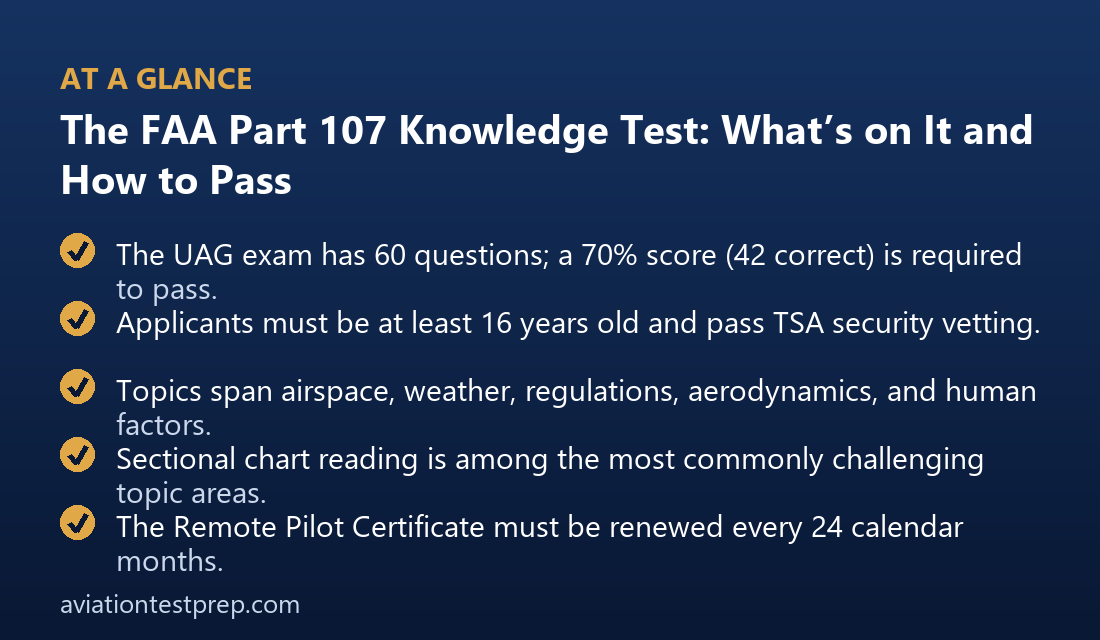
- Be at least 16 years of age
- Be able to read, speak, write, and understand English
- Be in a physical and mental condition to safely operate a small UAS
- Pass the FAA aeronautical knowledge test (UAG) at an approved testing center
- Pass a TSA security vetting process
Testing fees and any associated regulatory details can change, so always confirm the latest requirements directly at faa.gov/uas before you register.
What Topics Are Covered on the FAA Part 107 Knowledge Test?
The UAG exam consists of 60 questions, and you must score 70% or higher to pass. The subject matter is drawn from the FAA's Airman Certification Standards (ACS) for Remote Pilots and spans several aeronautical knowledge areas. Here is a breakdown of the major topic areas you can expect:
Regulations and Airspace
- Part 107 rules — operational limitations, waivers, and certificate requirements
- Airspace classification — Class A through G, special-use airspace, and temporary flight restrictions (TFRs)
- LAANC and DroneZone authorizations — how to obtain permission to fly in controlled airspace
Weather and Meteorology
- Reading and interpreting METARs, TAFs, and winds-aloft forecasts
- Understanding how weather phenomena — density altitude, turbulence, and fog — affect sUAS operations
- Identifying weather hazards specific to low-altitude drone flight
Loading, Performance, and Aerodynamics
- How weight and balance affect sUAS performance and stability
- Basic aerodynamic principles as they apply to multirotor and fixed-wing drones
- Effects of density altitude on battery performance and lift
Emergency Procedures and Crew Resource Management
- Lost-link procedures and fly-away scenarios
- Responsibilities of the remote pilot in command (Remote PIC)
- Communication and coordination with visual observers
Radio Communications and Airport Operations
- Basic radio phraseology used at uncontrolled airports
- Understanding CTAF frequencies and traffic patterns
- How manned and unmanned aircraft share airspace safely
Physiological Factors
- Effects of fatigue, stress, and medication on pilot performance
- Hazardous attitudes and aeronautical decision-making (ADM)
The breadth of these topics surprises many first-time test-takers. The FAA designed the test to ensure that drone pilots understand the entire National Airspace System (NAS), not just the rules specific to drones. That means you will encounter aeronautical charts, sectional legends, and weather products that look identical to those found on the Private Pilot written exam.
How to Study for the FAA Part 107 Knowledge Test
Knowing the topic list is helpful, but having a structured study strategy is what separates confident test-takers from those who leave the testing center wishing they had prepared differently. Here is a proven 5-step study method used by Aviation Test Prep learners:
- Audit what you already know. Take a free practice test first. Your diagnostic score tells you exactly which ACS knowledge areas need the most attention, so you are not wasting time on topics you already understand.
- Study by ACS code, not just topic. The FAA organizes every question around specific Airman Certification Standards codes. Aviation Test Prep maps every practice question to its ACS code, so you can drill down precisely where you are weak. Browse the full ACS code library at aviationtestprep.com/acs-codes.
- Use spaced repetition. Don't cram the night before. Study in shorter daily sessions — 30 to 45 minutes — spread over two to four weeks. Spaced repetition is one of the most research-backed techniques for long-term retention.
- Ask Ace for explanations. When a practice question stumps you, don't just move on. Ace, Aviation Test Prep's AI tutor, explains the why behind each answer in plain language — covering the underlying regulation, aeronautical concept, or chart-reading skill so the knowledge actually sticks.
- Simulate test conditions. In the final week of your prep, take full 60-question timed practice exams. Simulating the real testing environment reduces anxiety and helps you manage your time effectively on test day.
Reading Sectional Charts: The Topic That Trips Up the Most Candidates
Of all the subjects on the FAA Part 107 knowledge test, sectional aeronautical charts tend to generate the most anxiety among candidates who have never flown a manned aircraft. The exam will ask you to identify airspace boundaries, read magenta and blue airport symbols, interpret ceiling and visibility requirements, and decode chart legend symbols.
The good news: you do not need to memorize the entire legend. You need to recognize the most common symbols and understand how they translate into operational go/no-go decisions for drone pilots. Aviation Test Prep's ACS-aligned practice questions include numerous chart-reading questions with detailed explanations, making this once-intimidating skill genuinely approachable.
Ready to pass your FAA written exam?