Every time a pilot sets the altimeter, checks a METAR, or interprets a surface analysis chart, they are interacting with the concept of atmospheric pressure. Yet pressure is invisible, and its behavior is counterintuitive until the underlying physics become clear. The FAA Aviation Weather Handbook (FAA-H-8083-28B), Chapter 8, provides the definitive foundation: atmospheric pressure is the force per unit area exerted by the weight of the atmosphere, and that weight changes continuously with altitude, temperature, and humidity. Understanding these relationships is not merely academic — it directly affects whether your altimeter reads correctly and whether your aircraft performs as expected.
This article walks through how pressure is produced at the molecular level, how barometers measure it, which units are used in different contexts, and why pressure varies across the atmosphere in ways every pilot must internalize.
How Atmospheric Pressure Is Produced
The air around us is a mixture of gas molecules in constant, random motion. Each individual molecule is too small to feel, but every time a molecule strikes a surface it imparts a tiny force. Multiply that tiny force by the enormous number of molecular collisions occurring every second across every square inch of surface area, and the cumulative result is air pressure — a real, measurable force. Critically, because the molecules move in all directions — up, down, and sideways — air pressure acts in all directions simultaneously. This is why a sealed container does not collapse: the pressure inside pushes outward just as the atmosphere pushes inward.
As air density increases, more molecules occupy a given volume, producing more strikes per unit area per unit time. This means denser air exerts greater pressure. Conversely, thinner air (less dense) exerts less pressure. These two ideas — density driving pressure, and altitude reducing both — are the engine behind nearly every pressure-related phenomenon in aviation meteorology.
The Barometer: Weighing the Atmosphere
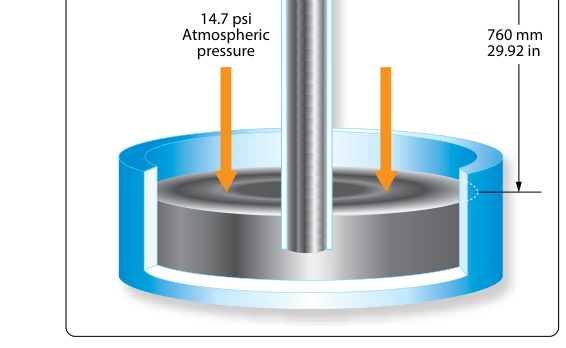
Because air has mass, Earth's gravity pulls it downward, giving the atmosphere weight. About three centuries ago, Evangelista Torricelli demonstrated this by balancing the atmosphere against a column of liquid mercury. He found that at sea level the atmosphere could support a mercury column roughly 29.92 inches (760 mm) tall. This elegant experiment proved that pressure could be expressed as the height of a fluid column — and gave birth to the barometer.
Modern aviation and meteorology rely on the aneroid barometer, which replaces liquid mercury with a sealed, flexible metal cell from which most of the air has been evacuated (creating a partial vacuum inside). As ambient pressure rises, the cell is compressed; as pressure falls, the cell expands. One end of the cell is fixed; the other end drives a mechanical linkage that magnifies the movement and moves an indicator hand across a scale calibrated in pressure units. Aneroid elements are compact, rugged, and safe to use in an aircraft — making them the basis for every aircraft altimeter and encoding altimeter in service today.
Units of Pressure: Millibars, Hectopascals, and Inches of Mercury
Atmospheric pressure is expressed in several units, and knowing which unit applies in which context prevents critical errors.
- Hectopascals (hPa): The SI unit adopted internationally after 1960. One hPa equals one millibar exactly. Standard sea-level pressure is 1013.2 hPa. This unit appears in METAR/SPECI reports worldwide (look for the "Q" group outside the U.S.).
- Millibars (mb or mbar): The traditional meteorological unit, still widely used on U.S. weather analysis charts. Numerically identical to hPa. Standard sea-level pressure is 1013.2 mb.
- Inches of mercury (inHg): The unit used for U.S. aviation altimetry. Standard sea-level pressure is 29.92 inHg. This is the value pilots dial into the Kollsman window of an altimeter.
- Pounds per square inch (psi): Common in U.S. engineering contexts. Standard sea-level pressure is 14.7 psi. Not used operationally for weather or altimetry.
A key practical point: hPa and mb are interchangeable numbers, so 1013.2 hPa = 1013.2 mb. When flying internationally, an ATC clearance may include an altimeter setting in hPa rather than inHg. A pilot who does not recognize the format risk setting the wrong value.
Station Pressure vs. Sea-Level Pressure
The pressure actually measured at an airport at its field elevation is called station pressure. Because pressure decreases with altitude, airports at higher elevations have inherently lower station pressures than airports at sea level, regardless of weather. Denver's station pressure is always lower than New Orleans' station pressure under identical atmospheric conditions simply because Denver sits more than a mile above sea level.
Station pressures from different airports are therefore not directly comparable. To solve this, meteorologists mathematically correct every station's measured pressure as if it were located at mean sea level (MSL). This correction adds back the pressure equivalent of the air column between the station and sea level. A rough approximation: pressure increases by about 1 inHg per 1,000 feet of descent. An airport at 5,000 feet MSL with a measured station pressure of 25 inHg would report a sea-level pressure of approximately 30 inHg (25 + 5 × 1). This sea-level pressure — also called altimeter setting when adjusted for local temperature — is what populates surface analysis charts and is used to compare pressure patterns across the country.
How Pressure Varies with Altitude
As you climb, the mass of air above you decreases, so the weight pressing down on you decreases. The result is a steady drop in atmospheric pressure with altitude. This pressure decrease is not perfectly linear — it is slightly exponential — but in the lower troposphere, the standard atmosphere approximation holds well. Crucially, the rate of pressure decrease depends on air temperature.
Warm air is less dense and physically expands upward, so the same pressure levels are found at higher altitudes in warm air than in cold air. Cold air is denser and contracts, so pressure levels are found at lower altitudes. The practical result: the rate of pressure decrease with altitude is less steep in warm air and more steep in cold air. This has a direct and dangerous implication for altimetry — in very cold air, your altimeter will read higher than your actual altitude. The AIM and FAA temperature correction guidance address this, particularly for instrument approach procedures in cold weather.
Air Density and Its Relationship to Pressure
Pressure and density are directly related. According to Boyle's law as applied to air, density increases with increasing pressure and decreases with increasing temperature. Water vapor also plays a role: humid air is actually less dense than dry air at the same pressure and temperature, because water vapor molecules (H₂O, molecular weight 18) are lighter than the nitrogen (N₂, molecular weight 28) and oxygen (O₂, molecular weight 32) they displace.
These density effects converge in the concept of density altitude — the altitude in the standard atmosphere at which the prevailing density would exist. High temperatures, high elevation, and high humidity all reduce air density and raise density altitude, degrading aircraft performance even when the altimeter reads a comfortable field elevation.
Key Numbers and Rules
- Standard sea-level pressure: 29.92 inHg / 1013.2 mb / 1013.2 hPa / 14.7 psi
- Standard lapse rate for pressure (approximate): pressure decreases roughly 1 inHg per 1,000 ft near sea level
- Altimeter setting is sea-level pressure corrected for local conditions — always reported in inHg in U.S. aviation
- 1 mb = 1 hPa exactly — these units are numerically interchangeable
- Warm air = lower pressure decrease rate with altitude; cold air = higher pressure decrease rate with altitude
- Humid air is less dense than dry air at equal pressure and temperature
- U.S. METAR altimeter setting uses inHg (e.g., A2992); international METAR uses hPa (e.g., Q1013)
Common Test Traps
- Confusing mb and hPa with inHg: Many students try to enter a hPa value directly into an altimeter designed for inHg, or assume the numbers are the same scale. 1013 hPa ≠ 1013 inHg. Convert correctly or use the appropriate instrument setting.
- Assuming station pressure equals altimeter setting: They are not the same. Station pressure is the raw measured value at field elevation; altimeter setting is corrected to sea level and then further adjusted. Using station pressure where altimeter setting is required will produce significant altimeter error at high-elevation airports.
- Forgetting cold-temperature altimeter error: Because pressure drops more steeply in cold air, an altimeter using standard atmosphere assumptions will read higher than your true altitude in cold conditions. The mnemonic is "High to Low, Look Out Below" — flying into lower pressure (or colder air) causes the altimeter to over-read.
- Thinking denser air means lower pressure: At the same altitude, denser air is associated with higher pressure. It is only as you ascend — moving to lower-pressure, lower-density air — that the two decrease together. Keep the cause-and-effect direction straight.
- Misidentifying the aneroid barometer's operating principle: Some students confuse the aneroid cell's vacuum-based expansion/contraction with a liquid-mercury mechanism. The aneroid contains no mercury; it works by flexing a partially evacuated metal capsule.