Most airports in the United States do not have an operating control tower. At these uncontrolled airports, there is no air traffic controller issuing takeoff clearances or sequencing traffic — pilots and remote pilots are responsible for seeing and avoiding each other. The primary tool for coordinating that self-separation is the Common Traffic Advisory Frequency (CTAF), a single radio frequency designated for pilots to broadcast their positions and intentions so everyone in the area can build a shared picture of the traffic environment.
For Part 107 remote pilots, understanding CTAF is not just an academic exercise. FAA regulations and the AIM make clear that sUAS (small unmanned aircraft systems) operators share the airspace with manned aircraft. Even though most consumer drones lack radios, a remote pilot must monitor and understand radio traffic to know who is flying nearby and to make smart go/no-go decisions before and during operations near airports.
What CTAF Is and How It Works
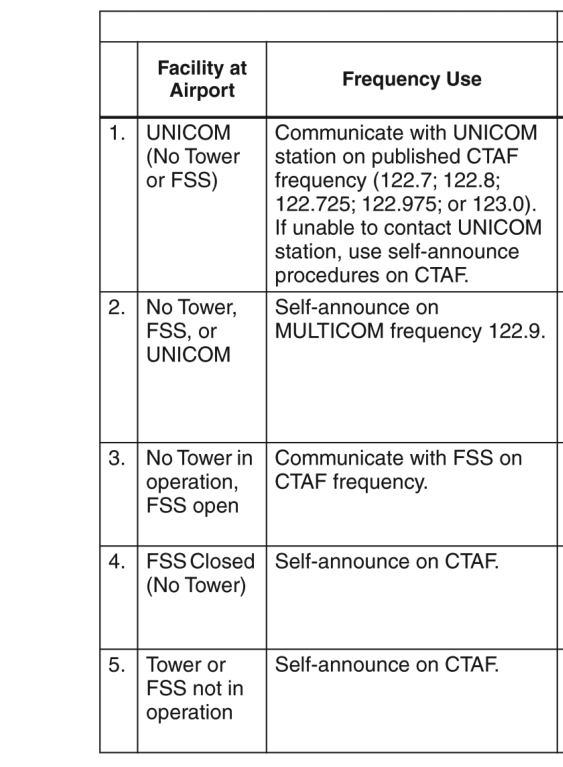
The CTAF is a designated radio frequency assigned to an airport for the purpose of carrying out airport advisory practices while operating to or from an airport without an operating control tower. At some airports, the CTAF is the same as the Unicom frequency — typically 122.8, 122.7, 122.725, 122.8, or 123.0 MHz — where a fixed-base operator (FBO) may also provide fuel prices, wind conditions, or runway-in-use information. At airports that have a part-time control tower, when the tower is closed the CTAF is the tower frequency itself. This is an important distinction: pilots switch to the tower frequency and self-announce on it when the tower is not operating.
The CTAF for a given airport is published in the Chart Supplement (formerly called the Airport/Facility Directory), on sectional aeronautical charts with a distinctive magenta or blue C inside a circle next to the frequency, and in the airport information blocks on instrument approach plates. Remote pilots conducting pre-flight planning should look up the CTAF for any airport within or near their operating area so they can monitor traffic on a handheld radio or scanner.
Position Reports and Self-Announce Procedures
The principle behind CTAF is self-announce: each pilot broadcasts their own position, altitude, and intentions without waiting to be asked. The AIM recommends a standard format designed to give other pilots the maximum useful information in the fewest words. A typical transmission follows this pattern:
- Airport name — stated twice at the beginning and once at the end to make sure everyone knows which airport is being referenced (multiple airports may share a CTAF frequency).
- Aircraft type and tail number — so other pilots can anticipate performance characteristics.
- Position and altitude — where the aircraft is right now relative to the airport or a recognizable landmark.
- Intentions — what the pilot plans to do next (entering downwind, turning base, short final, departing runway 27, etc.).
For example: "Smithville traffic, Cessna 172 November 4 5 2 Tango Foxtrot, 10 miles to the southeast at 3,500 feet, inbound for landing, Smithville." Recommended calls are made at specific points in the traffic pattern: entering the downwind leg, turning base, turning final, and upon clearing the runway. Pilots departing also announce intentions before taxiing, on the runway prior to takeoff, and after takeoff when turning crosswind.
The Traffic Pattern and Standard Left Traffic
Understanding CTAF transmissions requires knowing what a standard traffic pattern looks like. The FAA-recommended pattern consists of five legs flown at a standard altitude of 800 to 1,000 feet above airport elevation (check the Chart Supplement for published altitudes): the upwind, crosswind, downwind, base, and final legs. Turns in the pattern are made to the left by default unless the airport has a published right-traffic pattern, which is noted in the Chart Supplement with the notation "RP" followed by the runway number (sectional charts do not typically depict traffic pattern direction this way). A remote pilot operating near an uncontrolled airport must know whether aircraft will be arriving from the left or right side of the runway — this directly affects where to expect low-altitude manned traffic.
Unicom vs. MULTICOM vs. CTAF
These three terms cause frequent confusion, so let's define each precisely:
- CTAF: The designated frequency for traffic advisories at a specific airport. It is a role, not a specific frequency — the actual MHz value varies by airport.
- Unicom: A licensed aeronautical advisory station operated by a private entity (usually an FBO). When a Unicom is present, the Unicom frequency often serves as the CTAF. Pilots can request an airport advisory — wind, favored runway, known traffic — from the Unicom operator.
- MULTICOM: Frequency 122.9 MHz used at airports that have no Unicom and no tower. It is the CTAF when no other designated frequency exists. Remote pilots operating near very small, remote airstrips should be aware that manned aircraft may be broadcasting on 122.9.
When a control tower operates part-time, the published tower frequency becomes the CTAF during the tower's closed hours. This is published in the Chart Supplement and noted on approach plates. Pilots should never assume the airport is uncontrolled just because no one answers on the frequency — the tower may simply be closed, and everyone is self-announcing.
Why This Matters for Part 107 Remote Pilots
Part 107 rules require remote pilots to yield the right-of-way to all manned aircraft and to operate in a manner that does not create a hazard. Near uncontrolled airports, this means understanding where and when manned aircraft are likely to be at low altitude. Aircraft on final approach may be as low as 50 to 300 feet above ground level just before the runway threshold. Aircraft in the traffic pattern are typically at 800–1,000 feet AGL within a rectangle that extends roughly ½ to 1 mile from the runway centerline.
Before launching near an uncontrolled airport, a remote pilot should:
- Look up the CTAF and any pattern altitude in the Chart Supplement.
- Monitor the CTAF on a handheld radio or scanner before and during flight operations.
- Be aware of runway orientation and traffic pattern direction (left or right traffic).
- Note any published right-traffic patterns that shift where low-altitude aircraft will appear.
- Consider the hours of peak flight activity (often early morning and late afternoon) and plan operations accordingly.
If a remote pilot hears a manned aircraft announcing it is on short final, the prudent action is to land immediately or at minimum descend to the lowest safe altitude and move the drone away from the approach corridor.
Key Numbers and Rules
- Standard traffic pattern altitude: 800–1,000 feet AGL (verify the published altitude in the Chart Supplement).
- MULTICOM frequency: 122.9 MHz (airports with no Unicom or tower).
- Common Unicom frequencies include: 122.7, 122.725, 122.8, and 123.0 MHz.
- State the airport name twice at the beginning and once at the end of each CTAF call.
- Standard pattern turns are to the left; right-traffic airports are marked "RP" on charts.
- The CTAF at a part-time towered airport is the tower frequency when the tower is closed.
- Part 107 remote pilots must yield right-of-way to all manned aircraft per 14 CFR Part 107.37.
Memory Aid
For remembering the standard CTAF self-announce call sequence, use the phrase "Who, Where, What":
- Who — your aircraft type and identification (e.g., Cessna 172, N452TF)
- Where — your current position and altitude relative to the airport
- What — your intentions (entering downwind, turning final, departing, etc.)
Wrap each call with the airport name at the start and end, and you have a complete, professional position report every time.
Common Test Traps
- CTAF vs. Unicom confusion: CTAF is the designated frequency for traffic advisories — Unicom is the station that may share that frequency. They are not the same thing, though they often share the same MHz value at a given airport.
- Part-time towers: Students forget that when a control tower is closed, the tower frequency itself becomes the CTAF. The airport is still served by a frequency — pilots self-announce on it rather than assume no radio communication is needed.
- MULTICOM frequency: The specific value 122.9 MHz is directly testable. Do not confuse it with common Unicom frequencies.
- Right-traffic pattern direction: A question may describe an aircraft's position to the right of final and ask whether this is standard. Left traffic is standard; right traffic must be published. Always check the Chart Supplement.
- Remote pilot obligations near manned traffic: Part 107 does not exempt drone operators from yielding to manned aircraft simply because the airport is uncontrolled or the drone is small. The right-of-way rule under 107.37 requires remote pilots to yield to manned aircraft in virtually all circumstances, though it is a regulatory requirement rather than an absolute physical law.