Every pilot — including Part 107 remote pilots operating in controlled airspace — must be able to communicate clearly and precisely over a radio. Aviation radio communication is notoriously unforgiving: static, distance, accent, and frequency congestion can all conspire to make a single misheard letter or number dangerously ambiguous. Is that runway "1-5" or "5-0"? Is that transponder code "7600" or "7700"? The NATO phonetic alphabet and FAA-standardized number pronunciation exist to eliminate that ambiguity completely. If you plan to fly in Class B, C, or D airspace — or even request a Part 107 waiver — you will need to use these conventions fluently.
This article covers every letter, every digit, and every rule you need for the FAA Part 107 knowledge test and for real-world ATC communications. By the end, you will understand not just the sounds, but the reasoning behind standardized aviation speech.
Why Standardized Communication Exists
Human speech is full of ambiguity. Over a noisy radio channel, the letters B, C, D, E, G, P, T, V, and Z can all sound nearly identical. Similarly, the words "nine" and "five" can blur together at high volume or low signal strength. The International Civil Aviation Organization (ICAO), which sets global aviation standards, adopted the NATO phonetic alphabet to assign each letter a unique, phonetically distinctive word. The FAA incorporated these standards into the Aeronautical Information Manual (AIM), making them the required method of communication in U.S. airspace.
For remote pilots, this matters in two concrete ways. First, you may need to contact ATC directly — to obtain a real-time authorization, report an emergency, or coordinate with tower in Class D airspace. Second, the Part 107 knowledge test itself will expect you to recognize and apply these conventions correctly.
The NATO Phonetic Alphabet — All 26 Letters
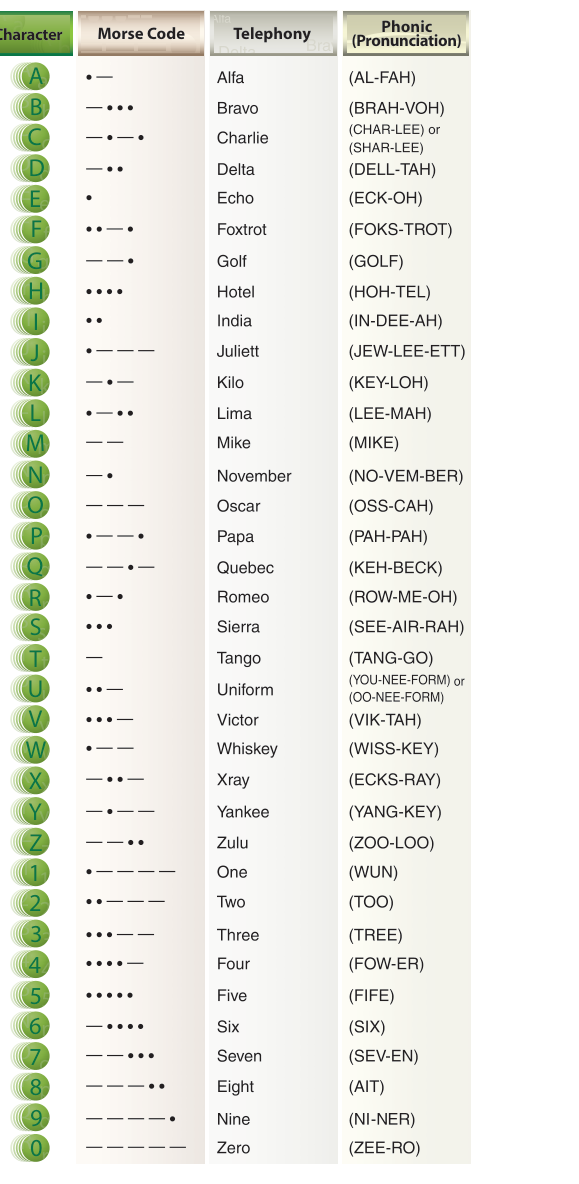
Each letter of the English alphabet is replaced by a standardized spoken word. When you spell out a tail number, a location name, or a waypoint identifier, you use these words instead of the raw letters:
- A — Alpha (AL-fah)
- B — Bravo (BRAH-voh)
- C — Charlie (CHAR-lee)
- D — Delta (DELL-tah)
- E — Echo (EKK-oh)
- F — Foxtrot (FOKS-trot)
- G — Golf (GOLF)
- H — Hotel (hoh-TELL)
- I — India (IN-dee-ah)
- J — Juliet (JEW-lee-ett)
- K — Kilo (KEY-loh)
- L — Lima (LEE-mah)
- M — Mike (MIKE)
- N — November (no-VEM-ber)
- O — Oscar (OSS-car)
- P — Papa (pah-PAH)
- Q — Quebec (keh-BECK)
- R — Romeo (ROH-mee-oh)
- S — Sierra (see-AIR-ah)
- T — Tango (TANG-go)
- U — Uniform (YOU-nee-form)
- V — Victor (VIK-tor)
- W — Whiskey (WISS-key)
- X — X-ray (EKS-ray)
- Y — Yankee (YANG-key)
- Z — Zulu (ZOO-loo)
Notice the deliberate variety in syllable count, vowel sounds, and consonant combinations. "Foxtrot" and "Golf" cannot possibly be confused; neither can "Kilo" and "Lima." This diversity is intentional and was validated through extensive international testing before ICAO standardized the list.
Standardized Number Pronunciation
Numbers in aviation are spoken differently from ordinary English in several important ways, and the FAA AIM defines these pronunciations explicitly.
Individual Digit Pronunciation
Each number is pronounced as a separate digit, not as a combined number. For example, altitude 4,500 feet is spoken as "four thousand five hundred," but a heading of 045 degrees is spoken as "zero four five." The key special pronunciations to memorize are:
- 0 — "Zero" (never "oh" in formal ATC communication, though "oh" is sometimes heard informally)
- 3 — "Tree" (to avoid confusion with "free" or the letter E)
- 5 — "Fife" (to distinguish from "fire" or "fine")
- 9 — "Niner" (to avoid confusion with the German word "nein," meaning no, and to distinguish from other numbers on congested frequencies)
The pronunciations for 1, 2, 4, 6, 7, and 8 are standard English: "one," "two," "four," "six," "seven," and "eight." However, "tree," "fife," and "niner" are non-negotiable on the FAA test and in actual ATC communication.
How to Say Altitudes, Headings, and Frequencies
Different types of numbers follow specific grouping conventions:
- Altitudes and flight levels: Altitudes below 10,000 feet are stated as hundreds: 2,500 feet is "two thousand five hundred." Flight Level 350 is spoken as "flight level three five zero."
- Headings: Always stated as three digits. A magnetic heading of 90 degrees is "zero niner zero." A heading of 180 degrees is "one eight zero."
- Radio frequencies: Spoken digit by digit, with the decimal point called "point" or "decimal." The frequency 121.5 MHz is "one two one point five" or "one two one decimal five."
- Transponder codes: Always four digits, spoken individually. Code 1200 is "one two zero zero." The emergency code 7700 is "seven seven zero zero."
- Wind speeds and visibility: Spoken as whole numbers, not digit by digit. A wind of 15 knots is "one five knots" is incorrect; it is spoken as "fifteen knots." Visibility of 3 miles is simply "three miles."
Applying These Standards as a Remote Pilot
Under Part 107, a remote pilot in command operating in controlled airspace must either obtain a prior authorization via the FAA's LAANC system or contact ATC directly. When speaking with a controller, your call should be structured, brief, and use proper phonetics for all identifying information. For example, if your drone bears a registration number, you might reference it phonetically. More commonly, you will need to state your location, altitude request, and aircraft type clearly.
Consider a scenario: you are requesting authorization to fly in Class D airspace at a small regional airport. You contact the tower and say: "Anytown Tower, UAS operator, one mile south of the field at the intersection of Highway Niner and Route Two, requesting authorization to fly at or below two hundred feet AGL for approximately thirty minutes, unmanned aircraft." Every number is spoken using FAA conventions, and any location abbreviation would be spelled phonetically if ambiguous.
Even if you use LAANC and never speak to a controller during routine operations, you must monitor frequencies in some cases, and the Part 107 written test will absolutely test your knowledge of phonetic and numeric conventions.
Key Numbers and Rules
- "Niner" is used for the digit 9 in all formal aviation communication.
- "Tree" replaces "three" to avoid confusion with similar-sounding words.
- "Fife" replaces "five" for the same reason.
- "Zero" is preferred over "oh" for the digit 0 in ATC communication.
- Headings are always three digits: 090, not 90.
- Transponder codes are always four digits, spoken individually.
- Frequencies use "point" or "decimal" for the decimal separator.
- Emergency frequency is 121.5 MHz — spoken "one two one point five."
- Guard frequency 243.0 MHz is used by military and is spoken "two four tree decimal zero."
Memory Aid
For the three non-standard digit pronunciations, remember the phrase "Tree Fife Niner" — that covers the only three digits (3, 5, 9) whose standard English names are replaced in aviation. If you can recall that phrase and what each word replaces, you have the hardest part of number pronunciation locked in.
Common Test Traps
- Saying "five" instead of "fife" or "nine" instead of "niner." The FAA knowledge test will present answer choices using the correct and incorrect pronunciations side by side. Always select the aviation-standardized form.
- Confusing "zero" and "oh." Some informal pilots say "oh" for 0, but the FAA AIM specifies "zero" as the correct pronunciation in formal communication. Test questions follow AIM, not informal habit.
- Omitting the leading zero on headings. A heading of 90 degrees must be stated as "zero niner zero," not "niner zero." Three digits are always required for headings.
- Mispronouncing Lima as "lye-mah." The correct ICAO pronunciation is "LEE-mah" — as in Lima, Peru, not lime. The test may not quiz pronunciation directly, but knowing it prevents miscommunication on the radio.
- Grouping transponder digits incorrectly. Some students say "twelve hundred" for squawk 1200. The correct form is "one two zero zero" — each digit individually — to prevent any ambiguity with similar codes.
Mastering the phonetic alphabet and standardized number pronunciation is one of the most immediately practical skills you can build as a new remote pilot. These conventions exist because clear communication is a direct safety tool, and the FAA holds all airspace users — including UAS operators — to the same professional communication standard as manned aircraft pilots. Learn them cold, and you will communicate with confidence the moment you key your radio.