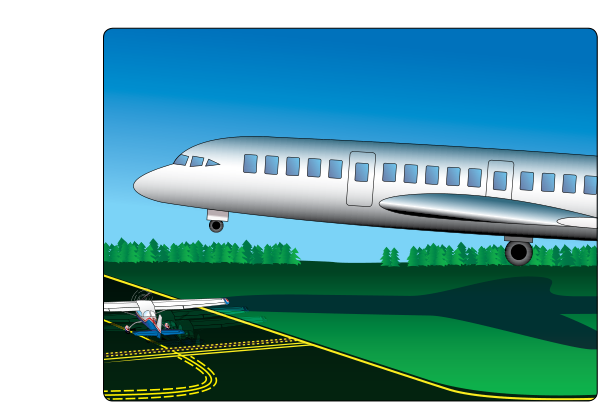
Thousands of airports across the United States operate without an air traffic control tower. At these non-towered airports (sometimes called uncontrolled airports), pilots are responsible for seeing and avoiding other traffic, sequencing themselves into the traffic pattern, and broadcasting their position so that other pilots know where they are. Advisory Circular 90-66, Recommendations for Non-Towered Airport Operations, consolidates FAA best-practices guidance for operating at these airports safely. Although the document carries the word "recommendations," its content reflects decades of operational experience and is heavily tested on both the Private Pilot and Part 107 Remote Pilot knowledge exams.
For Part 107 remote pilots, understanding AC 90-66 is especially important. Unmanned aircraft systems (UAS) operating near non-towered airports must share the airspace with manned traffic that follows these same radio procedures. Knowing how manned aircraft communicate, where they fly, and what distances trigger radio calls helps a drone operator anticipate traffic and remain safely clear of the pattern.
What is a Non-Towered Airport?
A non-towered airport is any airport that does not have an operating control tower. Some airports have a tower facility that is part-time — when the tower is closed, that airport reverts to non-towered procedures. The key operational difference is that no authority is sequencing or separating traffic. Instead, all aircraft share a common radio frequency called the Common Traffic Advisory Frequency (CTAF), and pilots broadcast their own position and intentions — a practice called self-announce.
The CTAF may be a dedicated Unicom frequency (most commonly 122.8 MHz, 122.7 MHz, or one of several others), a Multicom frequency (122.9 MHz), or a Flight Service frequency. The frequency is published on sectional charts, in the Chart Supplement (formerly Airport/Facility Directory), and in the applicable instrument approach procedure charts. Remote pilots should look up the CTAF for any non-towered airport within their operating area even if they are not themselves transmitting, because understanding the radio environment helps them picture where manned traffic is.
The Traffic Pattern at Non-Towered Airports
AC 90-66 recommends that all aircraft follow a standard left-hand traffic pattern unless a right-hand pattern is specifically designated in official publications or indicated by a segmented circle/traffic pattern indicator on the field. The standard pattern altitude for propeller-driven aircraft is 1,000 feet above ground level (AGL), while turbine-powered aircraft typically fly at 1,500 feet AGL. Helicopters generally operate at 500 feet AGL or lower to remain clear of fixed-wing traffic.
The traffic pattern consists of five named legs: the departure leg (upwind), crosswind leg, downwind leg, base leg, and final approach leg. Aircraft entering the pattern should do so at a 45-degree angle to the downwind leg, aiming for the midpoint of the runway in use, unless local procedures differ. This 45-degree entry is the most commonly recommended way to merge with existing traffic smoothly.
Pilots wishing to depart the pattern can exit by continuing straight ahead on the departure leg, or by making a 45-degree turn to the left (in a left-hand pattern) after reaching pattern altitude. This keeps departing aircraft clear of arriving traffic.
Self-Announce Radio Procedures
Because there is no controller, pilots must announce their own positions and intentions. AC 90-66 recommends specific call-up points where pilots should broadcast. A complete self-announce call includes: the airport name (stated twice for clarity), the aircraft type and identification, the pilot's position in the pattern, altitude, and intentions. Saying the airport name twice at the beginning and end of the call helps other pilots identify which airport the broadcast is about, which is important because multiple airports may share the same CTAF frequency.
Recommended self-announce points include:
- Before taxiing — announcing the intent to taxi and the active runway.
- Before departing the runway hold-short line — a final position report confirming departure intentions.
- Entering downwind, base, and final — one call at each leg transition so arriving traffic is continuously positioned.
- Leaving the runway after landing — a brief call that the aircraft is clear of the active runway.
- 10 miles out — inbound aircraft should announce their position and intentions well before reaching the airport environment.
AC 90-66 also recommends that pilots make position reports when operating in the vicinity of the airport. As a practical guideline, inbound self-announce calls are recommended beginning approximately 10 nautical miles from the airport, but "vicinity of the airport" itself is not a fixed 10 NM boundary — the AIM describes it in terms of the airspace where traffic pattern operations and arrivals/departures occur, which can vary by airport and traffic pattern airspace. This is especially relevant for Part 107 pilots: if you are flying UAS operations within the airspace near a non-towered airport and manned aircraft are making position calls, those calls will reference distances from the airport that help you estimate where the aircraft is and where it is going.
Airport Advisory Areas and Traffic Pattern Altitudes
At some non-towered airports, a Flight Service Station (FSS) may be located on the field and provide an Airport Advisory Service (AAS). Pilots are encouraged to contact the FSS on the CTAF to receive wind, altimeter, active runway, and known traffic information. This advisory service does not constitute air traffic control — the FSS specialist does not issue clearances or sequence aircraft — but the information is valuable for situational awareness.
The Traffic Pattern Indicator (TPI) and segmented circle on the airport surface provide visual guidance for the pattern direction and runway in use. Remote pilots conducting visual operations near an airport should look for these markers. A tetrahedron (a large, pivoting triangular shape) on the field points in the direction of landings when oriented freely.
Why AC 90-66 Matters for Part 107 Remote Pilots
Part 107 operations in uncontrolled airspace below 400 feet AGL near a non-towered airport require careful attention to manned aircraft activity. Under 14 CFR Part 107, remote pilots must:
- Obtain an FAA authorization (via LAANC or a DroneZone waiver) before operating within the lateral boundaries of surface-class airspace at a non-towered airport that has surface Class E airspace designated to the surface.
- Yield the right-of-way to all manned aircraft at all times.
- Monitor the CTAF or coordinate with manned traffic when operating near the pattern.
Understanding AC 90-66 means a remote pilot can listen to self-announce calls and build a mental picture of where manned aircraft are entering downwind, turning base, or on final. A drone on final approach corridor at 200 feet AGL is directly in the path of a landing aircraft descending through 500 feet — knowing the pattern geometry prevents exactly that conflict.
Key Numbers and Rules
- Standard traffic pattern altitude: 1,000 feet AGL for piston aircraft; 1,500 feet AGL for turbine aircraft.
- Standard pattern direction: Left-hand turns, unless charted or marked otherwise.
- Entry angle: 45 degrees to the downwind leg, midfield.
- Inbound self-announce: Begin calls at approximately 10 nautical miles from the airport.
- CTAF monitoring: Recommended throughout operations within the airport environment.
- Airport name stated twice: At the beginning and end of each self-announce call.
- Class E surface area authorization: Required for Part 107 UAS operations when Class E airspace extends to the surface at a non-towered airport.
Common Test Traps
- Confusing CTAF with ATC clearance: Transmitting on CTAF does not grant any clearance or permission. It is advisory only. The FAA exam may frame a question implying that a Unicom operator can sequence or separate traffic — they cannot.
- Assuming all non-towered airports have Class G airspace at the surface: Many non-towered airports have Class E airspace designated to the surface (shown as a dashed magenta ring on sectional charts). Part 107 pilots need LAANC authorization to fly there, even though there is no tower.
- Forgetting right-hand pattern exceptions: The standard is left-hand traffic. Right-hand patterns are published in the Chart Supplement and depicted with a segmented circle indicator. Exam questions sometimes test whether you know to check official sources for pattern direction rather than assuming left.
- Mixing up helicopter and fixed-wing pattern altitudes: Helicopters fly a lower pattern (typically 500 feet AGL) to remain clear of fixed-wing aircraft. A question may ask which aircraft has priority at a given altitude within the pattern.
- Underestimating the 10-nautical-mile advisory range: Students sometimes think radio calls begin only in the immediate vicinity of the airport. AC 90-66 recommends self-announces starting at 10 NM out, so manned traffic may already be making calls well before they appear on a sectional chart's airport symbol.