For aviation maintenance technicians, few responsibilities carry more weight than ensuring an aircraft engine is inspected and overhauled at the right time. Engine inspection intervals and Time Between Overhaul (TBO) requirements sit at the intersection of regulatory compliance, mechanical integrity, and passenger safety. Understanding these requirements — not just the numbers, but the why behind them — is essential for both the AMT knowledge test and a safe career in aircraft maintenance.
This article walks through the framework of engine inspection intervals, what TBO means and how it is established, who sets the limits, how they apply differently to certificated operations versus owner-flown general aviation aircraft, and what the inspector looks for at each phase.
What Is TBO and How Is It Established
Time Between Overhaul, or TBO, is the manufacturer-recommended interval — expressed in flight hours, calendar time, or both — after which an engine should be removed from service and completely overhauled. The TBO figure is not an arbitrary guess. Engine manufacturers develop it through extensive testing, statistical analysis of component wear rates, metallurgical fatigue data, and field experience. The goal is to identify a threshold before which the probability of in-flight failure remains acceptably low.
TBO values are published in the engine manufacturer's overhaul manual and are also referenced in service bulletins and service instructions. For example, many Lycoming and Continental reciprocating engines carry TBO recommendations in the range of 1,800 to 2,400 hours, though specific models vary. Turbine engines similarly carry TBO limits set by their manufacturers, and those limits may be expressed in hours, cycles (one takeoff and landing counted as one cycle), or both — whichever limit is reached first controls.
It is critical to understand that TBO recommendations from the manufacturer are just that — recommendations for most general aviation operations. They do not carry the force of an Airworthiness Directive (AD) unless the FAA specifically mandates compliance through an AD or unless the aircraft is operated under certain commercial rules that make TBO mandatory.
Regulatory Framework: Who Must Comply
The distinction between mandatory and recommended TBO is one of the most commonly tested and most practically important concepts in this subject area. Title 14 CFR Part 91, which governs general aviation operations, does not require owner-operators to overhaul engines at the manufacturer's recommended TBO. The owner of a Part 91 aircraft may legally fly an engine beyond its TBO if the engine continues to meet airworthiness standards as demonstrated by proper inspections. However, this decision carries significant responsibility and risk, and insurers and maintenance professionals must be consulted carefully.
By contrast, aircraft operated under 14 CFR Part 135 (commuter and on-demand operations) and 14 CFR Part 121 (airline operations) are typically required to comply with maintenance program requirements that incorporate manufacturer TBO limits. Under these regulations, operators must maintain FAA-approved continuous airworthiness maintenance programs (CAMPs), which specify exactly when overhauls must occur. For turbine-powered aircraft especially, the FAA and operators negotiate specific inspection and overhaul intervals within the CAMP, often tied to manufacturer data.
Airworthiness Directives can also make an overhaul or inspection mandatory regardless of operational category. When the FAA determines that a safety defect or wear-related issue creates an unsafe condition, it issues an AD under 14 CFR Part 39. ADs may require one-time inspections, repetitive inspections at specific intervals, or removal and overhaul before a certain number of hours or calendar time. Compliance with ADs is mandatory for all certificated aircraft, with no exceptions.
Types of Engine Inspections
Engine inspections occur on several levels, each with a different scope and trigger.
Annual and 100-Hour Inspections
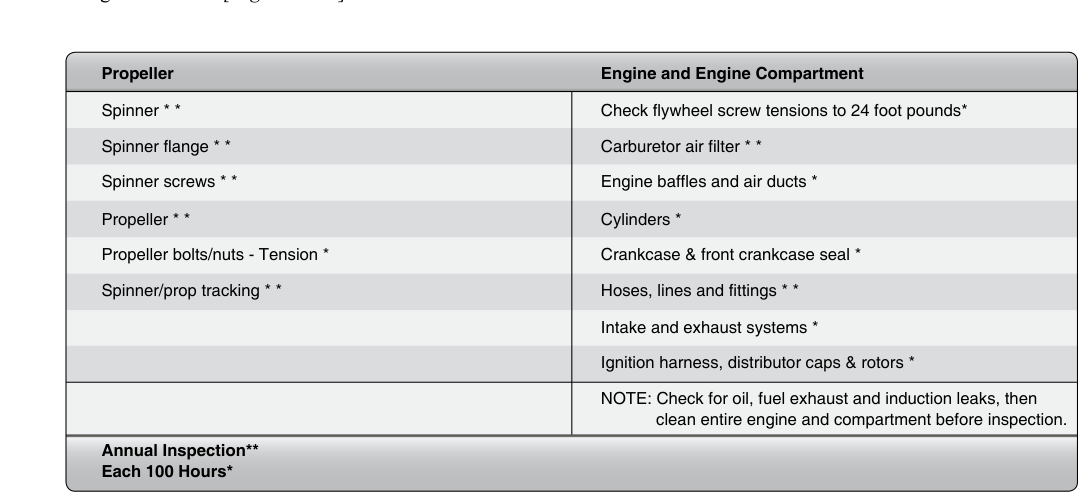
Under 14 CFR Part 91.409, aircraft used for hire or flight instruction must receive a 100-hour inspection in addition to their annual inspection. Both the annual and the 100-hour inspection are comprehensive inspections of the entire aircraft, including the engine. For the engine, the inspector examines compression (using a differential compression tester), looks for oil leaks, checks the condition of spark plugs, inspects ignition wiring, checks fuel system components, inspects the exhaust system for cracks or carbon deposits, and reviews the engine logbooks for compliance with ADs and service bulletins.
The annual inspection must be performed by an IA (Inspection Authorization holder), while a certificated A&P mechanic may perform a 100-hour inspection. The 100-hour limit has a 10-hour ferry allowance — meaning a flight to reach a maintenance facility can exceed the limit by up to 10 hours, but those 10 hours are counted toward the next 100-hour interval.
Progressive Inspection Programs
Under 14 CFR Part 91.409(d), an owner may elect a progressive inspection program approved by the FAA. Instead of a single comprehensive annual inspection, the aircraft is inspected in smaller segments on a continuous cycle, spreading the workload and minimizing downtime. The engine is still inspected to the same standard, but in portions spread over the inspection cycle. This approach is common in busy flight schools and charter operations seeking to reduce aircraft downtime.
Compression Testing
Differential compression testing is a key engine inspection tool performed during 100-hour and annual inspections, and often between scheduled inspections if performance problems arise. The tester pressurizes a cylinder with regulated air and measures how much pressure escapes. A reading below approximately 60/80 (60 psi held against 80 psi input) typically indicates a worn or damaged cylinder, though the manufacturer's limits take precedence. Low compression can point to leaking valves, worn or stuck piston rings, or a cracked cylinder.
Oil Analysis and Spectrometric Analysis
Regular oil changes and oil analysis programs allow technicians to detect internal engine wear before it becomes catastrophic. Spectrometric oil analysis programs (SOAP) check engine oil samples for microscopic metal particles. Elevated levels of specific metals — iron from cylinder walls, chromium from rings, aluminum from pistons, copper from bearings — can identify which components are wearing abnormally. Many operators use oil analysis between TBO intervals as an early warning system.
Overhaul: Top vs. Major
Not all engine overhauls are equal. A top overhaul addresses only the cylinder assemblies — the pistons, rings, valves, and valve guides — while the crankcase and crankshaft remain in the aircraft. A top overhaul may be appropriate when compression readings indicate cylinder wear but the bottom end of the engine remains within limits. A major overhaul (or complete overhaul) disassembles the entire engine, inspects every component to manufacturer tolerances, replaces worn or damaged parts, reassembles the engine, and runs it on a test stand before return to service. After a major overhaul, the engine's time is reset and tracked as SMOH (Since Major Overhaul); this is not the same as zero-time-since-new status, which applies only to new or factory-rebuilt engines. Rebuilt engines may be returned to zero-time status only by the original manufacturer or FAA-approved facility.
Why It Matters
Engine failures in flight remain a leading cause of accidents in general aviation. Many of these failures are traceable to deferred maintenance, ignored inspection findings, or engines operated well beyond TBO without proper condition monitoring. The inspection interval system exists to catch wear trends and emerging failures before they result in power loss at a critical moment. For an AMT, understanding when inspections are due, what they entail, and what findings demand immediate action versus monitoring, is a core professional competency.
Beyond safety, there are legal and financial consequences to non-compliance. Operating an aircraft with an overdue inspection renders it unairworthy. If an accident occurs, the liability implications for the technician, owner, and operator are severe. Thorough logbook entries documenting every inspection — including the specific findings and any corrective actions — protect all parties and provide the maintenance history future technicians will rely on.
Key Numbers and Rules
- Annual inspection: Required for all certificated aircraft under 14 CFR 91.409 once every 12 calendar months.
- 100-hour inspection: Required for aircraft operated for hire or flight instruction under Part 91; 10-hour ferry tolerance allowed.
- TBO (typical reciprocating): 1,800–2,400 hours for many Lycoming/Continental engines (manufacturer-specific; verify the POH and overhaul manual).
- Part 91 TBO compliance: Recommended but not mandatory unless mandated by an AD or CAMP.
- Part 135/121 TBO compliance: Generally mandatory through FAA-approved maintenance programs.
- Compression test threshold: Approximately 60/80 psi is a common guideline; manufacturer limits govern.
- AD compliance: Mandatory for all certificated aircraft under 14 CFR Part 39, regardless of operational category.
- Zero-time status after rebuild: Only the original engine manufacturer or FAA-approved rebuild facility may return an engine to zero time.
Common Test Traps
- TBO is mandatory for all aircraft — FALSE. Under Part 91, TBO is a manufacturer recommendation, not a regulatory requirement, unless an AD or CAMP mandates it. Students frequently confuse this with Part 135/121 operations where TBO is effectively required.
- Confusing annual and 100-hour inspections. Both cover the same scope, but an annual requires an IA while an A&P can sign off a 100-hour. The 100-hour does NOT replace the annual for legal airworthiness purposes.
- Misunderstanding the 10-hour ferry allowance. Those 10 hours are NOT free hours — they are borrowed from the next 100-hour interval. The next inspection comes 100 hours after the previous one was due, not 100 hours after the ferry flight.
- Overhaul vs. rebuilt. An overhauled engine may be returned to zero SMOH hours, but only a factory rebuild by the original manufacturer earns a zero-time logbook entry in the FAA sense. Many test questions probe this distinction.
- Ignoring calendar limits. Some engines and components have both hour-based AND calendar-based limits (e.g., every 12 years regardless of hours). Students focused only on flight hours miss that the calendar limit may trigger first.