Introduction
Before a Part 121 dispatcher releases a flight to any destination or alternate airport, federal regulations demand a rigorous check of landing performance. Section 121.195 of Title 14 of the Code of Federal Regulations (14 CFR) establishes the minimum field length requirements for turbojet-powered transport category airplanes operating under air carrier rules. The regulation is not merely a formality—it is a hard legal limit that determines whether a flight may legally depart. Understanding its requirements, the logic behind the distance factors, and how wet-runway corrections tighten those limits is essential knowledge for every aircraft dispatcher candidate.
The core concept is straightforward: regulators do not allow an airplane to use every foot of a runway. Instead, they require a safety margin expressed as a percentage of the available landing distance. The landing distance the airplane actually needs, under approved Airplane Flight Manual (AFM) data, must fit comfortably within that factored runway length. This article explains the mechanics of the regulation, the numbers you must know, and the practical dispatch decisions that flow from them.
How the Regulation Works
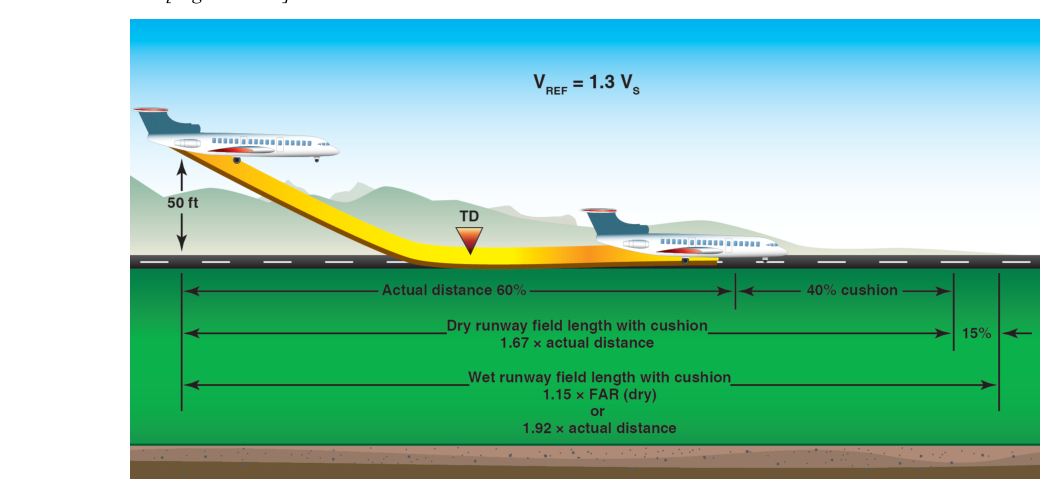
14 CFR 121.195 applies to turbine-powered transport category airplanes dispatched under Part 121. It establishes what is commonly called the 60% rule for dry runways. The regulation requires that the landing distance from a height of 50 feet above the runway threshold—as published in the AFM for the expected landing weight, altitude, and temperature—must not exceed 60 percent of the effective runway length available. Stated the other way, the available runway must equal or exceed 1/0.60 (approximately 1.667 times) the demonstrated AFM landing distance.
Breaking down the variables the dispatcher must account for:
- Landing weight: The anticipated weight at the destination, accounting for fuel burn en route. If the airplane will be heavier than planned (e.g., due to a shorter-than-expected route), the landing distance increases.
- Airport elevation: Higher elevations reduce air density, increasing the true airspeed at the threshold and lengthening the ground roll.
- Temperature: Higher temperatures further reduce air density, compounding the effect of elevation.
- Wind component: A maximum of 50 percent of the reported headwind component may be assumed; 150 percent of any tailwind component must be assumed. This conservative treatment protects against wind shifts after dispatch.
- Runway slope: The AFM or performance charts may account for runway gradient; uphill slopes generally aid stopping, downhill grades hurt it.
- Effective runway length: This is the declared Landing Distance Available (LDA), which may differ from the physical runway length if a displaced threshold is in use.
The dispatcher performs this analysis at the time of departure, using the best available forecast for the destination. If the airplane cannot meet the 60% criterion at the planned landing weight, the dispatcher has several legal tools: reduce fuel load (reducing landing weight), select a longer runway at the same airport (if available), or select an alternate airport entirely.
Wet Runway Requirements
A wet runway degrades braking friction dramatically. Tire-to-pavement contact is compromised by the water film, and aquaplaning (hydroplaning) can render brakes almost completely ineffective at high speeds. 14 CFR 121.195(d) addresses this by adding a further requirement when the destination runway is forecast to be wet or slippery at the estimated time of arrival.
For wet runways, the required landing distance is the greater of two values:
- The distance computed under the normal dry-runway 60% rule (i.e., the AFM dry landing distance multiplied by 1.667), or
- The AFM wet landing distance (if a specific wet-runway landing distance is published in the AFM) multiplied by 115%—meaning the available runway must be at least 115% of the AFM wet distance.
If the AFM does not contain a specific wet landing distance, operators may use an FAA-approved method to derive one—often by applying an incremental factor to the dry AFM distance. The intent is always to ensure that wet-surface braking degradation is accounted for before the flight departs. Dispatchers must pay close attention to terminal aerodrome forecasts (TAFs) and PIREPs to determine whether the wet-runway correction applies.
Why It Matters: Operational and Safety Perspective
The 60% rule exists because the AFM certified landing distance is demonstrated under ideal conditions: standard temperature, sea level, zero wind, a dry and smooth runway, maximum braking, and precise threshold crossing. Real-world operations rarely replicate all of these conditions simultaneously. The 1.667 safety factor absorbs the aggregate effect of non-standard conditions, pilot technique variation, and unexpected events such as a late flare or a momentary brake application delay.
From the dispatcher's perspective, this regulation represents a joint responsibility with the captain. Under 14 CFR 121.533, both the pilot-in-command and the dispatcher share responsibility for the safety of the flight. The dispatcher must ensure the landing field length analysis is completed and legally satisfied before releasing the flight. If forecasts at the destination deteriorate after departure, the dispatcher has authority—and a duty—to coordinate a diversion to an alternate airport where the field length requirements can still be met.
An often-overlooked practical point: the regulation is a dispatch constraint, not a takeoff constraint. The airplane must be capable of meeting the landing field length requirement at the anticipated landing weight and conditions at departure time. Once airborne, if conditions change, the crew and dispatcher must reevaluate and divert if necessary. This is distinct from the takeoff field length rules under 14 CFR 121.189, which govern the departure runway analysis.
Key Numbers and Rules
- Dry runway factor: AFM landing distance must be ≤ 60% of available runway (equivalently, runway must be ≥ 1.667 × AFM landing distance).
- Wet runway factor: Available runway must be ≥ 115% of AFM published wet landing distance, and this result must also be compared against the dry-runway 60% requirement; the more restrictive governs.
- Headwind credit: Only 50% of the reported headwind may be used (conservative assumption).
- Tailwind penalty: 150% of any reported tailwind component must be applied (aggressive assumption).
- Reference speed: Landing distance is measured from 50 feet above the threshold to a full stop.
- Effective runway length: Use Landing Distance Available (LDA), not necessarily the full published runway length, if a displaced threshold exists.
- Related sections: 14 CFR 121.189 (takeoff limitations), 121.197 (alternate airport landing limitations — which applies the same 60% factor as 121.195 for turbine-powered airplanes), and 121.91–121.93 (performance requirements overview).
Alternate Airport Landing Limitations: A Critical Distinction
14 CFR 121.197 governs the field length requirements at alternate airports for turbine-powered transport category airplanes. For these airplanes, 121.197 applies the same 60 percent standard used for destination airports under 121.195 (i.e., the runway must be ≥ approximately 1.667 × AFM landing distance). Dispatchers must confirm that both the destination and the alternate satisfy this landing distance requirement, using the appropriate forecast conditions for each airport, before the flight can be legally released.
Worked Example
Suppose an AFM specifies a dry landing distance of 4,200 feet at the anticipated landing weight, elevation, and temperature for a destination airport. The question is whether a runway with an LDA of 7,000 feet is acceptable on a dry day.
Apply the 60% rule: 4,200 ÷ 0.60 = 7,000 feet required. The available LDA of 7,000 feet exactly meets the minimum. The flight may be dispatched legally, though this is cutting it close and a dispatcher might assess whether a different runway or weight reduction provides additional margin.
Now suppose the destination is forecasting rain at arrival and the AFM publishes a wet landing distance of 5,500 feet. The wet requirement: 5,500 × 1.15 = 6,325 feet. Compare to the dry-rule result: 7,000 feet. The dry rule (7,000 feet) is more restrictive in this case, so 7,000 feet is still the governing requirement. The 7,000-foot LDA remains exactly compliant. However, if the wet AFM distance were 6,200 feet, then 6,200 × 1.15 = 7,130 feet—which would exceed the available 7,000-foot LDA, and dispatch to that runway would be illegal under wet conditions.
Common Test Traps
- Confusing 121.195 with 121.197: Both the destination and the alternate use the same 60% rule for turbine-powered transport category airplanes (runway ≥ 1.667 × AFM distance). Do not assume the alternate uses a different, more lenient factor for these airplanes.
- Forgetting the wind adjustments: Examiners frequently present a headwind scenario and expect you to use only 50% of it. Using the full headwind overstates performance and produces an artificially short required distance.
- Applying the wet factor incorrectly: The 115% multiplier applies to the AFM wet distance, not to the AFM dry distance. You then compare that result to the dry-rule result and use whichever is longer.
- Using total runway length instead of LDA: If a displaced threshold is depicted, the LDA is shorter than the full runway. Dispatchers must use LDA, not physical length.
- Assuming the regulation only applies at takeoff: 121.195 is a dispatch rule evaluated before departure. It does not mean the crew stops the flight mid-air if conditions change, but it does require the dispatcher (and captain) to reassess and coordinate an alternate if conditions deteriorate en route.