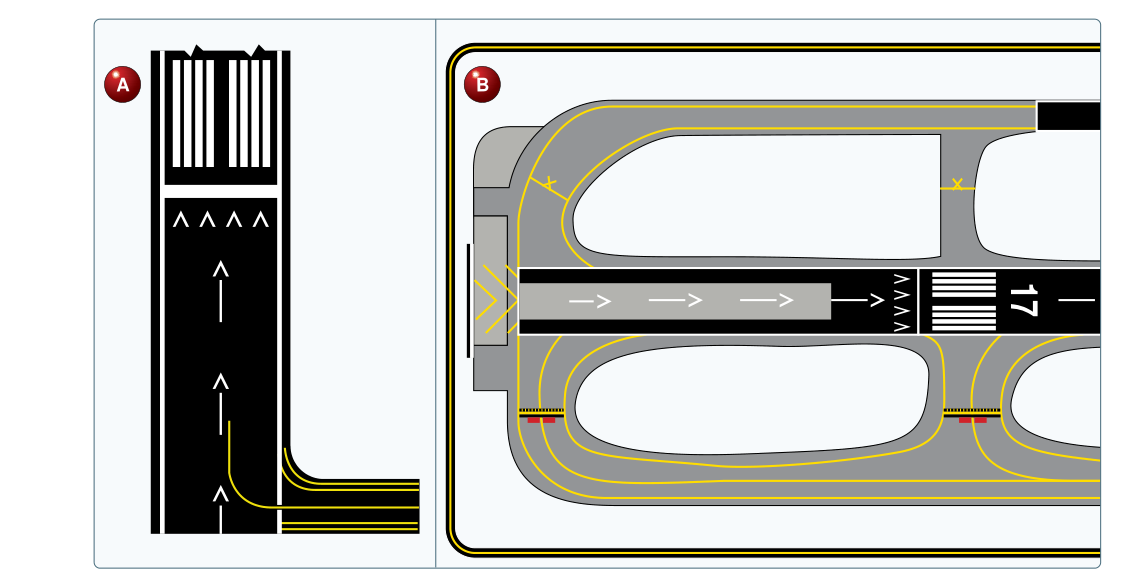
Every time you fly a visual approach and cross over the runway numbers, you are crossing one of the most carefully defined lines in aviation: the runway threshold. The threshold is the official beginning of the landing portion of a runway — the point where touchdown is authorized. Understanding exactly what the threshold markings mean, and especially what a displaced threshold is and is not, is essential both for safe real-world operations and for passing the FAA Private Pilot Knowledge Test.
Runway markings are standardized by the FAA and described in both the Aeronautical Information Manual (AIM) and the Pilot's Handbook of Aeronautical Knowledge (FAA-H-8083-25). They exist to give pilots an instant, unambiguous visual picture of the runway environment — even when approaching at 75 knots with only seconds to process what is ahead. Let's break down each element in detail.
Basic Threshold Markings
The runway threshold is marked by a row of white stripes running perpendicular to the runway centerline, positioned at the very beginning of the usable landing area. These stripes are called threshold bars or the threshold stripe pattern. The number of stripes corresponds to the width of the runway: wider runways get more stripes. For example, a 60-foot-wide runway has four stripes total, while a 150-foot-wide runway has 12 stripes total. The stripes are eight feet wide and 150 feet long, separated by six-foot gaps.
Just inboard of those threshold stripes — starting at the threshold itself — you'll find the runway designation marking, which is the two-digit runway number painted in large white numerals. The number represents the magnetic heading of the runway rounded to the nearest 10 degrees and then divided by 10. Runway 27, for instance, faces roughly 270° magnetic (due west). These numbers also help you confirm you are lined up with the correct runway, which is critical at multi-runway airports.
Beyond the numbers, continuing down the runway, are the other standard markings: the centerline (dashed white stripe), aiming point markings (two large white rectangles about 1,000 feet from the threshold), and touchdown zone markings (groups of one, two, and three rectangular bars indicating distance from the threshold). Together, these give you constant spatial awareness during the approach and rollout.
What Is a Displaced Threshold?
A displaced threshold exists when the threshold — the point where landings may begin — is located at a position other than the physical beginning (the very end) of the pavement. In other words, some paved runway surface exists before the threshold, but that area is not authorized for landing.
Displaced thresholds are created for a variety of safety and operational reasons. The most common include: an obstacle in the approach path (such as trees, terrain, or structures) that requires a steeper or higher approach to clear; pavement near the runway end that is structurally adequate for taxiing and takeoff roll but not for the repeated high-impact loads of landing; or noise abatement requirements. Whatever the reason, the FAA has determined that landing on that pre-threshold pavement would be unsafe or unacceptable under the circumstances.
How a Displaced Threshold Is Marked
The displaced threshold is marked in a very specific, standardized way that you must be able to identify instantly. Here is what you will see:
- Threshold bar: The normal row of white stripes appears at the displaced threshold location — not at the physical end of the pavement.
- Large white arrows: On the paved surface before the displaced threshold (between the physical pavement beginning and the threshold bar), large white arrows are painted pointing toward the threshold. These arrows make it visually obvious that you are looking at pre-threshold pavement and that the real threshold is farther down.
- Demarcation bar (if needed): If the runway surface before the displaced threshold could be confused with a usable runway surface (for example, if there is no clear color or texture difference), a yellow demarcation bar may be added across the width of the pavement at the beginning of the arrows area.
- Runway numbers: The runway designation number is painted at the displaced threshold location, not at the physical pavement edge. This ensures that pilots on approach see the correct reference point for where landing begins.
What You Can and Cannot Do in the Pre-Threshold Area
This is where many students — and some pilots — get confused, and it is a favorite topic on the FAA Knowledge Test. The rules for the paved area before a displaced threshold are actually more permissive than many people assume.
According to the AIM, the area before a displaced threshold may be used for:
- Takeoff runs: You may use that pavement as part of your takeoff roll. This can give you extra runway distance and is perfectly legal.
- Landing rollout: If you have already touched down past the threshold and are rolling out, you may roll through (and onto) the pre-threshold pavement during deceleration.
- Taxiing: You may taxi on the surface, since it is physically part of the airport movement area.
What you may NOT do with the pre-threshold area:
- You may not touch down before the displaced threshold. Landing begins at or beyond the marked threshold. Touching down in the arrow zone is not authorized for landing.
Think of it this way: the arrows are telling you, "You can roll on me, but you cannot land on me." This distinction is tested directly on the FAA exam, often with a diagram asking what operations are permitted on a specific section of pavement.
Relocated Threshold vs. Displaced Threshold
The AIM makes a distinction worth noting. A displaced threshold is a permanent or long-term marking, while a relocated threshold is a temporary change, often implemented during runway construction or repair using a different set of markings (including orange cones or temporary markings). A relocated threshold may prohibit all aircraft operations — including taxi — on the closed portion of the runway. Always consult NOTAMs before any flight to check for temporary runway changes, because runway threshold locations can change with little advance notice.
Why This Matters for Safety
Failing to recognize a displaced threshold in flight can result in landing short of the threshold — potentially on pavement that was intentionally excluded from the landing zone because of structural weakness, or dangerously close to an obstacle that the displaced threshold was designed to protect you from. The approach to a displaced threshold is typically designed around a standard 3-degree glidepath that clears all obstacles in the approach corridor when you aim for the threshold itself. If you instead aim for the physical end of the pavement, you may fly a shallower path that puts you below that obstacle clearance envelope.
From an exam perspective, confusing what can and cannot be done in the pre-threshold area is one of the most reliably tested traps on the Private Pilot Knowledge Test. Getting this wrong in an exam costs you points; getting it wrong in flight could cost far more.
Key Numbers and Rules
- Threshold stripes are 150 feet long and 8 feet wide, with 6-foot gaps between them.
- The number of stripes depends on runway width — more stripes for wider runways (e.g., 4 stripes total on a 60-ft runway, 12 stripes total on a 150-ft runway).
- The pre-threshold area (marked with arrows) is authorized for takeoff, rollout, and taxi — but NOT for landing.
- A yellow demarcation bar may be added at the start of the arrow zone if the surface could be confused with a landing area.
- A relocated (temporary) threshold may prohibit all use of the pre-threshold pavement; check NOTAMs.
- Runway numbers represent magnetic heading ÷ 10, rounded to the nearest 10 degrees.
Common Test Traps
- "Can I take off from before the displaced threshold?" Yes — the pre-threshold pavement is available for takeoff roll. Many students incorrectly think the displaced threshold applies to all operations.
- "Can I land on the arrows?" No. Arrows mean pre-threshold pavement, and landing there is not authorized, even though the surface looks like usable runway.
- "Where are the runway numbers painted?" At the displaced threshold location, not at the physical end of the pavement. Students often assume the numbers are always at the pavement edge.
- Confusing a displaced threshold with a closed runway. A closed runway uses a large yellow X at each end and is off-limits for all operations. A displaced threshold still allows takeoff, taxi, and rollout — only landing is restricted before the threshold.
- Ignoring NOTAMs for temporary relocations. A threshold that was at one position in the Chart Supplement may have been temporarily relocated due to construction. Always check NOTAMs before flight.
Runway threshold markings and displaced thresholds are a small slice of airport operations knowledge, but they carry outsized importance: they define the legal and safety boundary of where your aircraft may first contact the runway. Master the visual cues — the stripes, the arrows, the numbers — and you will handle this topic with confidence both in the testing room and in the cockpit.