Before a pilot can file and fly an IFR flight plan, every piece of navigation equipment must be trustworthy. The VOR (VHF Omnidirectional Range) receiver is one of the most fundamental enroute and approach navigation tools in the IFR cockpit, and the FAA requires pilots to confirm that their VOR equipment meets a defined accuracy standard within the 30 days preceding any IFR flight. This requirement lives in 14 CFR 91.171, and the rule is deceptively simple on the surface — but the details of each approved check method, the associated error tolerances, and the logbook entry requirements are favorite territory for FAA knowledge test writers.
Understanding not just what the rule says but why each method exists — and what each one actually measures — gives you both the test answer and the genuine airmanship to make good decisions when a VOR check station is unavailable or a receiver is reading suspiciously.
Why VOR Receiver Accuracy Matters
A VOR receiver translates the phase difference between two radio signals broadcast by a ground station into a bearing — your radial from the station. If the receiver has drifted out of calibration, it may indicate you are on a specific radial when you are actually several degrees off. In enroute cruise, a few degrees of bearing error is largely a nuisance. On a VOR instrument approach, however, where you may be navigating to a final approach fix or flying a final course with obstacle clearance that accounts for a known maximum course deviation, accumulated receiver error can place your aircraft dangerously close to terrain or obstacles. The FAA therefore mandates a periodic cross-check to ensure the receiver's indicated bearing agrees with a known reference within acceptable limits.
The 30-Day Rule and Who It Applies To
Under 14 CFR 91.171, no person may operate an aircraft under IFR using a VOR system unless within the preceding 30 days that VOR equipment has been checked and found to be within the required accuracy. The regulation applies to the specific aircraft and its VOR receiver(s) — not to the pilot's general proficiency. If an aircraft has two VOR receivers, each must be checked individually. The rule does not apply to VFR flight; it is purely an IFR prerequisite.
The Five FAA-Approved VOR Check Methods
14 CFR 91.171 identifies several methods, each with its own error tolerance. It is critical to know which method you used, because the allowable error differs between them.
1. FAA VOR Test Facility (VOT)
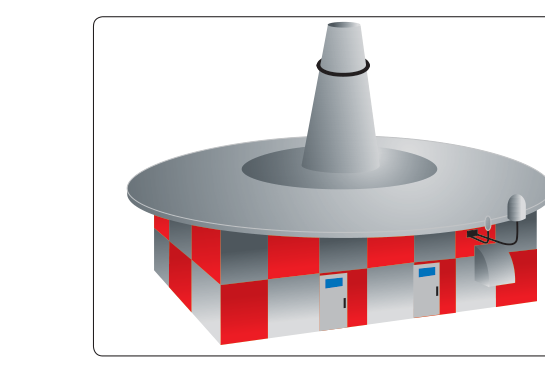
A VOT (VOR Test Facility) is a special ground-based transmitter maintained by the FAA specifically for receiver testing. Unlike a navigation VOR, a VOT broadcasts only a single test signal: the 360° radial omnidirectionally in all directions. No matter where you position the aircraft on the airport, a properly functioning VOR receiver tuned to a VOT frequency should indicate 180° with a FROM flag (or equivalently, 0°/360° with a TO flag) on the Course Deviation Indicator (CDI). VOT frequencies are published in the Chart Supplement (formerly Airport/Facility Directory) for airports that have them.
To perform the check: tune the VOT frequency, center the CDI needle, and read the OBS (Omni Bearing Selector). The indicator should read 0° TO or 180° FROM. The maximum allowable bearing error when using a VOT is ±4 degrees per 14 CFR 91.171(b). If the CDI centers at, say, 184° FROM, that is 4 degrees off — still within limits. At 185° FROM, you have exceeded the allowable error and the receiver should be removed from IFR service.
2. Certified Airborne Checkpoint
The FAA designates certain fixes over specific ground checkpoints at specific altitudes as airborne VOR checkpoints. These are also published in the Chart Supplement. At the designated position and altitude, the aircraft's VOR receiver should indicate a specific published radial. Because you are airborne and there is inherent variability in exact position, the allowable error for an airborne check is ±6 degrees — slightly more forgiving than the VOT because of position uncertainty.
3. Certified Ground Checkpoint
Some airports have a designated ground checkpoint — a marked spot on the ramp or taxiway from which a specific VOR radial should be received. Like airborne checkpoints, these are published in the Chart Supplement. When the aircraft is parked on that precise spot and the VOR is tuned to the specified station, the receiver should indicate the published radial. The allowable error for a ground checkpoint is ±4 degrees per 14 CFR 91.171(b), the same tolerance as a VOT, because the aircraft's position is precisely defined.
4. Dual VOR Check (Aircraft with Two VOR Receivers)
If the aircraft is equipped with two independent VOR receivers (both usable for IFR navigation), you may check them against each other. Tune both receivers to the same VOR station. Without moving the aircraft, compare the indicated bearings on both receivers. The two receivers must agree within ±4 degrees of each other. This method does not verify that either receiver is correctly calibrated in an absolute sense — only that they agree with each other. It is important to understand that this check does not give you a known reference bearing; it simply confirms that the two receivers are reading consistently. If both are off by 3 degrees in the same direction, they will pass this check but may be slightly inaccurate in absolute terms.
5. Over a Known Ground Position
A pilot may also check the VOR by flying directly over a prominent, accurately charted ground feature (such as a VOR station itself) while simultaneously checking what radial the receiver indicates. This alternative airborne check is described in AIM and related FAA guidance rather than being separately enumerated in 91.171(b), which explicitly codifies only the VOT, ground checkpoint, airborne checkpoint, and dual VOR check methods. Because you are flying overhead, the CDI should center on a radial that corresponds with the bearing from the station to your exact overfly position. This method carries the same ±6 degree allowable error as the airborne checkpoint, reflecting position uncertainty. This method is the least precise of all the approved options and is generally a last resort.
Key Numbers and Rules
- VOT check: ±4 degrees maximum error; receiver must show 0° TO or 180° FROM.
- Certified ground checkpoint: ±4 degrees maximum error.
- Certified airborne checkpoint: ±6 degrees maximum error.
- Dual VOR check: ±4 degrees maximum disagreement between the two receivers.
- Over known ground position (airborne): ±6 degrees maximum error.
- Currency window: 30 days preceding the IFR flight (not 30 calendar days — 30 days from the date of the check).
- VOT and ground checkpoint locations are found in the Chart Supplement (CS).
- Dual VOR check does NOT require a known checkpoint — but provides only a relative, not absolute, accuracy verification.
Required Logbook Entry
14 CFR 91.171 also mandates a specific logbook entry after each check. The entry must include:
- The date of the check.
- The place where the check was performed (or the name of the VOT or checkpoint).
- The bearing error (how many degrees off the receiver indicated).
- The signature of the pilot in command performing the check.
This logbook entry is not optional — it is the legal record that establishes currency. If an FAA inspector asks for documentation, you must be able to show a logbook entry meeting all four requirements. Students frequently focus only on the numerical error and forget the signature requirement, which is a common knowledge-test trap.
Memory Aid
"VOT = 4, Air = 6, Dual = 4" is a simple phrase to lock in the tolerances. Think of it as the tighter checks (VOT, ground, dual) all sharing ±4°, while the airborne methods (certified airborne checkpoint and known ground position overfly) allow ±6° because of position uncertainty in the air. Anytime you are standing still or have a precisely defined position, the standard is stricter.
Common Test Traps
- Confusing ±4° vs. ±6° methods: VOT and ground checkpoints are ±4°; airborne checks are ±6°. The dual VOR check is ±4° (disagreement between the two). Mixing these up is the most common error on the knowledge test.
- VOT indication direction: The VOT always broadcasts the 360° radial, so the receiver should show 0° TO or 180° FROM — not some other value. Forgetting which needle deflection is correct is a classic trap.
- The dual check limitation: Many students think a dual VOR check verifies absolute accuracy. It only checks that the two receivers agree with each other. Both could be slightly miscalibrated in the same direction and still pass.
- Missing logbook elements: The test may ask which elements are required in the logbook entry. All four — date, place, bearing error, and pilot signature — are required. Omitting the signature or the bearing error value are frequent mistakes.
- "30 calendar days" vs. 30 days: The regulation says 30 days, not 30 calendar days. The distinction matters: a check performed on March 5 is valid through April 4, not just through the end of March.