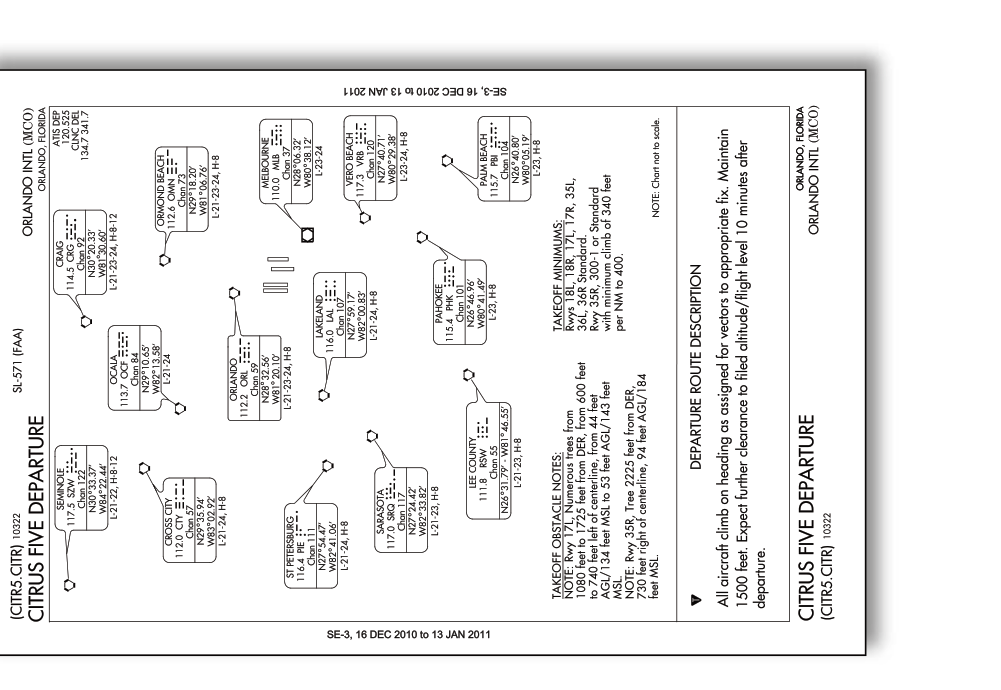
Every instrument-rated pilot must grapple with a critical but sometimes underappreciated phase of flight: the departure. Once you enter the clouds shortly after liftoff, you are navigating a three-dimensional obstacle environment you cannot see. Departure Procedures (DPs) exist precisely to bridge that gap — they are FAA-designed or FAA-approved routing and climb instructions that keep IFR aircraft clear of terrain and obstructions during the initial climb. Knowing how to read, interpret, and apply DPs is not only a tested subject on the FAA Instrument Rating knowledge exam; it is a genuine safety skill that every pilot flying IFR must internalize.
The FAA publishes DP guidance primarily in the Instrument Procedures Handbook (FAA-H-8083-16) and references it throughout the Instrument Flying Handbook (FAA-H-8083-15) and the Aeronautical Information Manual (AIM). This article walks through both types of DPs, how they are constructed, when they are required, and what you must do — and not do — to use them correctly.
The Two Types of Departure Procedures
The FAA divides published DPs into two distinct categories, each serving a related but different purpose:
- Obstacle Departure Procedures (ODPs): These exist solely to provide obstacle clearance. They may be textual (a written set of instructions) or graphic (a charted procedure). ODPs are published whenever a standard climb out of a particular runway environment would not safely clear all obstacles within the departure area. Following an ODP is not mandatory unless ATC assigns it or the operator's operating specifications require it — but it is always a sound safety practice.
- Standard Instrument Departures (SIDs): These are ATC-designed procedures intended to streamline traffic flow as well as provide obstacle clearance. SIDs are almost always graphic procedures and include specific routing, fixes, altitude constraints, and sometimes speed restrictions. Using a SID requires pilot acceptance and appropriate avionics capability, and ATC must assign it.
Both types appear in the FAA's Terminal Procedures Publications (the instrument approach plates booklet) and are also available on electronic flight bag platforms. Graphical ODPs use a distinct symbol — a "T" with a circle around it — on the airport information/instrument approach chart index and approach plate covers to alert pilots that takeoff minimums and/or a DP are available for that airport.
How Obstacle Departure Procedures Work
To understand an ODP, you first need to understand the obstacle clearance environment the FAA designs around. During a standard IFR departure, the FAA assumes the aircraft crosses the departure end of the runway (DER) at 35 feet above ground level and then climbs at a standard rate of 200 feet per nautical mile (ft/NM). This standard gradient, when followed, keeps the aircraft within what the FAA calls the "obstacle clearance surface" — an invisible sloped plane radiating outward from the runway that provides a minimum of 48 feet of clearance per nautical mile over obstacles in the initial segment.
When an obstacle penetrates that surface, the FAA has several options: publish a diverse departure (allowing any heading up to 15 degrees either side of the runway centerline), designate a specific textual ODP describing a required turn or route, or publish a graphic ODP with more complex routing. A graphic ODP may include waypoints, radials, DME arcs, or climb-to-altitude-before-turning instructions, all designed to steer the aircraft through a corridor in the surrounding terrain.
Critically, some ODPs require a non-standard climb gradient — a rate steeper than 200 ft/NM. These are explicitly printed on the procedure. For example, a note might read: "Climb via runway heading to 2,400 feet before turning right, or climb at or above 340 ft/NM to 3,000 feet." If your aircraft cannot achieve that gradient with the current weight, density altitude, and configuration, you should not fly that procedure — it was designed around a performance standard your airplane does not meet in those conditions. Always cross-check the required climb gradient against your airplane's actual climb performance using the Pilot's Operating Handbook (POH) before flight.
Diverse Departures and When They Apply
Not every airport has a published DP. When no DP is published and ATC issues no specific routing, the FAA permits a "diverse departure" — the pilot may climb on any heading within 15 degrees of the extended runway centerline (in either direction) and proceed directly to the en route structure, provided the standard 200 ft/NM climb gradient is met. The key requirement for a diverse departure is that the airport environment has been evaluated by the FAA and found to be free of obstacles that would penetrate the obstacle clearance surface in that lateral band.
If you are departing an airport where no DP is published and you are operating in IMC, you as pilot-in-command bear the responsibility to either use a published ODP or develop your own personal departure plan that provides adequate obstacle clearance. This is not optional — 14 CFR Part 91 places the responsibility for obstacle clearance on the PIC when no DP is in use.
Reading a Graphic ODP
Graphic ODPs look similar to SID charts and contain several elements you must understand before flight:
- Departure runway(s): ODPs are often runway-specific. An ODP for Runway 28 may not be applicable — or may be wildly different — from the ODP for Runway 10 at the same airport.
- Climb gradient requirements: If printed, these are mandatory performance minimums, not advisory. They appear near the relevant segment of the procedure.
- Climb-to altitude before proceeding: Many ODPs require reaching a specific altitude (e.g., "Climb to 5,000 feet via runway heading before proceeding on course") to ensure obstacle clearance before the aircraft turns toward the destination.
- Lost communications instructions: Graphic DPs often include lost comms guidance specific to that procedure, supplementing the general lost comm rules found in 14 CFR 91.185.
- Notes and restrictions: Procedural notes may restrict use to specific aircraft categories, limit use to certain times of day, or require specific navigation equipment (e.g., DME or GPS).
SIDs vs. ODPs: Practical Differences
Pilots sometimes conflate SIDs and ODPs because both appear on DP charts. The essential practical differences are these: A SID is an ATC tool — you fly it when ATC assigns it, and you must have the chart and the relevant navigation capability to accept the clearance. An ODP is a safety tool — it is available for pilot use even without an ATC assignment, and in many cases prudent airmanship demands you use it. You can always request an ODP from ATC even if it was not offered; ATC will typically accommodate the request or provide an amended clearance that achieves the same obstacle avoidance.
When ATC issues a clearance that includes the phrase "Climb via SID," it means you are expected to follow all the lateral routing, altitude constraints, and speed restrictions on the SID chart exactly as published. This is a specific and legally meaningful instruction. Deviating from a "climb via" clearance without authorization is a regulatory violation.
Key Numbers and Rules
- Standard climb gradient: 200 ft/NM is the baseline assumed by all departure obstacle clearance surfaces.
- Minimum obstacle clearance: 48 feet within the initial departure area for the standard gradient to be considered compliant.
- Diverse departure corridor: ±15 degrees of extended runway centerline heading is allowed for airports with no published DP and a favorable obstacle evaluation.
- 35-foot crossing height: Aircraft are assumed to cross the departure end of the runway at 35 feet AGL when obstacle surfaces are calculated.
- Non-standard gradients: Explicitly charted; always check POH climb performance data against these requirements before accepting the procedure.
- Pilot responsibility: Under 14 CFR Part 91, the PIC is responsible for obstacle clearance when departing IFR, regardless of whether ATC has issued a DP.
Common Test Traps
- ODPs are not mandatory — but ignoring them is dangerous. The FAA knowledge test frequently tests whether students understand that ODPs are not required by regulation for Part 91 operators unless specifically assigned. However, the exam also tests that the PIC retains obstacle clearance responsibility — so skipping the ODP does not relieve you of that duty.
- The standard gradient is 200 ft/NM, not 200 ft/min. Test questions often phrase climb performance in feet per minute; you must convert using your aircraft's groundspeed to verify compliance with the charted gradient in ft/NM.
- Runway-specific procedures catch pilots off guard. A DP published for one runway does not automatically apply — or may even be contraindicated — for the opposite runway. Always verify the applicable runway before briefing a DP.
- "Climb via SID" means ALL constraints, not just the routing. Altitude and speed restrictions on a SID chart are mandatory when a "climb via" clearance is issued. Missing any single constraint is a deviation.
- No published DP does not mean no obstacles. Some test questions imply that the absence of a DP means an airport is obstacle-free. In fact, it may simply mean the standard diverse departure satisfies the clearance requirements — terrain may still be significant.