Inside the AMT General Exam: Core Knowledge Every A&P Needs
What Is the AMT General Exam — and Why Does It Matter?
The AMT General exam is the first of three written knowledge tests every aspiring Aviation Maintenance Technician must pass on the path to earning an FAA Airframe and Powerplant (A&P) certificate. Alongside the Airframe and Powerplant exams, the General test forms the foundation of your credentialing journey — and for good reason. It covers the broad, cross-cutting knowledge that every working A&P mechanic relies on daily, regardless of whether they're rebuilding a turbine engine or patching composite structure.
If you're studying for the AMT General exam, understanding exactly what's tested — and how to approach it strategically — is the single most important step you can take before sitting in that testing center chair. This guide walks you through the core subject areas, common stumbling blocks, and a proven study approach to help you feel genuinely prepared.
The Structure of the AMT General Exam
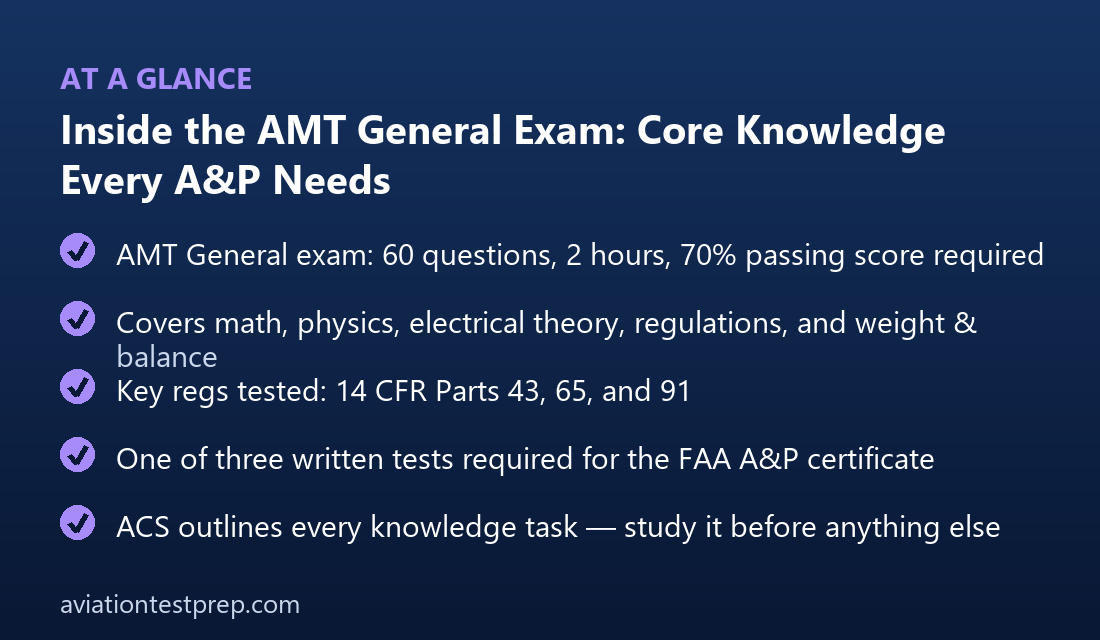
The FAA's AMT General knowledge test is drawn from the Mechanic Airman Certification Standards (ACS), which outline the specific tasks and knowledge elements an A&P candidate must demonstrate. The exam consists of 60 questions, and you'll have two hours to complete it. A passing score is 70% or higher — meaning you can afford to miss up to 18 questions, but you want a much larger cushion than that going in.
The questions span a wide range of technical and regulatory topics. Here's a high-level breakdown of the major subject areas you'll encounter:
- Mathematics — fractions, decimals, ratios, algebra, and geometry as applied to aviation maintenance tasks
- Physics — matter, energy, work, power, heat, fluid mechanics, and gas laws
- Electrical fundamentals — Ohm's Law, series and parallel circuits, capacitance, and inductance
- Aircraft drawings and publications — blueprints, schematics, charts, and technical data interpretation
- Weight and balance — computing center of gravity, loading schedules, and moment arms
- Fluid lines and fittings — material identification, installation standards, and flare types
- Materials and processes — metals, non-metals, finishing, and non-destructive inspection methods
- Ground operations and servicing — safety, fueling, towing, and fire prevention
- Cleaning and corrosion control — types of corrosion, identification, and treatment
- FAA regulations and maintenance publications — 14 CFR Parts 43, 65, and 91, as well as advisory circulars
- Mechanic privileges and limitations — what certificate holders may and may not do
Core Knowledge Areas Every A&P Needs to Master
Mathematics and Physics: The Invisible Framework
Many candidates underestimate the math on the AMT General exam. Questions aren't designed to trick you with advanced calculus, but they do require confident arithmetic, working with fractions and decimals, solving for unknowns, and applying geometric formulas — all in the context of real maintenance tasks. For example, you might need to calculate the area of a control surface patch, determine the mechanical advantage of a pulley system, or use the gas laws to explain what happens to tire pressure as altitude changes.
Physics concepts tie directly into the work A&P mechanics perform every day. Understanding how heat transfers through metals, how hydraulic pressure multiplies force, and how Bernoulli's principle affects airflow isn't just test knowledge — it's the why behind maintenance procedures. Build your conceptual understanding here and the questions become much more intuitive.
Electrical Fundamentals: More Than Just Ohm's Law
Electrical questions are among the most frequently missed on the AMT General exam. Candidates often memorize Ohm's Law (V = IR) but struggle when questions combine it with series/parallel circuit analysis or ask about the behavior of capacitors and inductors in AC circuits. Spend extra time on:
- Calculating total resistance in series vs. parallel circuits
- Understanding how voltage, current, and resistance change across branches
- The difference between AC and DC systems and where each is used on aircraft
- Basic magnetism and how generators and motors work
Aircraft Drawings and Technical Publications
Modern aviation maintenance is documentation-driven. The AMT General exam tests your ability to read and interpret engineering drawings, wiring diagrams, hydraulic schematics, and assembly blueprints. You should also be comfortable locating information in aircraft maintenance manuals (AMMs), illustrated parts catalogs (IPCs), and airworthiness directives (ADs). Knowing how to use these publications efficiently is just as important as knowing the content inside them.
Weight and Balance: Precision Under Pressure
Weight and balance calculations are a staple of the General exam and show up throughout a mechanic's career. You'll need to calculate center of gravity (CG) positions, determine if an aircraft is within its approved CG envelope, and understand how adding, removing, or shifting weight affects balance. These problems reward methodical work — set up the moment arms carefully and double-check your arithmetic before selecting an answer.
Regulations: Know Your Rules
FAA regulations governing maintenance are heavily tested on the AMT General exam. Key areas include:
- 14 CFR Part 65 — eligibility requirements, privileges, and limitations for mechanics
- 14 CFR Part 43 — maintenance, preventive maintenance, rebuilding, and alteration standards, including return-to-service requirements
- 14 CFR Part 91 — general operating and flight rules, including required inspections
Pay particular attention to the distinction between what an A&P mechanic can approve for return to service versus what requires an IA (Inspection Authorization) or repair station involvement. These nuances appear regularly in exam questions and in real shop situations.
How to Study for the AMT General Exam Effectively
Passing the AMT General exam isn't about cramming — it's about building durable understanding you can apply. Here's a structured approach that works:
- Map the ACS — Start by reviewing the Mechanic ACS to understand exactly which knowledge codes are tested. This prevents wasted study time on out-of-scope material. You can explore ACS code breakdowns at aviationtestprep.com/acs-codes.
- Study by subject block — Work through one subject area at a time rather than jumping between topics. Finish electrical, then move to weight and balance, and so on.
- Practice questions early and often — ACS-aligned practice questions reveal gaps in your knowledge faster than re-reading the textbook. Browse exam-specific question banks at aviationtestprep.com/browse-exams.
- Review every missed question deeply — Don't just note that you got something wrong. Read the explanation, trace it back to the underlying concept, and revisit the ACS task it covers.
- Test yourself under realistic conditions — Timed, full-length practice sessions build both knowledge and the mental stamina you need on test day.
Aviation Test Prep's platform includes Ace, our AI-powered study tutor, who can explain tricky concepts in plain language, walk you through calculation problems step by step, and quiz you on the areas where your performance data shows the most room for improvement. Ace doesn't just give you the answer — it teaches you the reasoning behind it, which is exactly what the AMT General exam demands.
Our 5-step study method — Learn, Practice, Review, Simulate, and Assess — is built into the platform to guide you from first read-through to test-day confidence. Each step is designed to reinforce retention and ensure you're not just recognizing correct answers, but genuinely understanding the material.
Common Mistakes Candidates Make (And How to Avoid Them)
- Skipping math practice — Don't assume the math section will be easy. Practice applied problems with a calculator, since one is permitted during the exam.
- Ignoring regulations — Regulatory questions are reliable points to gain. Read Part 43 and Part 65 carefully and know the specific limitations they impose.
- Overlooking corrosion and materials topics — These sections feel dry but are consistently represented in the question bank.
- Guessing without elimination — Use process of elimination actively. Even when uncertain, you can usually rule out one or two obviously incorrect options.
Get Started with FAA-Aligned AMT General Practice Questions
The AMT General exam is rigorous, but it's entirely passable with the right preparation. The core knowledge it tests — math, physics, electrical theory, regulations, and technical publications — isn't obscure trivia. It's the working knowledge that makes a safe, competent A&P mechanic. Start building that foundation today by exploring our free practice resources at aviationtestprep.com/free-practice-test, or visit the Aviation Test Prep blog for more study guides across all FAA knowledge exams.
Every A&P mechanic who's signed off a logbook entry started exactly where you are — with a study plan and the AMT General exam ahead of them. You've got this.
Ready to take the next step? Create your free Aviation Test Prep account today and start practicing with ACS-aligned AMT General questions guided by Ace, your AI study partner.
Ready to pass your FAA written exam?