Staying Legal as a Remote Pilot: Part 107 Recurrent Training and Rules
Staying Legal as a Remote Pilot: What Part 107 Recurrent Training Really Means
Earning your Part 107 Remote Pilot Certificate is a proud milestone, but the FAA's framework doesn't let you coast on that initial pass forever. Part 107 recurrent training is the mechanism that keeps commercial drone operators legally current — and understanding exactly what it requires, what's changed in recent years, and how to prepare efficiently can save you from an unwanted certificate suspension or worse. Whether you're a seasoned aerial photographer or a new UAS operator branching into precision agriculture, this guide walks you through everything you need to stay legal and confident in the air.
Why Part 107 Recurrent Training Exists
The FAA created the recurrent requirement for a straightforward reason: the UAS industry evolves quickly. Airspace rules change, new operational categories emerge, and safety data from real-world operations continuously refines best practices. A remote pilot who passed the initial aeronautical knowledge test several years ago may not be current on critical updates such as LAANC authorization procedures, remote ID requirements, or the latest operational limitations for controlled airspace.
By requiring recurrent training, the FAA ensures that every active Part 107 certificate holder maintains a baseline of current aeronautical knowledge — protecting not only other airspace users but also the public on the ground and the broader reputation of the commercial UAS industry.
The Two Pathways to Staying Current Under Part 107
The FAA has provided two distinct ways for a remote pilot to satisfy the recurrent requirement. Understanding both options helps you choose the most efficient path for your schedule and learning style.
Option 1: The FAA WINGS-Based Online Training Course
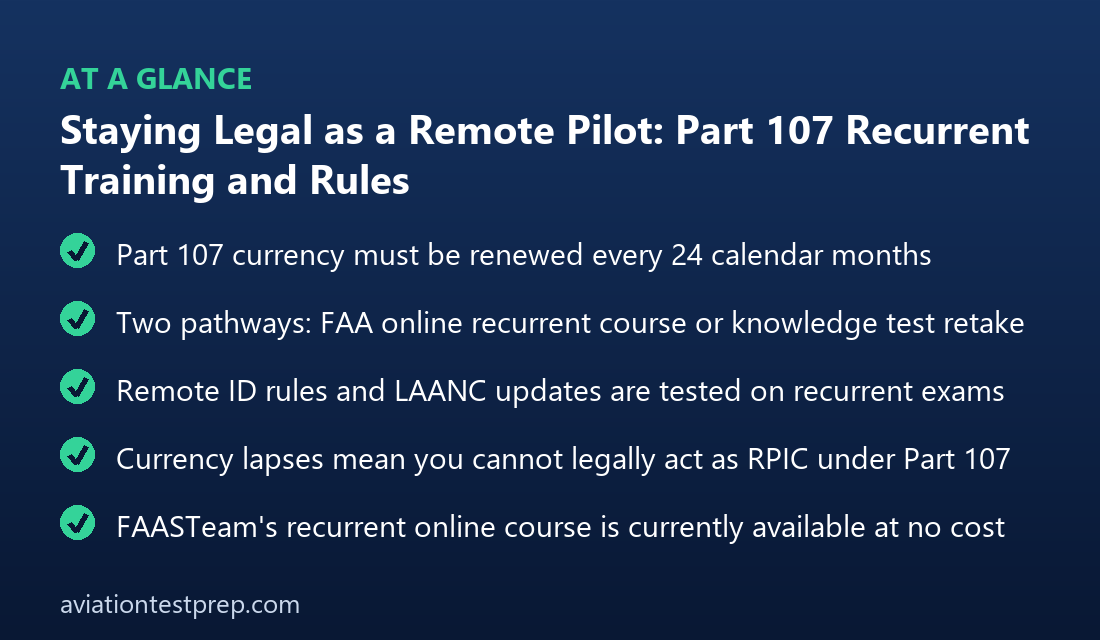
The FAA Safety Team (FAASTeam) offers a free online recurrent training course through the FAASafety.gov portal. This self-paced, online-only course is specifically designed for Part 107 remote pilots and covers updated regulations, airspace classification, weather, emergency procedures, and crew resource management concepts as they apply to UAS operations. Upon successful completion, you receive a certificate of completion — no visit to a testing center required.
This pathway became available as an alternative to retesting and has been widely adopted because it is:
- Free — no testing fee at a knowledge testing center
- Self-paced — complete it on your own schedule
- Comprehensive — covers all updated content areas the FAA deems essential
- Convenient — accessible from any device with an internet connection
Always verify current course availability and any updated requirements directly at faa.gov/uas or the FAASafety.gov website, as the FAA periodically updates its training offerings.
Option 2: Passing the FAA Recurrent Knowledge Test (UAG)
The traditional route is sitting for the aeronautical knowledge test at an FAA-approved Knowledge Testing Center (KTC). This is the same style of test as the initial Part 107 exam — multiple-choice questions covering the UAS-specific content areas defined in the Airman Certification Standards (ACS). Passing this test renews your currency for another 24-calendar-month period.
Some remote pilots actually prefer this route because it forces structured, comprehensive review of the full Part 107 knowledge base, which can be valuable if your operations involve complex airspace or you want to sharpen your overall UAS aeronautical knowledge.
How Often Must You Complete Recurrent Training?
Under 14 CFR Part 107, a remote pilot must complete a recurrent aeronautical knowledge test or an approved FAA recurrent training course every 24 calendar months to exercise the privileges of a Part 107 certificate. If your recurrency lapses, you are not legally authorized to operate as a remote pilot in command (RPIC) for commercial or other operations covered by Part 107 — even if your plastic certificate is still in your wallet.
Mark your calendar well in advance. A helpful habit is to schedule your recurrent training roughly 60 days before your currency expiration date, giving yourself a buffer for study preparation and, if testing, appointment availability at a KTC.
Key Content Areas Covered in Part 107 Recurrent Training
Whether you choose the online FAASTeam course or the knowledge test, the core subject matter is drawn from the Part 107 ACS. Here's a snapshot of what you should expect to review:
- Applicable regulations — current 14 CFR Part 107 rules, waivers, and exemptions
- Airspace classification and operating requirements — Classes B, C, D, E, and G, plus the use of LAANC and DroneZone for authorization
- Remote identification (Remote ID) — understanding Standard and Broadcast Module requirements
- Weather and meteorology — interpreting METARs, TAFs, and winds-aloft forecasts as they affect UAS operations
- Loading and performance — how weight, battery charge, and environmental conditions affect your aircraft's capabilities
- Emergency procedures — lost-link procedures, flyaway prevention, and coordinating with ATC if necessary
- Crew resource management — communication and decision-making with visual observers and team members
- Airport operations — understanding surface movement areas and how to safely operate near airports
If any of these topics feel rusty, targeted practice is your best investment of study time. Our ACS code browser lets you drill down into specific knowledge areas so you can focus on genuine weak spots rather than reviewing material you already know cold.
How to Study Efficiently for Part 107 Recurrent Training
Even experienced remote pilots sometimes underestimate how much the regulatory landscape has shifted since their last certification cycle. A structured approach pays dividends. At Aviation Test Prep, we recommend a 5-step study method:
- Assess your baseline — Take a free diagnostic practice test to identify which ACS content areas need the most attention.
- Study by topic — Work through each content area systematically rather than just grinding random questions.
- Practice with ACS-aligned questions — Our FAA-aligned practice questions mirror the style, depth, and ACS coding of the actual knowledge test, helping you build genuine understanding rather than surface-level memorization.
- Ask Ace — When a concept doesn't click, consult Ace, our built-in AI tutor. Ace explains the reasoning behind correct answers, cross-references relevant regulations, and helps you connect theory to real-world application.
- Simulate test conditions — Take timed, full-length practice exams before your actual test date to build confidence and stamina.
Ready to see where you stand right now? Take a free practice test and get an instant snapshot of your current knowledge level across Part 107 content areas.
Common Mistakes Remote Pilots Make with Recurrency
Staying legally current sounds simple, but a few recurring mistakes trip up even experienced operators:
- Confusing certificate issuance date with currency date — Your 24-month clock starts from the date you completed your most recent qualifying test or training, not the date printed on your certificate.
- Waiting until the last minute — KTC appointment slots can fill up, and online course platforms occasionally experience outages. Build in lead time.
- Assuming no rules have changed — Remote ID, LAANC updates, and operational category changes are real and tested. Don't skip reviewing current regs.
- Neglecting weather sections — Many remote pilots over-index on regulations and under-prepare on meteorology, which is consistently represented on the knowledge test.
Staying Informed Between Recurrency Cycles
Passing your recurrent training is a floor, not a ceiling. The best remote pilots stay engaged with regulatory changes throughout the 24-month window. A few practical habits:
- Subscribe to FAA UAS news updates at faa.gov/uas
- Monitor NOTAM and TFR systems before every flight
- Participate in FAASTeam safety seminars and webinars
- Revisit our Aviation Test Prep blog for plain-language breakdowns of regulatory updates and study tips
For a full overview of all available exams and how they fit into your aviation journey, browse our exam library — including resources for both initial Part 107 candidates and those preparing for recurrency.
Conclusion: Keep Your Certificate Current, Keep Your Operations Legal
Part 107 recurrent training isn't just a bureaucratic checkbox — it's a genuine safeguard that keeps you, your clients, and the National Airspace System safer. The 24-month cycle is manageable, the study material is well-defined, and with the right tools the preparation process can actually be engaging. Staying current is one of the most professional things you can do as a remote pilot, and it opens every door that a lapsed certificate closes.
Start your recurrent prep today — create your free Aviation Test Prep account and get instant access to ACS-aligned practice questions, Ace our AI tutor, and the full 5-step study method designed to get you current and confident.
Ready to pass your FAA written exam?