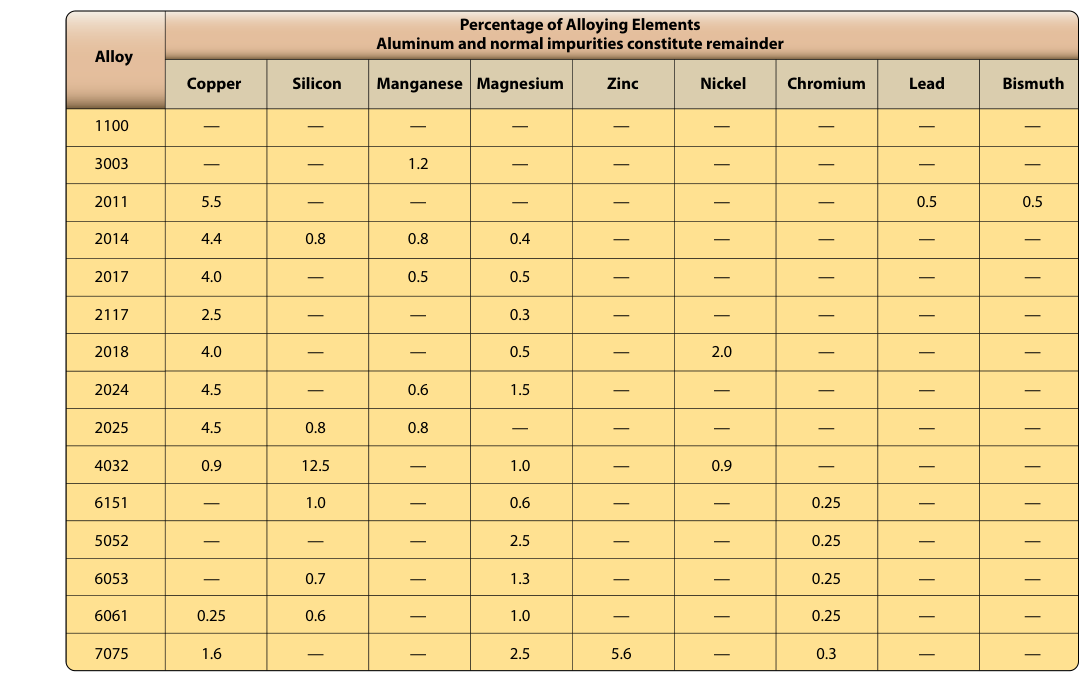
When an aviation maintenance technician opens a structural repair manual or reviews a material specification, one of the first things encountered is a string of numbers and letters describing the aluminum alloy to be used. Something like 2024-T3 or 7075-T6 is not arbitrary; every character carries precise engineering meaning. Understanding the designation system allows the AMT to select the correct alloy and temper for a given repair, ensuring the repaired structure meets its original strength and corrosion-resistance requirements. Getting this wrong — substituting a softer temper or a weaker alloy — can silently compromise airworthiness.
The FAA's Aviation Maintenance Technician Handbook – Airframe (FAA-H-8083-31) dedicates significant coverage to aluminum alloy identification because aluminum and its alloys make up the largest portion of the structural material in most certificated light aircraft. This article walks through the full designation system, explains what each digit and letter means mechanically, and highlights the most testable specifics for the AMT knowledge exam.
The Four-Digit Alloy Designation System
The Aluminum Association established a four-digit numbering system that has been adopted universally in aviation. The first digit identifies the principal alloying element — the element that most influences the alloy's properties. The remaining digits refine the specific composition within that family.
- 1xxx series — Commercially pure aluminum (99% or higher purity). Very soft, highly corrosion-resistant, excellent electrical conductivity. Used for fuel and oil lines, not primary structure.
- 2xxx series — Copper is the principal alloying element. These alloys respond well to heat treatment and achieve high strength. 2024 is the most common aircraft structural alloy, widely used in fuselage skins, wing skins, and structural members where fatigue resistance matters.
- 3xxx series — Manganese is the principal alloying element. Moderate strength, good formability and corrosion resistance. Used for fuel tanks and cowling.
- 4xxx series — Silicon is the principal alloying element. Low melting point; used primarily in welding wire and brazing alloys rather than structural sheet.
- 5xxx series — Magnesium is the principal alloying element. Good corrosion resistance (including saltwater environments), moderate-to-good strength, not heat-treatable for strength. Common in marine and some aircraft applications.
- 6xxx series — Magnesium and silicon together. Heat-treatable, good corrosion resistance and medium strength. 6061 is used in extruded shapes and fittings.
- 7xxx series — Zinc is the principal alloying element, often with magnesium and copper. Heat-treatable to the highest strengths of any aluminum alloy. 7075 is extensively used in wing spars, bulkheads, and heavily loaded fittings.
The second digit indicates modifications to the original alloy or impurity limits. A zero in the second position means the original alloy composition; digits 1 through 9 indicate controlled modifications. The third and fourth digits in the 1xxx series identify the purity level, while in all other series they simply serve as identifiers to distinguish specific alloys within the group — they do not directly encode compositional data beyond that.
The Temper Designation System
Knowing the alloy family is only half the story. The same alloy can be soft and formable or hard and strong depending on how it has been processed after casting and rolling. The temper designation describes this processing history and, therefore, the resulting mechanical properties. The temper code is separated from the alloy number by a hyphen.
Basic Temper Letters
- F — As-Fabricated. No special control over thermal or work-hardening conditions after manufacturing. Properties are not guaranteed. Rarely specified for structural applications.
- O — Annealed. The alloy has been fully softened by heating and slow cooling. Maximum ductility, lowest strength. Used when the material must be formed or worked extensively before final heat treatment.
- H — Strain-Hardened. Strength has been increased by cold working (rolling, drawing). Used only for non-heat-treatable alloys (1xxx, 3xxx, 5xxx series). The first digit following H (H1, H2, H3) indicates whether the alloy is strain-hardened only, strain-hardened and partially annealed, or strain-hardened and stabilized, respectively. A second digit (1–8) indicates the degree of hardening, with H18 being fully hard.
- T — Thermally Treated. The alloy has been solution heat-treated, quenched, and then aged. This applies only to heat-treatable alloys (2xxx, 6xxx, 7xxx series). The T temper is the most critical for aircraft primary structure, and its sub-digits are heavily tested.
- W — Solution Heat-Treated. An unstable intermediate condition; the alloy has been solution heat-treated but has not yet aged. Aging will continue at room temperature. A time designation may follow (e.g., W ½ hr).
Critical T-Temper Sub-Designations
For the AMT airframe exam, the T-temper sub-digits are especially important because they differentiate alloys that look identical but behave very differently during and after repair.
- T3 — Solution heat-treated, cold-worked (strain-hardened), then naturally aged (at room temperature) to a substantially stable condition. 2024-T3 is the classic example — high strength combined with good fatigue resistance.
- T4 — Solution heat-treated and naturally aged only, without cold working. Slightly lower strength than T3 for the same alloy.
- T6 — Solution heat-treated, then artificially aged (elevated temperature aging, also called precipitation hardening). 7075-T6 achieves very high tensile strength through this process. Artificial aging takes hours rather than the days or weeks needed for natural aging.
- T73 — Solution heat-treated and then over-aged in a special two-step aging process. Used for 7075 to improve stress-corrosion cracking resistance at some sacrifice of ultimate strength. Designated 7075-T73 in fittings and thick sections where stress-corrosion is a concern.
- T351, T3511, T36, T361, T651 — Additional digits indicate stress-relieving by stretching (51), straightening, or specific controlled cold working applied after solution heat treatment. These distinctions matter when the SRM specifies an exact procurement temper.
Why the Designation Matters in Practice
An AMT performing a skin repair cannot simply grab any aluminum sheet from stock. The structural repair manual will specify a particular alloy and temper, and substitution must be approached carefully. Substituting a higher-strength alloy such as 7075-T6 for 2024-T3 in the same thickness might seem conservative, but 7075 is less damage-tolerant and more notch-sensitive, which can actually reduce fatigue life in a dynamically loaded skin. Conversely, using 2024-O (annealed) instead of 2024-T3 would dramatically reduce the strength of the repair — the annealed material may be only about one-third as strong in tension.
Temper also affects how material must be handled. In the W condition, 2024 is workable for a limited time after solution heat treatment — this is the basis of refrigerating rivets to slow natural aging and preserve their driven characteristics. Once 2024-T3 or 7075-T6 has reached its final temper, it cannot be re-heat-treated in the field without specialized furnaces and quench facilities, and any attempt will alter properties unpredictably.
Key Numbers and Rules
- 2024-T3 — Tensile ultimate strength approximately 64,000–70,000 psi depending on product form; the most widely used aircraft skin alloy.
- 7075-T6 — Tensile ultimate strength approximately 78,000–83,000 psi; used in the highest-load structural members such as spars and bulkheads.
- 6061-T6 — Tensile ultimate strength approximately 42,000–45,000 psi; good corrosion resistance; common in extruded angles and tubing.
- The first digit tells the principal alloying element; the temper letter tells the processing history.
- Only heat-treatable alloys (2xxx, 6xxx, 7xxx) use T tempers; non-heat-treatable alloys (1xxx, 3xxx, 5xxx) use H tempers for strengthening.
- Clad aluminum (Alclad) is designated separately — e.g., Alclad 2024-T3 — meaning a pure aluminum or aluminum-zinc cladding has been roll-bonded to the core alloy for corrosion protection, at a slight sacrifice in strength.
- Alclad cladding is typically about 5% of the total sheet thickness per side, depending on sheet gauge.
Common Test Traps
- Confusing H and T tempers. A common exam distractor will list an H temper for a 2024 alloy or a T temper for a 3003 alloy. Remember: H tempers only apply to non-heat-treatable alloys; T tempers only apply to heat-treatable alloys.
- Assuming higher alloy number means stronger. The series number only identifies the principal alloying element, not a ranking of strength. 5052 is not stronger than 2024 simply because 5 is greater than 2.
- Forgetting what the W temper means. W designates a solution heat-treated but not yet aged condition — it is unstable and will naturally age at room temperature. It is not a finished structural temper.
- Mixing up T3 and T4. Both involve natural aging, but T3 includes cold working after solution heat treatment, giving it higher strength. T4 does not include that cold-working step.
- Overlooking Alclad strength reduction. Because the cladding layer is pure (softer) aluminum, Alclad sheet has slightly lower strength than bare sheet of the same alloy and temper. Where the SRM specifies bare 2024-T3, substituting Alclad 2024-T3 of the same thickness is not automatically acceptable at one-for-one thickness.