Corrosion is one of the most persistent threats to aircraft structural integrity. Unlike a dent or a crack that a mechanic can immediately spot and measure, corrosion can hide beneath paint, inside hollow structures, and along mating surfaces where two different metals touch. Left unchecked, it weakens load-bearing members silently and rapidly, turning airworthy metal into a structural liability. For the Aviation Maintenance Technician (AMT) working on airframe systems, understanding the chemistry, appearance, and location of each corrosion type is not just a test topic—it is a daily safety responsibility governed by 14 CFR Part 43 and manufacturer maintenance manuals.
This article covers every major corrosion type found on aircraft metallic structures, explains why each occurs, describes how to identify it in the field, and highlights the exam-focused details you need to know for the FAA Airframe Knowledge Test.
What Is Corrosion?
At its core, corrosion is the electrochemical deterioration of a metal as it reacts with its environment. Most aircraft metals are thermodynamically unstable in the presence of oxygen and moisture—they want to revert to a lower-energy oxidized state. The corrosion process requires an anode (the metal that is attacked and loses material), a cathode (a more noble metal or region that is protected), an electrolyte (moisture containing dissolved salts, acids, or other ions), and a metallic path connecting anode to cathode. Remove any one of these four elements and corrosion stops. That principle drives every corrosion prevention strategy in aviation maintenance.
Types of Corrosion
Surface (Uniform) Corrosion
Surface corrosion is the most straightforward type: a broad, relatively even attack across an exposed metal surface. On aluminum alloys it typically appears as a gray or white powdery deposit (aluminum oxide and aluminum hydroxide) with general dulling or pitting of the surface beneath. On steel, it produces the familiar reddish-brown iron oxide we call rust. Surface corrosion develops wherever protective coatings have broken down and bare metal is exposed to moisture and atmospheric oxygen. Although surface corrosion is the easiest to detect visually, even a thin layer of aluminum oxide is deceptive—it looks mild but the powdery residue indicates that measurable metal has already been lost. Cleaning and refinishing early prevents further penetration.
Pitting Corrosion
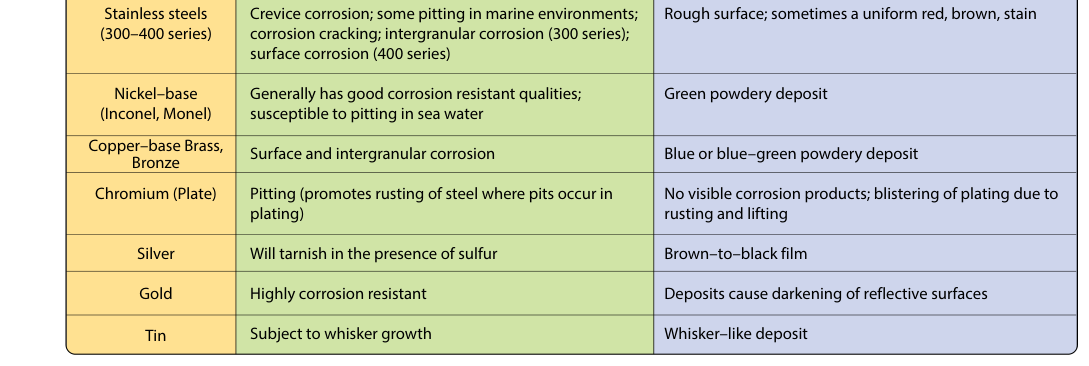
Pitting corrosion is a localized, highly destructive form that creates small cavities or pits in the metal surface while the surrounding area may look relatively clean. It is especially common on aluminum alloys and stainless steel. Pitting begins when the protective oxide film breaks down at a microscopic defect, creating a small active anode surrounded by a large passive cathode—a very unfavorable area ratio that drives aggressive local attack. The pit itself becomes acidic as corrosion products accumulate, accelerating the process. Pitting is dangerous because it acts as a stress concentrator: even a tiny pit can initiate a fatigue crack under cyclic loading. On the knowledge test, remember that pitting is considered one of the most serious forms of corrosion on aircraft structural members precisely because of its crack-initiation potential.
Intergranular Corrosion
Intergranular corrosion (IGC) attacks along the grain boundaries of a metal rather than across the grain surfaces. It is most commonly associated with certain aluminum alloys (particularly the 2000 and 7000 series) and stainless steels that have been improperly heat-treated or sensitized. During improper heat treatment, alloying elements precipitate at grain boundaries, making those boundaries anodic relative to the grain interiors. The result is a network of corrosion paths that penetrate deeply into the metal while the surface may appear nearly normal. Badly affected aluminum can exhibit exfoliation—layers of metal actually lifting and flaking away like pages of a book—which is sometimes called exfoliation corrosion. Because visible surface lifting or blistering is generally a later-stage indicator rather than an early one, detecting IGC before it reaches the exfoliation stage typically relies on nondestructive inspection methods such as eddy current or ultrasonic testing, or dye penetrant inspection on machined surfaces. Because IGC destroys internal structure with minimal surface evidence, it is extremely hazardous.
Galvanic Corrosion
Galvanic corrosion occurs when two dissimilar metals are in electrical contact in the presence of an electrolyte. The more active (anodic) metal corrodes preferentially while the more noble (cathodic) metal is protected. The driving force is the difference in electrochemical potential between the two metals, which can be predicted using the galvanic series. In aircraft construction, common problem pairings include aluminum in contact with steel fasteners, copper electrical terminals touching aluminum structure, and magnesium components near almost any other structural metal. The rate of attack depends on the area ratio: a large cathode combined with a small anode is the worst-case scenario—a steel rivet in a large aluminum skin sheet corrodes the aluminum aggressively around the fastener hole. Prevention relies on isolating dissimilar metals with sealants, anodizing, non-conductive barrier materials, or corrosion-inhibiting primers such as zinc chromate, along with proper wet-installation practices for fasteners.
Concentration Cell (Crevice) Corrosion
Concentration cell corrosion, often called crevice corrosion, forms wherever a difference in ion concentration or oxygen content exists within a confined space. The most common form found on aircraft is the oxygen differential cell: moisture trapped in a lap joint, under a washer, or between mating surfaces has depleted oxygen in the crevice compared to the open surface outside. The oxygen-starved metal inside the crevice becomes anodic and corrodes. This type is particularly insidious on lap-jointed aluminum skins, under bolt heads, around rivet heads, and wherever two surfaces are held tightly together but not sealed. Inspectors look for paint bubbling or staining at the edges of lap joints as an early indicator. Crevice corrosion is why manufacturers specify faying surface sealant in all overlapping structural joints.
Fretting Corrosion
Fretting corrosion occurs at the interface of two tightly fitting surfaces that experience slight, repetitive relative motion—enough to disrupt any protective oxide film but not enough to separate the surfaces and allow fresh air in. The microscopic relative movement grinds away oxide particles (which act as an abrasive), and fresh metal immediately re-oxidizes, creating a cycle of continuous material loss. It is common at bolt holes in control surfaces, at spline and gear interfaces, and wherever tight-fitting assemblies vibrate in service. Fretting appears as a reddish-brown powder (iron oxide on steel) or black powder (aluminum oxide on aluminum) at the interface, along with pitting or surface damage at the contact zone. Because fretting also generates stress concentrations, fatigue cracking frequently follows.
Filiform Corrosion
Filiform corrosion is a specialized, thread-like form that develops under thin organic coatings—especially lacquers and certain primers on aluminum—when humidity is high. It appears as a network of fine, worm-like filaments spreading across the surface beneath the coating. The head of each filament is the active anodic cell; the tail is a drier, cathodic region. Filiform corrosion is largely cosmetic in early stages but indicates coating failure and can progress to pitting if not addressed. It is frequently found on aircraft that operate in humid coastal environments or that are improperly stripped and refinished.
Why Corrosion Identification Matters
Aircraft structures must maintain adequate strength and damage tolerance throughout their service life, with requirements addressed in 14 CFR Part 23 and, for transport category airplanes, provisions such as 14 CFR 25.571 covering damage tolerance and fatigue evaluation. 14 CFR Part 43 obligates the AMT to return an aircraft to airworthy condition after any maintenance, which includes treating and documenting corrosion findings. Corrosion control guidance, contained in AC 43-4B and referenced in FAA maintenance handbooks, stresses that any corrosion found must be evaluated against the applicable structural repair manual or engineering data to determine whether it is within allowable limits or requires repair before further flight. Misidentifying a pitting or intergranular attack as mere surface discoloration can allow structurally dangerous conditions to persist undetected.
Key Numbers and Rules
- Galvanic series: Magnesium is the most anodic (active) common aircraft metal; platinum and gold are at the noble end. The farther apart two metals sit in the series, the more aggressive the galvanic attack on the anodic one.
- Most dangerous structural types: Intergranular and pitting corrosion, due to deep penetration and stress-concentration effects with minimal surface warning.
- Aluminum alloy series at highest IGC risk: 2000-series (2024) and 7000-series (7075) are the primary exam-tested alloys.
- Crevice corrosion driver: Oxygen differential—oxygen-depleted zone is the anode (attacked); oxygen-rich zone is the cathode (protected).
- Fretting indicator colors: Reddish-brown powder = steel/iron fretting; black powder = aluminum fretting.
- Exfoliation: A severe, visible manifestation of intergranular corrosion; layered flaking parallel to the rolled surface of sheet metal.
- Prevention of galvanic corrosion: Isolate dissimilar metals with sealant, anodize surfaces, use compatible fastener materials, or apply corrosion-inhibiting primer such as zinc chromate to fastener holes during wet installation.
Common Test Traps
- Pitting vs. surface corrosion severity: Students often assume widespread surface corrosion is worse than a few small pits. The FAA reverses this—pitting is typically more dangerous due to stress concentration and potential crack initiation.
- Intergranular vs. exfoliation: Exfoliation IS intergranular corrosion—it is the advanced, visible stage where layers lift. They are not two separate types; exfoliation is a symptom of advanced IGC.
- Galvanic corrosion confusion: The metal that corrodes is the anodic (more active) one, NOT the cathodic (more noble) one. Magnesium always corrodes next to steel; the steel does not.
- Crevice corrosion cause: A common wrong answer attributes crevice corrosion to galvanic action between two different metals. In reality, the two surfaces in a crevice can be the same metal—the driver is the oxygen concentration difference, not a difference in metal composition.
- Fretting vs. wear: Fretting is corrosion combined with abrasion—it involves an electrochemical component and produces oxide debris. Plain mechanical wear does not. The FAA tests the distinction by describing the colored powder residue at the joint interface as the telltale sign of fretting corrosion specifically.