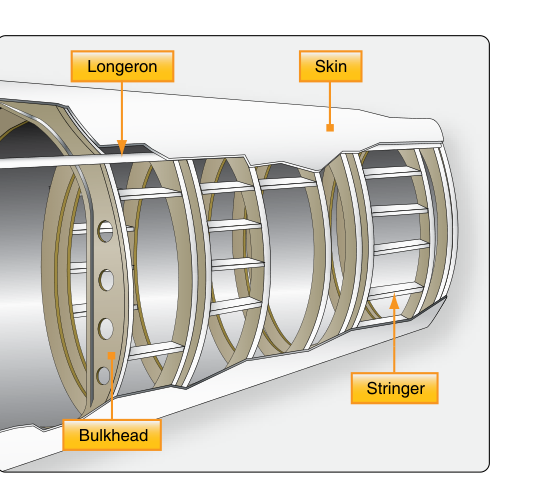
When you look at the smooth aluminum shell of a modern airplane, you are seeing far more than a weather barrier. That outer skin is a primary structural member — it carries tension, compression, shear, and torsional loads generated during flight and ground operations. This approach, called stressed-skin construction, comes in two closely related forms: monocoque and semi-monocoque. Understanding how each works, why one became the industry standard, and what holds these structures together is essential knowledge for any Aviation Maintenance Technician working on metallic airframes.
The word monocoque comes from the French for "single shell," and that name captures the central idea: the outer skin alone resists all applied loads. Semi-monocoque adds an internal framework of formers, frames, stringers, and longerons that work together with the skin, sharing the burden. Nearly every certificated fixed-wing aircraft you will service uses some variant of semi-monocoque construction, making it the most important structural concept in airframe maintenance.
Pure Monocoque Construction
In a true monocoque structure, the skin is the only load-carrying element. There are no internal longitudinal members; the skin handles bending, torsion, and shear entirely on its own. Early aircraft designers experimented with this idea using formed plywood shells, and it worked well on short, stubby fuselages where the skin could be kept thick enough to resist buckling.
The fatal flaw of pure monocoque design is skin buckling. Because the skin must resist compressive loads without any internal reinforcement, it must be relatively thick and therefore heavy. Any dent, corrosion pit, or damage that reduces the skin's cross-sectional area can cause a dramatic and sudden loss of load-carrying ability. Repairing a monocoque shell without restoring its exact original geometry is extremely difficult. For these reasons, pure monocoque fuselages are rare in modern production aircraft.
Semi-Monocoque Construction: How It Works
Semi-monocoque design solves the buckling problem by introducing an internal skeleton that prevents the skin from collapsing under compression. The skin still carries significant stress — that is what makes it "stressed-skin" — but the internal members share the load and provide the skin with support against buckling. The result is a structure that is both lighter and more damage-tolerant than a pure monocoque shell of equivalent strength.
The internal skeleton consists of several distinct types of members, each performing a specific function:
- Frames and formers: These are the circumferential (hoop) members that define the cross-sectional shape of the fuselage and resist loads that would otherwise collapse the tube. Frames are heavier, structural members located at major load points such as wing attachment, landing gear attachment, and door cutouts. Formers are lighter members used primarily to maintain shape between frames.
- Stringers and longerons: These run lengthwise along the fuselage, parallel to the aircraft's longitudinal axis. Stringers are relatively small, closely spaced members that stiffen the skin panels and help carry bending loads. Longerons are heavier longitudinal members, typically found at the corners of a fuselage, that carry the primary bending tension and compression loads generated when the aircraft pitches nose-up or nose-down.
- Stressed skin: The outer skin is riveted or bonded to the stringers and frames. This attachment allows the skin to act as a series of flat or curved panels supported on all edges. Rather than buckling freely, the skin can develop significant shear and tension loads before reaching its failure point. In bending, the skin on the tension side of the fuselage carries tensile stress; on the compression side it carries compressive stress, stabilized by the stringers behind it.
- Bulkheads: These are major transverse members, similar to frames but heavier and designed to carry concentrated loads — for example, the pressure bulkheads at the front and rear of a pressurized cabin, or the firewall separating the engine compartment from the cockpit.
Load Paths in Semi-Monocoque Structures
Understanding load paths is critical for maintenance because any repair that interrupts or redirects a load path can overload adjacent structure. In a semi-monocoque fuselage, the primary structural loads are:
- Bending loads: Wing lift tries to bow the fuselage upward in the center, placing the upper fuselage skin in compression and the lower skin in tension. Longerons and heavy stringers near the top and bottom of the fuselage carry most of this bending stress.
- Shear loads: Vertical and horizontal forces from the wings and tail are transferred into the fuselage as shear. The skin panels are the primary shear carriers — this is why skin panels cannot be left unrepaired even if the remaining structure seems intact.
- Torsional loads: Control surface deflections, asymmetric thrust, and maneuvering all try to twist the fuselage. The closed tube formed by the skin — when properly attached to its framework — is extremely efficient at resisting torsion. Any opening (a window, a door, an access panel) that interrupts this closed tube must be reinforced with doublers and heavy framing to restore torsional stiffness.
- Tension and compression: Pressurization loads in pressurized aircraft create hoop tension in the skin (trying to expand the fuselage cross-section like a balloon) and longitudinal tension trying to stretch the fuselage end-to-end. Frames resist the hoop loads; longerons and the skin together resist the longitudinal loads.
Wing Semi-Monocoque Structure
The same principles apply to the wing. A typical metal wing uses spars as the primary spanwise bending members. The main spar and rear spar form a box beam, and the stressed skin covering the top and bottom of the wing between those spars acts as the cap of that box, significantly increasing its bending and torsional stiffness. Ribs define the airfoil shape and transfer aerodynamic loads from the skin into the spars. Stringers stiffen the wing skin panels between ribs. This spar-rib-stringer-skin combination is a wing-specific application of semi-monocoque philosophy and is called a stressed-skin wing box. "Fail-safe" is a related but separate design philosophy term describing redundant load paths built throughout the airframe structure, not an alternate name for the wing box itself.
Why Semi-Monocoque Matters for Maintenance
The structural logic of semi-monocoque construction has direct consequences for how an AMT approaches inspection and repair:
Damage assessment must consider load paths. A small crack in the skin at a random location is very different from the same crack at a stringer attachment or a frame intersection. Cracks at structural junctions can propagate faster and involve multiple load paths simultaneously. Always identify what structural members are near or inside any damage area before classifying its severity.
Repairs must restore original cross-sectional properties. Because the skin carries stress, a skin patch must have equivalent thickness and material properties. Using the wrong alloy — for example, substituting 2024-T3 with an annealed alloy — can introduce a weak link directly into a primary load path. The applicable Structural Repair Manual (SRM) or FAA-approved data must govern every repair.
Fasteners are structural. In semi-monocoque construction, every rivet attaching skin to stringer or frame is transferring shear load. Missing, loose, or corroded fasteners are not cosmetic defects — they reduce the effective panel area carrying the load and can trigger premature buckling.
Corrosion in hidden structure is especially dangerous. Frames and stringers inside the fuselage skin are subject to crevice corrosion, dissimilar metal corrosion, and moisture-trap corrosion. Because this internal structure is not visible from outside, borescope inspections and opened access panels are essential during scheduled maintenance.
Key Numbers and Rules
- Semi-monocoque is the standard construction method for virtually all modern metal transport-category and general aviation airframes.
- Actual skin thickness in aluminum fuselages varies widely by location and aircraft design; there is no single standardized FAA-defined range, so always consult the manufacturer's data for specified values.
- Repairs to primary structure require FAA-approved data — either the aircraft SRM or a Designated Engineering Representative (DER) approval. An FAA Form 337 is used to record and report major repairs and alterations after they have been accomplished using such approved data; it is not itself a source of approved data.
- A repair that increases skin thickness beyond specification can add weight and alter stiffness, potentially creating a stress concentration at the patch edges — thicker is not always better.
- Pressure bulkheads in pressurized aircraft are inspected for cracks and corrosion at prescribed intervals; failure of a pressure bulkhead can be catastrophic.
Common Test Traps
- Monocoque vs. semi-monocoque: Test questions may ask which structure relies solely on the skin to carry loads (monocoque) versus which uses skin plus internal framework (semi-monocoque). Do not mix these up.
- Stringer vs. longeron: Both run longitudinally, but longerons are the heavier primary bending members while stringers are lighter skin stiffeners. Some questions present them as interchangeable — they are not.
- Frames vs. formers: Frames are structural; formers are shape-maintaining. A question describing a member that resists fuselage collapse at a landing gear attachment is describing a frame, not a former.
- Skin repair material: The test may present a scenario where the original skin is 2024-T3 aluminum; the correct repair material must match the original specification. Substituting a softer or harder alloy without engineering approval is incorrect regardless of thickness.
- Why pure monocoque is not preferred: The answer is susceptibility to skin buckling under compression loads and the structural penalty of the thick skin required to prevent it — not cost or manufacturing difficulty.