Solid shank rivets are among the oldest and most reliable fasteners used in aircraft construction. Unlike blind rivets, which can be installed from one side of a structure, solid shank rivets require access to both sides — one side to drive the rivet and the other to form the shop head. This bilateral installation process produces an exceptionally strong, permanent joint that has been trusted in metal airframe construction for decades. Understanding the specific alloys, head styles, identification markings, and installation standards for solid shank rivets is not only essential for the FAA Airframe Knowledge Test, but is a fundamental daily skill for any aviation maintenance technician (AMT) working on sheet-metal structures.
The regulatory backbone for rivet selection and installation comes from FAA advisory circulars and manufacturer structural repair manuals (SRMs), both of which trace their technical roots to the FAA's own maintenance handbooks. The Aviation Maintenance Technician Handbook — Airframe (FAA-H-8083-31) is the primary FAA reference for this topic and forms the basis of the information in this article.
Rivet Materials and Alloy Designations
Aircraft solid shank rivets are manufactured primarily from aluminum alloys, though other materials such as monel, mild steel, and titanium are used in specific applications. Each aluminum rivet alloy is identified by a number derived from the Aluminum Association designation system, and each carries specific mechanical properties suited to particular structural contexts.
- 1100 (Pure Aluminum): Sometimes called A or 1100 rivets, these are made from commercially pure aluminum. They are very soft and easy to drive but have low strength. Their use is limited to non-structural applications such as attaching fairings, trim panels, and other secondary structures that carry minimal load.
- 2117-T4 (Field Rivet / AD Rivet): This is by far the most commonly used rivet in aircraft sheet-metal repair. The 2117-T4 alloy is supplied in the driven condition — no heat treatment or refrigeration is required before use. It is ready to install straight from the storage bin, which is why it earned the nickname field rivet. Its identifying mark is a dimple (small indentation) in the center of the manufactured head.
- 2017-T4 (D Rivet): The 2017-T4 is stronger than the 2117-T4 and is used where greater shear strength is needed. However, it work-hardens quickly after heat treatment, so it must be driven within approximately one hour of removal from refrigerated storage (or shortly after quenching). Its head marking is a raised dot.
- 2024-T4 (DD Rivet): The strongest of the common aluminum rivets, the 2024-T4 is used in highly stressed areas of the airframe. Like the 2017, it must be driven within a limited time after removal from cold storage — generally within ten to twenty minutes at room temperature — because it age-hardens rapidly. The manufactured head carries a raised double-dash (two raised lines) marking. Because of its hardness and tendency to crack if driven improperly, it requires careful technique.
- 5056 (B Rivet): This alloy is specifically designed for use with magnesium alloy structures. When aluminum rivets contact magnesium, galvanic corrosion can occur; the 5056 alloy is chemically compatible with magnesium and minimizes this risk. Its identifying mark is a raised cross (+) on the manufactured head.
- Monel Rivets: Used in areas exposed to high temperatures or corrosive environments, such as around exhaust systems or in seaplane hulls. Monel has excellent corrosion resistance and retains strength at elevated temperatures.
Head Styles and Their Applications
The head style of a rivet determines how it seats against the skin and how much aerodynamic drag or structural interference it creates. The AMT must choose the correct head style as specified in the applicable repair manual or engineering order — substituting one head style for another without authorization is not acceptable practice.
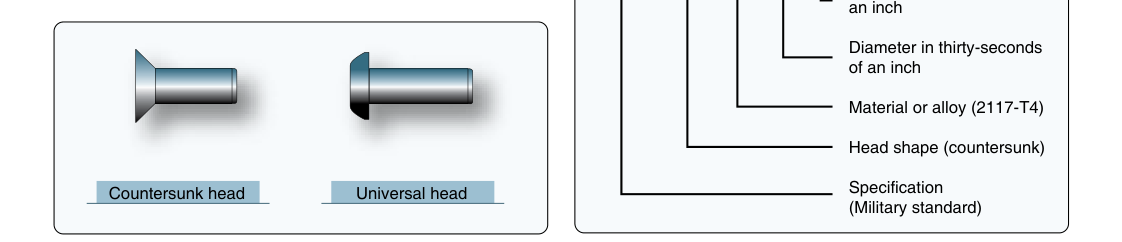
- Universal Head (AN470): The universal head is the most widely used general-purpose rivet head style in modern aircraft construction and repair. It has a rounded, dome-like profile that projects above the skin surface. This raised profile means the universal head is not suitable for areas requiring a smooth aerodynamic surface, but its large bearing area makes it strong and easy to drive. It replaced the round head and brazier head in most applications.
- Countersunk Head (AN426, 100-degree): The countersunk rivet is flush with — or slightly below — the skin surface after installation, making it the preferred choice for exterior skins where aerodynamic smoothness is critical, such as wing leading edges, fuselage outer skins, and control surfaces. The standard countersink angle in aircraft work is 100 degrees. The mating hole must be machine-countersunk or dimpled to accept the flush head. On thin sheets, dimpling (deforming the metal around the hole to form a conical recess) is used instead of machine countersinking, which would remove too much base material.
- Round Head (AN430): The round head is an older style with a high, hemispherical profile. It provides a large bearing surface but creates significant aerodynamic drag. Its use in new construction has been largely superseded by the universal head, but the AMT may still encounter round head rivets in older aircraft.
- Brazier Head (AN455/AN456): A low, wide-profile head that was popular in earlier aircraft designs because its broad bearing area distributes load well and its low height reduces snagging on internal structure. It has also been largely replaced by the universal head in current repair work.
- Flat Head (AN442): Used primarily in interior locations where clearance is tight and a very low profile is needed. Its thin, flat head keeps its overall height minimal, making it useful where other head styles would interfere with adjacent structure.
Rivet Identification and Part Number System
FAA-standardized rivet part numbers follow the AN (Army-Navy) or MS (Military Standard) system and encode all critical information. For example, the part number AN470AD4-6 breaks down as follows: AN470 identifies the universal head style; AD identifies the alloy (2117-T4 field rivet); 4 gives the diameter in thirty-seconds of an inch (so 4/32 = 1/8 inch); and 6 gives the grip length in sixteenths of an inch (6/16 = 3/8 inch). Knowing how to decode this numbering system is directly tested on the AMT Airframe written exam.
Grip Length and Rivet Selection
Selecting the correct rivet length is critical. The grip length must match the total thickness of the materials being joined. Once installed, the shank protruding beyond the far side of the material — called the bucktail — is upset (deformed) to form the shop head. The proper amount of shank protrusion before driving is 1.5 times the rivet diameter. The finished shop head should have a diameter of approximately 1.5 times the rivet diameter and a height of approximately 0.5 times the rivet diameter. If the shank is too short, the shop head will be too small and the joint will be weak. If it is too long, the shop head will be oversized, potentially cracking the material or causing distortion.
Why Rivet Type Selection Matters for Airworthiness
Using the wrong rivet alloy, head style, or size in a structural repair is not merely a procedural violation — it can directly compromise the airworthiness of the aircraft. An under-strength alloy in a high-load joint may allow the joint to fail under normal flight loads. A universal head rivet installed in an area requiring flush countersunk rivets disrupts airflow and can accelerate fatigue cracking by creating stress concentrations. An incorrectly driven shop head — too small, too large, off-center, or cracked — is classified as a defective rivet and must be removed and replaced. The AMT is responsible for consulting the aircraft's SRM, manufacturer drawings, or AC 43.13-1B (Acceptable Methods, Techniques, and Practices — Aircraft Inspection and Repair) before making any rivet substitutions.
Key Numbers and Rules
- Rivet diameter should be approximately 3 times the thickness of the thickest sheet being joined (standard sizing rule).
- Minimum edge distance from the center of a rivet hole to the edge of the sheet: 2 times the rivet diameter (2D) as an acceptable minimum, with 2.5 times the rivet diameter (2.5D) preferred.
- Minimum rivet pitch (center-to-center spacing): 3 times the rivet diameter.
- Shank protrusion before driving: 1.5× the rivet diameter.
- Finished shop head diameter: ~1.5× rivet diameter; height: ~0.5× rivet diameter.
- 2024-T4 (DD) rivets must typically be driven within 10–20 minutes at room temperature after removal from cold storage.
- 2017-T4 (D) rivets must be driven within approximately 1 hour of quenching or removal from freezer storage.
- The standard countersink angle for aircraft flush rivets is 100 degrees.
Common Test Traps
- Confusing alloy head markings: Students frequently mix up the AD (dimple), D (raised dot), DD (raised double dash), and B (raised cross) markings. Memorize the marking for each alloy — exam questions show a head marking and ask you to identify the alloy or required storage handling.
- Grip length vs. shank length: The grip length is the portion of the shank that fills the hole (equal to total material thickness). The total shank length includes the extra material that will form the shop head. Do not confuse the two on length-selection questions.
- Assuming the field rivet (2117-T4) needs refrigeration: Unlike 2017-T4 and 2024-T4, the 2117-T4 is used in the as-received condition — no freezer, no time limit. Many students incorrectly apply refrigeration rules to the AD rivet.
- Substituting universal for countersunk without authorization: On exam scenarios, selecting a universal head rivet for a flush-skin location — or vice versa — is always wrong unless the SRM specifically permits the substitution.
- 5056 rivet use: Some students forget that the B rivet (5056) is reserved specifically for magnesium structures. Using a standard aluminum alloy rivet on magnesium invites galvanic corrosion and is an airworthiness concern.