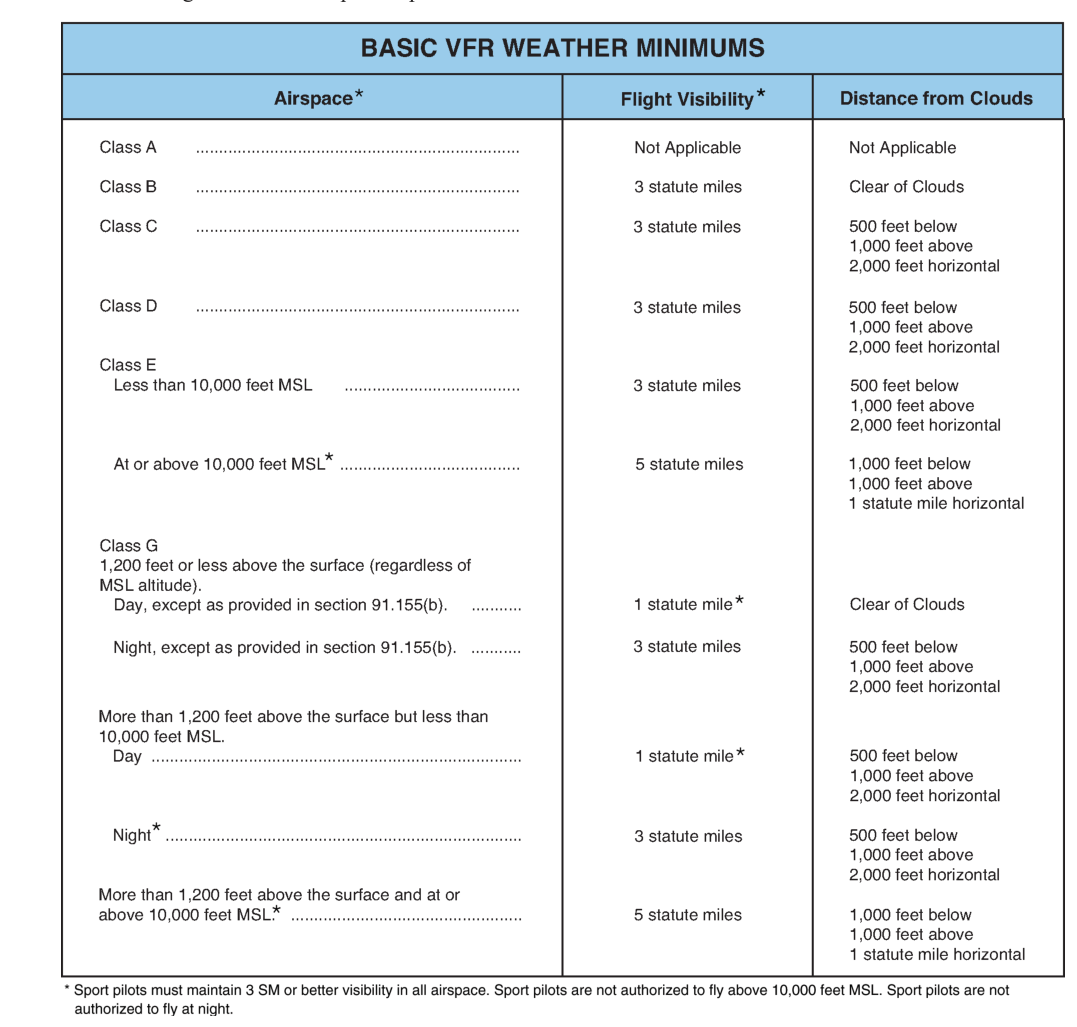
As a sport pilot, you share the skies with all other certificate holders—but you operate under specific weather minimums and airspace privileges that differ from those of a private pilot. Understanding exactly what the regulations require helps you plan every flight safely and keeps you on the right side of the FAA. The foundation for VFR weather minimums is found in 14 CFR 91.155, which applies to all VFR flights, with additional sport pilot limitations spelled out in 14 CFR 61.315.
VFR weather minimums are expressed in two measurements: flight visibility (how far you can see ahead from the cockpit) and cloud clearances (how far you must stay from clouds in each direction—above, below, and horizontally). The specific numbers depend on the class of airspace you are flying in and your altitude.
Airspace Weather Minimums at a Glance
In Class B airspace, the minimums are the simplest to remember: 3 statute miles visibility and clear of clouds. However, sport pilots are not permitted to fly in Class B, C, or D airspace, or at an airport with an operating control tower, unless they have received training and a logbook endorsement under 14 CFR 61.325. Without that endorsement, your flying is limited to Class E and Class G airspace.
In Class C and Class D airspace, VFR minimums are 3 statute miles visibility, with clouds no closer than 500 feet below, 1,000 feet above, and 2,000 feet horizontal. Again, a separate endorsement is required before a sport pilot may enter these areas.
In Class E airspace at or above 10,000 feet MSL, minimums increase to 5 statute miles visibility and clouds no closer than 1,000 feet below, 1,000 feet above, and 1 mile horizontal. These stricter requirements exist because aircraft speeds are higher and reaction time is shorter at altitude.
In Class E airspace below 10,000 feet MSL (the most common environment for sport pilots), the standard minimums are 3 statute miles visibility and the 500-1,000-2,000 cloud clearance rule (500 below, 1,000 above, 2,000 horizontal).
In Class G airspace—uncontrolled airspace—the minimums vary by altitude and time of day. During the day, at or below 1,200 feet AGL, you need only 1 statute mile visibility and must remain clear of clouds. At night in Class G, the minimums rise to 3 statute miles with the standard 500-1,000-2,000 cloud clearances. Sport pilots without a night-flight endorsement are not authorized to fly at night, so the daytime Class G minimums are the most relevant to your certificate unless you have that additional training and endorsement under 14 CFR 61.31(b).
Why It Matters
Flying into instrument meteorological conditions (IMC) without an instrument rating is one of the most dangerous situations in general aviation. The FAA's weather minimums are designed to give you enough forward visibility to see and avoid other traffic and terrain, and enough cloud separation to prevent you from accidentally entering clouds. For sport pilots flying light sport aircraft (LSA)—which are often slower and lower—these minimums provide a critical margin of safety. Additionally, operating in controlled airspace without the required endorsement is a regulatory violation that can result in certificate action.
Memory Aid
For Class B, C, and D airspace cloud clearances, use the phrase "3, 152": 3 miles visibility, 1,000 feet above, 500 feet below, 2,000 feet horizontal. For Class E above 10,000 MSL, remember the numbers get bigger—5 miles, 1,000-1,000-1 mile—because higher and faster demands more buffer.
Common Test Traps
- Class B minimums seem too easy: "Clear of clouds" sounds lenient, but you still need 3 miles visibility—and sport pilots need an endorsement just to enter Class B airspace at all.
- Confusing "statute miles" with "nautical miles": Visibility minimums in 91.155 are always in statute miles. Don't convert them—just use the statute mile figure as stated.
- Forgetting the altitude break in Class E: The 10,000-foot MSL threshold triggers the stricter 5-mile/1,000-1,000-1-mile standard. Below 10,000 feet, the 3-mile/500-1,000-2,000 rule applies.
- Night flying misconception: Sport pilots may not fly at night unless they hold the additional training and endorsement required under 14 CFR 61.31(b), so night minimums in Class G may still apply to endorsed sport pilots—and the FAA may include them as distractors on the knowledge test.