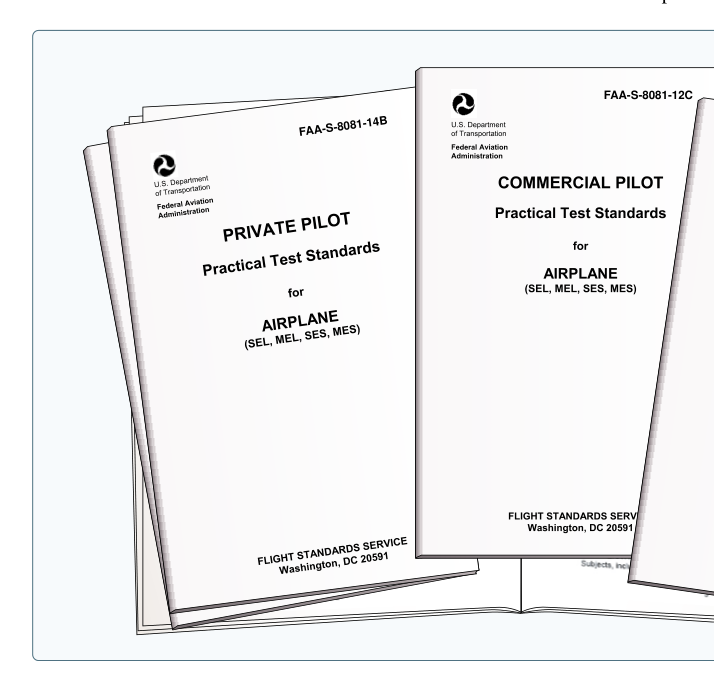
Every certificated flight instructor faces a fundamental assessment challenge: how do you objectively determine whether a student is truly prepared for a checkride? The FAA's answer is elegant in its simplicity—use the exact same standard the Designated Pilot Examiner (DPE) will apply on test day. That document is the Practical Test Standards (PTS) or, for most certificates and ratings issued today, its successor the Airman Certification Standards (ACS). Mastering how to use these publications as a continuous assessment benchmark—not just a last-minute checklist—is one of the defining competencies of an effective flight or ground instructor.
What the PTS and ACS Actually Are
The PTS and ACS are official FAA publications that define the tasks, conditions, and standards an applicant must demonstrate during a practical test. Each task specifies precisely what the evaluator expects the applicant to do, the conditions under which performance will be observed (such as simulated instrument conditions, specific aircraft category/class, or stated equipment), and the measurable tolerances that separate acceptable from unacceptable performance.
Familiar examples from the Private Pilot ACS include maintaining altitude within ±100 feet during level flight maneuvers, holding a heading within ±10 degrees, and tracking an airspeed within ±10 knots during certain phases of flight. Short-field and soft-field landing tasks specify target touchdown zones and airspeed windows. These numbers are not arbitrary—they represent the FAA's determination of the minimum performance level consistent with safe operations.
The ACS goes considerably further than the older PTS format. Where the PTS focused primarily on measurable stick-and-rudder skill, the ACS integrates three equally weighted elements for every task: Knowledge (K), Risk Management (R), and Skills (S). This architecture reflects the FAA's recognition, codified throughout the Aviation Instructor's Handbook (FAA-H-8083-9), that competent pilots must understand the aeronautical principles behind what they do, identify and mitigate the hazards involved, and execute the physical skill—all simultaneously. The ACS therefore gives instructors a three-dimensional view of readiness rather than a simple pass/fail skills check.
How to Use These Documents as a Daily Assessment Benchmark
Introducing the Standard From Day One
The Aviation Instructor's Handbook stresses that learners perform better when they have a clear, specific picture of the target. Instructors should hand the student the relevant ACS on the very first lesson and walk through the structure together. When a student understands from the outset that altitude tolerance during steep turns is ±100 feet, they can self-assess after every practice repetition. This transforms them from passive recipients of feedback into active participants in their own progress—a hallmark of effective instruction described in the Instructor's Handbook as moving students toward self-reliance.
Task-by-Task Criterion Referenced Assessment
Criterion-referenced assessment, as described in FAA-H-8083-9, measures student performance against a fixed, external standard rather than against other students. The ACS is perfectly suited for this approach. After each training flight, the instructor should evaluate every practiced task against its published standards and record the outcome. Was the student within tolerance? Consistently, or only occasionally? Did the student correctly explain the knowledge elements before the flight? Did they identify the primary risk-management considerations unprompted?
This systematic approach does two things. First, it produces a documented training record that reflects objective progress rather than instructor impressions. Second, it identifies root causes. If a student repeatedly busts the airspeed tolerance on short-field approaches, the ACS risk-management column for that task may reveal whether the underlying problem is a knowledge gap (misunderstanding of energy management), a judgment issue (failing to go around when unstabilized), or a physical skill deficiency (poor trim technique). Treating the right problem accelerates training and prevents checkride surprises.
The Three-Question Self-Check
Before signing any endorsement, apply a three-question framework drawn directly from the ACS structure to every task in the relevant area of operation:
- Does the student understand the knowledge elements—can they explain the aerodynamic, regulatory, and procedural underpinnings of this task?
- Has the student correctly identified and articulated the risk-management considerations the ACS lists for this task?
- Does the student consistently—not just occasionally—meet the published skill tolerances, including on days when conditions are less than ideal?
If the answer to all three is yes across every area of operation, the instructor can recommend the applicant with genuine professional confidence. If any answer is no, that shortfall becomes the next explicit training objective—not a vague area of concern, but a specific, documented deficiency tied to a specific ACS code.
Why This Approach Matters
Eliminating Bias and Protecting Integrity
The Instructor's Handbook identifies several characteristics of effective assessment: it must be objective, flexible, acceptable, and comprehensive. Anchoring every critique to published ACS standards directly satisfies the objectivity requirement. Without an external standard, even experienced instructors unconsciously allow personal relationships, fatigue, schedule pressure, or student frustration to influence their judgment. When the ACS specifies the tolerance, the instructor is not the judge—the document is. This protects the student from premature sign-off, protects the instructor from liability, and preserves the integrity of the certification system.
The Endorsement Obligation Under 14 CFR Part 61
Under 14 CFR §61.39 and the endorsement requirements in Part 61, an instructor who signs an applicant's logbook for a practical test is certifying—in writing—that the applicant has received the required training and is prepared for the test. The FAA takes this certification seriously. An instructor who endorses a student who has only occasionally met ACS tolerances, rather than consistently, is making a false certification and may face certificate action under 14 CFR §61.59. Using the ACS as a daily benchmark, with written records, is therefore not just good pedagogy—it is professional and legal risk management for the instructor.
Aligning Knowledge-Test Preparation With Flight Training
A feature of the ACS that many instructors underutilize is its direct linkage to FAA knowledge-test question codes. Each knowledge element in the ACS is assigned a code that corresponds to the learning statement codes in the FAA's knowledge-test question bank. This means that a student studying the ACS to prepare for flight maneuvers is simultaneously organizing their ground-school study around the same framework. Instructors who exploit this overlap—reviewing the knowledge codes for each upcoming task before a ground lesson—can make ground and flight preparation mutually reinforcing rather than parallel activities that never quite converge.
Key Numbers, Rules, and Edge Cases
- ±100 feet altitude is the standard tolerance for most Private and Instrument Pilot tasks; some tasks specify tighter windows, so verify each task individually in the applicable ACS.
- ±10 degrees heading and ±10 knots airspeed are common Private Pilot tolerances; Commercial tolerances are generally tighter, reflecting higher performance expectations.
- ACS vs. PTS: Most certificates and ratings now use the ACS. A small number of specialty ratings (e.g., some military competency certificates) may still reference a PTS. Always confirm which document governs the specific certificate being pursued before training begins.
- Standards are minimums, not goals. Train students to perform noticeably better than the published tolerance so that checkride nervousness does not erode their performance to below the standard.
- Consistent vs. occasional: The ACS standard is not met unless the student can replicate the performance reliably across varying conditions, not just on a best-day demonstration.
Common Test Traps
- Assuming ACS and PTS tolerances are identical across all certificates. Private Pilot, Instrument Rating, and Commercial Pilot ACS documents each contain task-specific tolerances that differ. Never assume a tolerance from memory without verifying the specific document.
- Treating the ACS as a checkride-week document. Instructors who only pull out the ACS in the final lesson before the practical test lose its most powerful benefit—its ability to structure every lesson from the first dual flight forward.
- Neglecting the risk-management column. On the FAA knowledge tests and during practical tests under the ACS format, risk-management elements are tested as rigorously as stick-and-rudder skills. Ignoring these during training leaves a significant gap.
- Signing off a student based on a single strong performance. The standard is consistent, repeatable performance. A single impressive flight does not constitute readiness under Part 61 endorsement requirements.
- Using an outdated version of the ACS or PTS. The FAA updates these documents periodically. Always download the current version from the FAA website before each training cycle begins.