Corrosion is one of the most persistent threats to aluminum aircraft structures. Left untreated, it weakens the metal, reduces fatigue life, and can lead to catastrophic structural failure. Because aluminum is the dominant structural material in most general aviation and transport-category aircraft, understanding how to identify, evaluate, and remove corrosion — without causing additional damage — is a core competency for every Aviation Maintenance Technician (AMT). This article covers the full range of approved removal methods, the reasoning behind each, and the practical knowledge you need for both the FAA AMT General knowledge test and real shop work.
It is important to understand from the start that corrosion removal on aluminum is not simply a matter of grinding away rust as it might be on steel. Aluminum is a softer, more workable metal, and overly aggressive treatment can remove more material than the corrosion did, creating stress risers or reducing structural cross-section below acceptable limits. Every removal technique must be matched carefully to the type, location, and depth of corrosion.
How Corrosion Attacks Aluminum
Aluminum forms a thin, naturally occurring aluminum oxide layer almost immediately upon exposure to air. This passive layer normally protects the underlying metal from further oxidation. However, when this layer is breached — by mechanical damage, dissimilar metal contact, contaminated moisture, or chemical attack — true corrosion begins. The most common forms found on aluminum aircraft structures include:
- Surface corrosion: General oxidation appearing as a white, gray, or powdery deposit on the metal surface. This is the mildest form and the easiest to treat.
- Pitting corrosion: Small, deep pits penetrating into the metal. Pitting is especially serious because it creates stress concentration points and can be difficult to detect beneath paint or coatings.
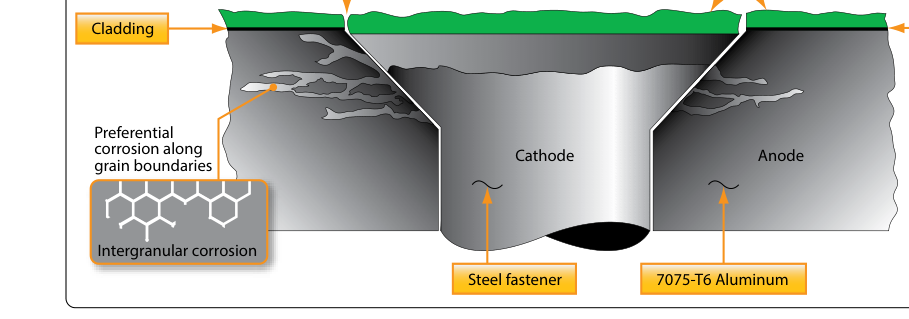
- Intergranular corrosion: Attack along grain boundaries within the metal. It may not be visible on the surface yet can cause significant subsurface damage and even delamination of sheet stock. High-strength aluminum alloys such as 2024 and 7075 are particularly susceptible.
- Exfoliation corrosion: An advanced form of intergranular corrosion in which layers of metal actually separate and peel, giving a layered or flaky appearance.
- Filiform corrosion: A thread-like or worm-track pattern that forms under paint or surface coatings, common on aluminum with thin paint films.
- Galvanic corrosion: Occurs when aluminum is in electrical contact with a more noble metal (such as steel hardware) in the presence of an electrolyte. The aluminum acts as the anode and corrodes preferentially.
Preliminary Assessment Before Removal
Before picking up any abrasive or chemical, the technician must assess the extent of the corrosion. FAA guidelines require determining whether the damage is within allowable limits set by the aircraft manufacturer's Structural Repair Manual (SRM). Some key questions include: How deep are the pits? How large an area is affected? Is there evidence of intergranular or exfoliation damage beneath what appears to be surface oxidation?
Tools for assessment include magnifying lenses, dye-penetrant inspection (DPI) for surface-breaking defects, and eddy-current testing for subsurface corrosion. If corrosion has penetrated beyond the manufacturer's allowable limits, the damaged material must be removed and the area repaired or a doubler installed — simple surface treatment is not sufficient.
Mechanical Corrosion Removal Methods
Mechanical removal is the most common first approach to aluminum corrosion. The goal is to abrade away all oxidized material down to bright, clean metal using the least aggressive means necessary.
Hand Abrasive Tools
For light surface corrosion and small areas, hand abrasion with fine abrasive papers or mats (aluminum oxide or silicon carbide) is a common approach, along with non-metallic, non-woven abrasive pads such as Scotch-Brite™-type materials. Aluminum wool may be used in some cases, but technicians should follow the applicable manufacturer instructions regarding its use, and steel wool must never be used, since it leaves embedded particles that cause new galvanic corrosion. The technician works with progressively finer grits or pads until the corroded material is gone and the surface is smooth. All abrasion strokes should follow the grain direction of the metal where possible to minimize cross-grain scratches.
Rotary and Power Tools
Power tools significantly increase the rate of metal removal and must be used with caution. Acceptable power tools include:
- Rotary files and burrs: Used for spot removal in pits, but care must be taken not to remove excessive base metal.
- Abrasive flap wheels and discs: Effective for larger surface areas, used at low speeds to avoid overheating the aluminum.
- Wire brushes: Only stainless steel or aluminum-bristle brushes are acceptable on aluminum structure. Carbon steel wire brushes embed steel particles and cause galvanic corrosion.
A critical rule when using power tools on aluminum: never use abrasives, wire wheels, or rotary files that have previously been used on steel or other ferrous metals. Embedded ferrous particles will initiate galvanic corrosion cells in the aluminum.
Blending and Rounding
After removal of corrosion products, all resulting cavities and depressions must be blended smooth with gentle radii. Sharp-edged pits and scratches are stress concentration points. The blended area should transition gradually to the surrounding surface. The depth of material removed must then be measured and compared to the SRM limits, which specify the maximum allowable material removal or pit depth for that particular part and location.
Chemical Corrosion Removal Methods
Chemical treatments are used both to remove corrosion products and to treat the underlying metal surface to inhibit future corrosion. They are typically used after mechanical removal or in areas where mechanical access is limited.
Chemical Conversion Coating (Alodine/Chem-Film)
Chemical conversion coating, commercially known as Alodine (also called chem-film or chromate conversion coating, produced to a military specification such as MIL-DTL-5541), is the most important chemical treatment in aluminum aircraft corrosion control. It works by chemically reacting with the aluminum surface to produce a thin, adherent chromate layer that:
- Seals the bare metal against moisture and oxidizing agents
- Provides excellent adhesion for primer and topcoat
- Offers mild cathodic protection to areas where the coating is slightly damaged
Alodine is applied by brush, spray, or immersion after the surface has been thoroughly cleaned and all corrosion mechanically removed. The solution typically contains hexavalent chromium compounds (though newer trivalent chromium formulations are increasingly used for environmental and health reasons). Contact/dwell time varies by specific product and manufacturer instructions, after which the surface is rinsed with clean water and allowed to dry. The resulting coating is iridescent gold to brown in color. The surface must not be abraded after Alodine application, as this destroys the protective layer.
Chemical Cleaning and Etching
Before corrosion removal or conversion coating, the area must be thoroughly cleaned to remove oils, grease, and dirt that would prevent chemical agents from reaching bare metal. Approved cleaners include alkaline or solvent-based degreasers. Acid etching solutions (typically phosphoric or chromic acid-based) may be used to chemically remove light oxide layers and prepare the surface for conversion coating.
Inhibiting Corrosion After Removal
Mechanical and chemical removal only address existing damage. Long-term protection requires re-establishing the full protective system: conversion coating, corrosion-inhibiting primer, and topcoat. Zinc chromate primer (or modern alternatives such as epoxy-based corrosion-inhibiting primers) is applied over the Alodined surface. The topcoat restores the paint barrier against moisture. In areas that cannot be painted — such as internal structure and faying surfaces — corrosion-inhibiting compounds (CICs) or sealants approved by the aircraft manufacturer should be applied.
Key Numbers and Rules
- Depth limits: Always consult the SRM. The FAA handbooks do not specify a universal percentage limit for material removal — allowable blend-out depth and area are determined solely by the applicable manufacturer's structural repair manual and vary significantly by aircraft, part, and location.
- Never use steel wool or ferrous wire brushes on aluminum — use non-metallic abrasive pads, stainless steel, or aluminum-bristle brushes, following manufacturer guidance.
- Never use tools previously used on steel on aluminum structure without thorough cleaning.
- Alodine contact time: Varies by product; always follow the specific manufacturer's instructions and the applicable specification (e.g., MIL-DTL-5541).
- Filiform corrosion under paint requires complete paint stripping of the affected area before mechanical removal can begin.
- Intergranular or exfoliation corrosion often exceeds allowable removal limits and requires engineering disposition or structural repair.
Common Test Traps
- Using steel wire brushes on aluminum: A classic distractor. The FAA test may offer steel wire brush as an option for corrosion removal. It is never acceptable on aluminum — it causes additional galvanic corrosion from embedded steel particles.
- Skipping the SRM check: Students sometimes assume any visible corrosion can simply be sanded away. The test expects you to know that depth and area limits in the manufacturer's documentation must always be verified before removal.
- Abrading after Alodine: Alodine must not be mechanically abraded after application or the protective chromate layer is destroyed. Mechanical work comes first, Alodine comes last before priming.
- Confusing corrosion types: The FAA test distinguishes between surface, pitting, intergranular, exfoliation, and galvanic corrosion. Know that exfoliation is an advanced form of intergranular corrosion and that intergranular corrosion is most dangerous in high-strength alloys.
- Ignoring dissimilar metal isolation: Galvanic corrosion is initiated by contact between aluminum and more noble metals. The test may ask about the correct method of preventing this — isolation with approved sealants, gaskets, or coatings, not simply painting over the joint.