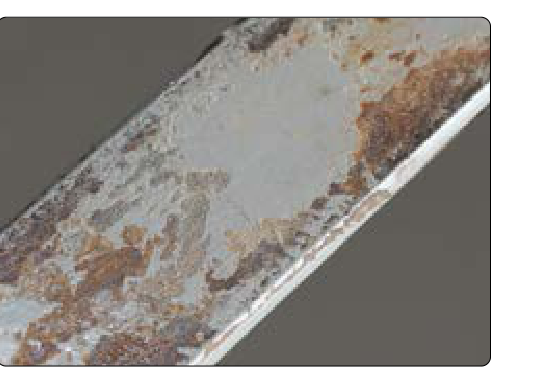
Of all the corrosion types an aviation maintenance technician encounters, fretting corrosion is among the most deceptive. It hides between mated surfaces, develops without moisture or salt spray as a trigger, and can reduce the fatigue life of a structural joint by a dramatic margin before a single external sign appears. Understanding how fretting corrosion forms, where it strikes hardest in an airframe, and how to prevent or arrest it is essential knowledge for any AMT — and it is a topic the FAA tests directly in the General knowledge area for Cleaning and Corrosion Control.
The core distinction that sets fretting apart from other corrosion forms is its mechanical origin. Most corrosion requires an electrolyte, moisture, or dissimilar metals. Fretting corrosion, by contrast, is born from repetitive, small-amplitude sliding motion between two surfaces that are nominally clamped or pressed together. The motion is tiny — often measured in micrometers — but it recurs continuously under vibration and cyclic loading, and the cumulative damage is severe.
How Fretting Corrosion Works
When two metal surfaces are in contact under load and subjected to vibration or cyclic stress, the microscopic peaks of each surface — called asperities — interlock. Relative motion, even at amplitudes invisible to the naked eye, shears these asperities away. The torn-off particles are highly reactive because the freshly exposed metal has no protective oxide film. In aluminum alloys, these particles oxidize almost instantly into a dark, powdery aluminum oxide debris. In steel, the product is a fine, reddish-brown iron oxide powder often described as resembling rust dust. This debris is harder than the parent metal, which means it acts as an abrasive trapped between the mating surfaces, accelerating the removal of more base material with every subsequent cycle.
The process is self-reinforcing. Debris trapped in the joint prevents the surfaces from reseating properly, increases local stress concentrations, and creates microscopic pits in the base metal. Those pits become stress risers — ideal initiation sites for fatigue cracks. This combination of surface damage and stress concentration is why fretting corrosion is considered a fatigue-corrosion interaction and why structures that might otherwise survive millions of load cycles can develop cracks far sooner when fretting is present.
The Role of Oxygen and Micro-Motion
Fretting is sometimes called wear oxidation because the chemical component — oxidation of fresh metal — is inseparable from the mechanical component — abrasive wear. Without oxygen, the debris would simply be a metallic wear powder; the presence of oxygen converts it to hard oxide particles. This is why fretting does not require an electrolyte and can occur in environments that would otherwise be considered non-corrosive. High-altitude or low-humidity environments offer no protection. Vibration alone is sufficient.
Common Locations in Aircraft Structures
Fretting corrosion favors specific design features where cyclic loads and clamped contact surfaces coexist:
- Fastener holes — The hole wall and the shank of a rivet or bolt are in intimate contact. Wing flex, pressurization cycles, and vibration create micro-motion at the hole edge. Fretting at fastener holes is one of the most common causes of fatigue cracking in aluminum skins.
- Lap joints and splice fittings — Two overlapping sheets clamped by multiple fasteners experience differential deflection under bending loads. The interface between the sheets undergoes small tangential sliding that accumulates into fretting damage over time.
- Control surface hinges — Aileron, elevator, and rudder hinges are subjected to continuous oscillatory loads in flight. The hinge pin against its bushing is a classic fretting scenario.
- Engine mount fittings and attach brackets — Engine vibration at relatively high frequency makes engine mounts particularly vulnerable. Steel engine mount tubes pressed into aluminum fittings will fret whenever protective lubricant is depleted.
- Spline and keyed shaft connections — Accessory drives and propeller hubs rely on spline fits that can fret if the spline is not properly lubricated and if torsional oscillation is present.
- Landing gear attach points — The repeated impact and spring-back of landing gear generates micro-motion at attach lugs and bushings.
Identifying Fretting Corrosion
Fretting damage most often reveals itself when a joint is disassembled during scheduled maintenance. Key indicators include:
- Dark gray or black powdery residue (aluminum oxide) around aluminum joint faying surfaces or fastener holes.
- Reddish-brown fine powder on steel components — sometimes called cocoa or fretting rust — packed into the clearance of a fit.
- Shallow, roughly circular or elongated pits in the contact zone, sometimes with a burnished or polished appearance at the center surrounded by pitting at the periphery.
- Cracks initiating at fastener holes, visible only by eddy current or dye penetrant inspection, with no corresponding external corrosion.
Because the damage is concealed, Non-Destructive Inspection (NDI) techniques are critical. Eddy current inspection is particularly effective for detecting fretting-related cracks at fastener holes in aluminum structure, since it can find tight, small cracks beneath surface coatings without requiring disassembly of every fastener.
Why Fretting Corrosion Matters
The FAA and manufacturers treat fretting corrosion as a structural concern, not merely a cosmetic one. Fretting damage is well documented as a significant contributor to reduced fatigue life in structural joints compared to undamaged structure. In an aircraft designed to meet specific fatigue life limits, this is not a margin that can be absorbed casually. An airliner wing panel or a general aviation spar attach fitting operating with undetected fretting damage may reach a crack-critical condition well before its scheduled inspection interval.
For the AMT, the practical consequence is that fretting corrosion demands attention whenever a joint is opened. Simply cleaning visible debris and reassembling without addressing the root cause — micro-motion — allows the cycle to restart immediately.
Key Numbers and Rules
- Fretting is driven by very small slip amplitudes at the mating surfaces — far below what is visible or even detectable by feel — rather than by any specific numeric range defined in FAA handbooks.
- The FAA Aviation Maintenance Handbook distinguishes fretting as a form of corrosion caused by slight movement between closely fitted surfaces under load, distinguishing it from galvanic, uniform surface, pitting, or intergranular corrosion.
- Fretting debris in aluminum joints appears dark gray to black; in ferrous metals it appears reddish-brown. These colors are the oxidized wear particles, not the corrosion products of moisture-driven electrochemical corrosion.
- Joints affected by fretting that are found to have associated fatigue cracks must be evaluated against the manufacturer's Structural Repair Manual (SRM) before return to service — the technician does not have discretion to simply blend the pits and reassemble without an engineering basis.
- Replacement fasteners installed in fretting-damaged holes typically require an oversize fastener or a bushing insert to restore hole geometry and clamp-up, per the applicable SRM or manufacturer data.
Prevention and Corrective Action
Preventing fretting is fundamentally about eliminating or reducing micro-motion at the interface, and providing a barrier between the mating surfaces:
Proper torque and clamp-up is the first line of defense. A fastener torqued to its specified value creates enough clamping force to raise the friction force between the surfaces above the driving cyclic force — preventing slip entirely in well-designed joints.
Faying surface sealant or corrosion-inhibiting compound (CIC) applied during assembly fills the microscopic voids between surfaces and acts as a lubricant that limits abrasive wear even if some micro-motion does occur. Common products include zinc chromate paste (in older designs) and modern chromate-free alternatives. The chosen compound must be approved for the specific application in the maintenance documentation.
Interference-fit fasteners — installed with the fastener diameter slightly larger than the hole per manufacturer data, such as certain interference-fit rivets or bolts — pre-stress the hole wall in compression, which both eliminates clearance for micro-motion and counteracts tensile fatigue stresses that would otherwise initiate cracks. Hi-Lok pins, by contrast, are typically installed as a close-tolerance fit rather than a true interference fit.
Surface treatments such as anodizing, hard anodizing, or shot peening introduce compressive residual stress into the surface layer, increasing fatigue resistance and slowing crack initiation even if fretting damage does develop.
When fretting damage is found during inspection, the corrective action sequence generally follows this logic: remove loose debris and oxide particles thoroughly, assess the depth and extent of pitting against SRM limits, perform NDI to rule out associated cracks, and then restore the surface — either by blending within allowable limits, installing an oversize fastener, or applying an approved bushing — before reassembly with the specified sealant and fastener torque.
Common Test Traps
- Fretting requires moisture — FALSE. A common misconception is that fretting is a moisture-driven electrochemical process. It is not. Oxygen alone, combined with micro-motion, is sufficient. This distinguishes it from galvanic and uniform surface corrosion.
- The debris color matters for identification. Test questions may ask how to identify fretting corrosion. Remember: dark/black powder in aluminum joints, reddish-brown in steel — not the reddish rust typical of electrochemical corrosion on steel.
- Fretting pits are initiation sites, not just cosmetic damage. Questions may test whether a technician can reassemble a fretted joint after cleaning. If pitting exists, NDI and SRM evaluation are required before return to service.
- Proper torque prevents fretting — it does not merely slow it. Sufficient clamp-up eliminates the micro-slip that drives the process. Under-torquing a joint allows slip to begin immediately.
- Fretting is classified as a distinct corrosion type in FAA materials, separate from galvanic, concentration cell, or pitting corrosion. Mixing up these categories is a frequent test error.