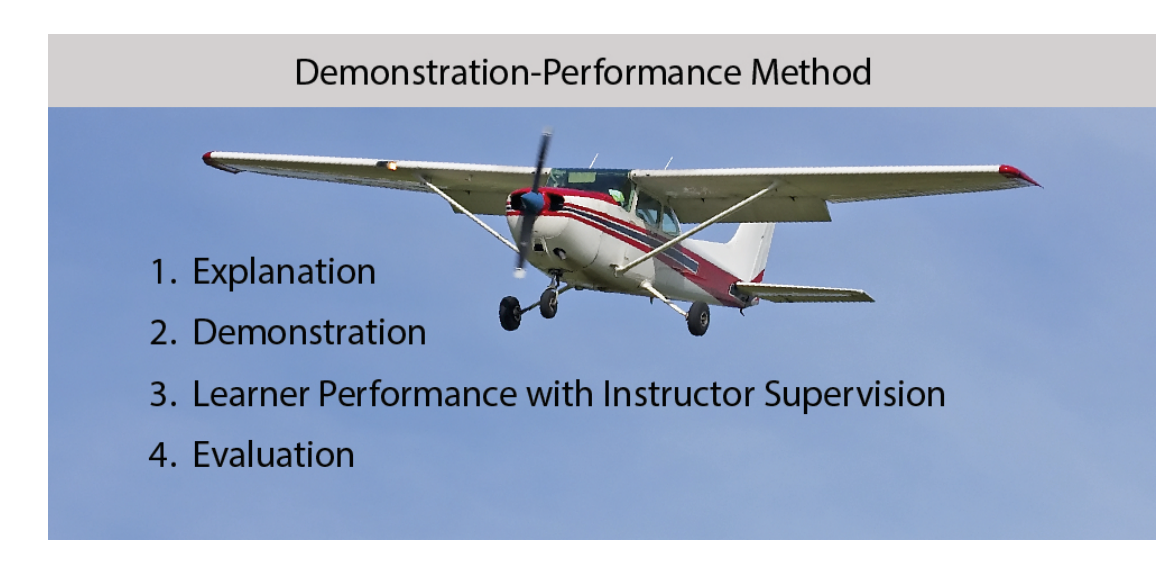
When it comes to teaching hands-on flying skills, the FAA recognizes that watching and then doing beats reading or listening every time. The demonstration-performance method is built on this simple truth. In this method, the instructor first demonstrates the maneuver exactly as it should be performed, narrating each step clearly. The student then attempts the same maneuver while receiving coaching, corrections, and encouragement from the instructor. This cycle of show-then-do continues until the student can perform the task safely and consistently without prompting.
According to the Aviation Instructor's Handbook (FAA-H-8083-9), the demonstration-performance method follows five distinct steps: explanation, demonstration, student performance, instructor supervision, and evaluation. Each step plays a specific role. Explanation primes the student's understanding before anything is seen or touched. Demonstration gives a concrete, accurate picture of what correct performance looks like. Student performance allows practice in a real environment. Instructor supervision ensures that errors are caught before they become habits. Finally, evaluation measures whether the learning objective has actually been met and tells the instructor what to teach next.
Why it matters
Flight training is a psychomotor skill domain—control inputs must become smooth and nearly automatic under varying conditions. Verbal instruction alone cannot build that kind of muscle memory. The demonstration-performance method bridges the gap between knowing and doing. When a student watches a steep turn performed correctly—seeing the bank angle, the horizon reference, the back-pressure applied—and then immediately tries it themselves with a qualified instructor on the controls, learning accelerates dramatically compared to passive study. This is why the FAA strongly endorses this method for all flight maneuvers, from basic climbs and turns to complex instrument approaches.
Equally important is the instructor supervision phase. This is not simply sitting beside the student and watching. Effective supervision means offering timely, specific feedback: not just "that was wrong" but "your right wing dropped through the turn—next time add a touch of right aileron as you roll in." Supervision also means recognizing when an error is about to become unsafe and taking corrective action immediately. The goal is to reinforce correct technique and redirect incorrect technique before patterns are locked in.
The evaluation step closes the loop. An instructor who demonstrates and supervises but never formally evaluates has no reliable way to know whether the student is truly ready to progress. Evaluation should reference clear, objective standards—such as those found in the applicable Airman Certification Standards (ACS) or Practical Test Standards (PTS)—so both instructor and student share the same picture of success.
Memory aid
Remember the five steps in order: Explanation, Demonstration, Student performance, Supervision (instructor supervision), Evaluation. Walk through these five steps mentally before every new maneuver introduction and you will cover all the required elements.
Common test traps
- Confusing the order of steps. The FAA lists explanation before demonstration. Students need a mental framework first; the demonstration then confirms and fills in that framework—not the other way around.
- Thinking evaluation is optional. Evaluation is a required step, not an afterthought. Without it, the instructor cannot determine whether the learning objective was met or whether additional practice is needed.
- Conflating supervision with demonstration. Supervision happens while the student is flying. Demonstration is performed by the instructor before the student takes the controls. These are distinct steps with distinct purposes.
- Assuming one demonstration is always enough. The handbook makes clear that re-demonstration may be necessary whenever a student's performance shows a persistent misunderstanding. The cycle of demo-practice-evaluation can and should repeat until standards are met.